igneous rocks & processes (mod #6)
 Call Kai
 Learn
 Practice Test
 Spaced Repetition
 Match
 Flashcards
 Knowt Play
1/60

Earn XP
Description and Tags
🍂
61 Terms
magma
Molten rock beneath the Earth’s surface;
Temperature: ~600-1200ºC
consists of varying amounts of liquids, solid, and dissolved gas

True
TRUE OR FALSE:
Some components of magma include:
Liquid: Ions of Si, O, Al, K, Ca, Na, Fe, Mg
Solid: minerals, rock fragments
Dissolved gas: H2O, CO2, SO2
Mohorovicic discontinuity
UNDER MAGMA:
this serves as the boundary zone where rising mantle melts interact with, accumulate beneath, or intrude into the Earth's crust
anatexis
MAGMA GENERATION:
partial melting of source rock in the upper mantle / lower crust
where low-melting-point minerals melt first while high-melting-point (refractory) minerals remain solid

partial melting
MAGMA GENERATION:
refers to differential melting of minerals between low and high melting temperature minerals
liquid melt fraction & residual rock
2 PRODUCTS OF DIFFERENTIAL/PARTIAL MELTING:
________ - enriched in low temperature constituents
________ - enriched in high temperature refractory elements
increase in temperature, decrease in pressure, addition of volatiles
3 processes involve in partial melting (PVT)
original heat, radioactive decay, nearby conduction, mantle upwelling
MAGMA GENERATION DRIVERS (INC TEMP):
possible heat sources:
____ ___ at the time of Earth formation
________ decay
______ from a nearby body of magma
Mantle ______
True
TRUE OR FALSE:
Magma generation may occur along plate boundaries or within a plate (intraplate).
hot spot
UNDER MAGMA GENERATION (INC TEMP):
increase in temps happen in these abnormally hot regions where the mantle rises up through lithosphere (e.g. Hawaii, Iceland, Yellowstone)

decompression partial melting
MAGMA GENERATION DRIVERS (DEC PRESSURE):
this process include:
reducing the pressure lowers the melting temperature
Melting by (adiabatic) pressure reduction
divergent plate boundaries (rift valley, mid-ocean ridges, hydrothermal vents)
MAGMA GENERATION DRIVERS (DEC PRESSURE):
decrease in pressure occurs along these areas
flux melting
MAGMA GENERATION DRIVERS (ADD VOLATILES):
refers to lowering melting temperature under pressure from addition of volatiles like H2O and CO2;
Volatiles sourced from hydrous minerals from subducted slab that are released to overlying mantle wedge
convergent plate boundaries
MAGMA GENERATION DRIVERS (ADD VOLATILES):
flux melting occurs along these areas
more specifically, ____ ____, — where crust & sediment dehydration of slab happens
ultramafic (peridotitic)
MAGMA TYPES:
SiO2 content: < 45%
Temp range: > 1200
Rel. Density: High
Rel. Viscosity: Low
Gas Content: Low
mafic (basaltic/gabbroic)
MAGMA TYPES:
SiO2 content: 45-52%
Temp range: 1000-1200
Rel. Density: 2nd highest
Rel. Viscosity: 2nd lowest
Gas Content: 2nd lowest

intermediate (andesitic/dioritic)
MAGMA TYPES:
SiO2 content: 52-63%
Temp range: 800-1000
Rel. Density: 2nd lowest
Rel. Viscosity: 2nd highest
Gas Content: 2nd highest
felsic/acidic (rhyolitic/granitic)
MAGMA TYPES:
SiO2 content: > 63%
Temp range: 650-800
Rel. Density: lowest
Rel. Viscosity: highest
Gas Content: highest
magmatic differentiation
Any process that causes magma composition to change;
includes assimilation, magma mixing
assimilation
MAGMATIC DIFFERENTIATION PROCESSES:
country rock incorporated, melt and then assimilate into the magma

magma mixing
MAGMATIC DIFFERENTIATION PROCESSES:
mixing and comingling of two magmas forming a composition in- between the two magma that mixed (homogenization)
Different magma with different physical properties like density, buoyancy, viscosity

magma mingling
incomplete blending of two distinct magmas that meet but retain their individual identities;
occurs when contrasting temperatures, high viscosity differences, or rapid cooling prevent the melts from fully diffusing into one another

fractional crystallization
process of crystallizing & removal of crystals from magma;
separates the components of a mixture based on differences in their crystallization temperature or solubility
minerals crystallize at diff temps

Bowen’s reaction series
UNDER FRACTIONAL CRYSTALLIZATION:
describes the temperature at which minerals crystallize when cooled, or melt when heated;

False; should be inverse
TRUE OR FALSE:
In Bowen’s reaction series, temperature and mineral composition have a direct relationship:
as magma cools from high to low temperatures, the crystallizing minerals shift from being Fe-, Mg-, Ca-rich to being Silica, Na, K-rich.
size, shape, mineral grain arrangement
igneous rock textures describes the appearance of rock based on ___, ____, and ____ ____ arrangement;
it also reveals the history and setting of formation of the rock
Rate of Cooling
Amount of Volatiles
Amount of Silica
3 things that can influence igneous rock textures (CVS)
abyssal/plutonic
hypabyssal/subvolcanic
TYPES OF INTRUSIVE IGNEOUS ROCKS (DEPTH):
____/____ - formed deep beneath the surface
____/____ - formed at shallow depths

aphanitic
phaneritic
IGNEOUS ROCK TEXTURES (CRYSTAL SIZE):
fine-grained; rapid cooling & volcanic (ex. rhyolite, basalt, andesite)
large, coarse-grained (visible to the naked eye); slow cooling & plutonic (ex. granite, gabbro, diorite)
porphyritic
IGNEOUS ROCK TEXTURES (CRYSTAL SIZE):
with two distinct crystal sizes—large crystals floating in a fine-grained or glassy background matrix, meaning it also has a 2-stage cooling process
has phenocryst & groundmass
phenocryst, groundmass
PORPHYRITIC COMPONENTS:
______ - large, visible crystals.
______ - fine-grained surrounding material

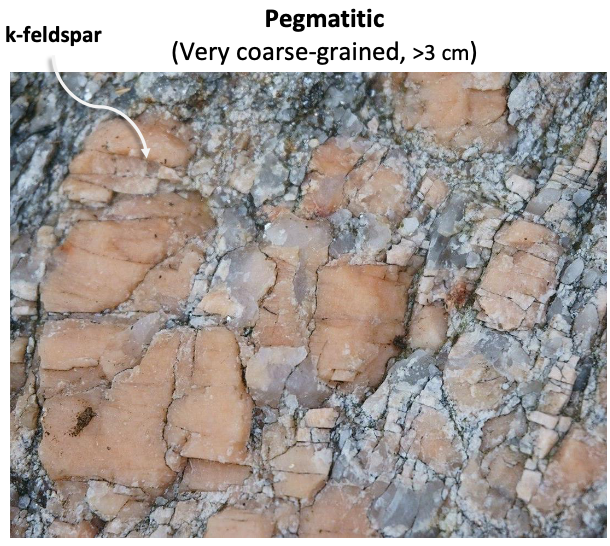
pegmatitic
IGNEOUS ROCK TEXTURES (CRYSTAL SIZE):
igneous rock texture where all or most crystals are very large (> 3cm) & is very coarse-grained;
undergoes extremely slow cooling deep underground
True
TRUE OR FALSE:
A pegmatitic texture is formed from magma rich in volatiles.
The high volatile content allows ions to move very quickly to build massive crystals rather than starting new tiny ones
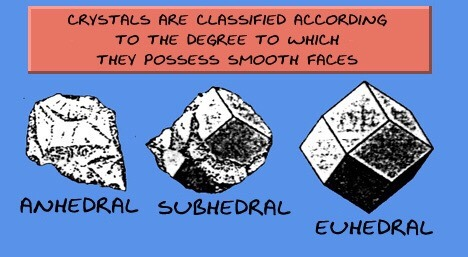
euhedral
IGNEOUS ROCK TEXTURES (CRYSTAL SHAPE):
a.k.a. idiomorphic;
refer to crystals who are completely bounded by well-developed, sharp, and recognizable crystal faces;
they form when a mineral has plenty of space

subhedral
IGNEOUS ROCK TEXTURES (CRYSTAL SHAPE):
hypidiomorphic;
crystals that are only partially bounded by good crystal faces, while other sides are irregular or crowded out by neighboring minerals
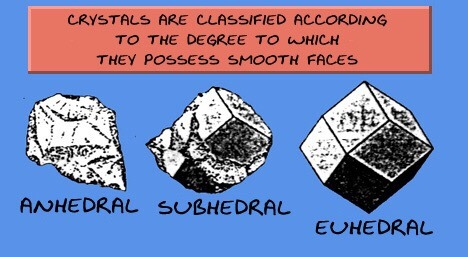
anhedral
IGNEOUS ROCK TEXTURES (CRYSTAL SHAPE):
xenomorphic/allotriomorphic;
these lack any recognizable crystal faces or geometric shapes;
happens when a mineral crystallizes last, filling in leftover spaces remain between previously formed crystals
holocrystalline, harzburgite
IGNEOUS ROCK TEXTURES (CRYSTALLINITY):
100% crystals;
very slow cooling rate;
intrusive
ex. ______
holohyaline, obsidian
IGNEOUS ROCK TEXTURES (CRYSTALLINITY):
100% glass;
very rapid cooling (quenching);
extrusive
ex. ______
hypocrystalline, porphyritic andesite
IGNEOUS ROCK TEXTURES (CRYSTALLINITY):
crystals and glass
moderate cooling;
shallow intrusive (near surface/dikes)
ex. ______
vesicular
amygdaloidal
pyroclastic/framgental
OTHER IGNEOUS TEXTURES:
1. pitted with vesicles
vesicles filled with secondary minerals (amygdules)
composed of consolidated fragments
False; should be amygdules
TRUE OR FALSE:
Phenocrysts are the secondary mineral infilling of a gas pore (void) and forms after the rock has already formed and cooled (post-emplacement).
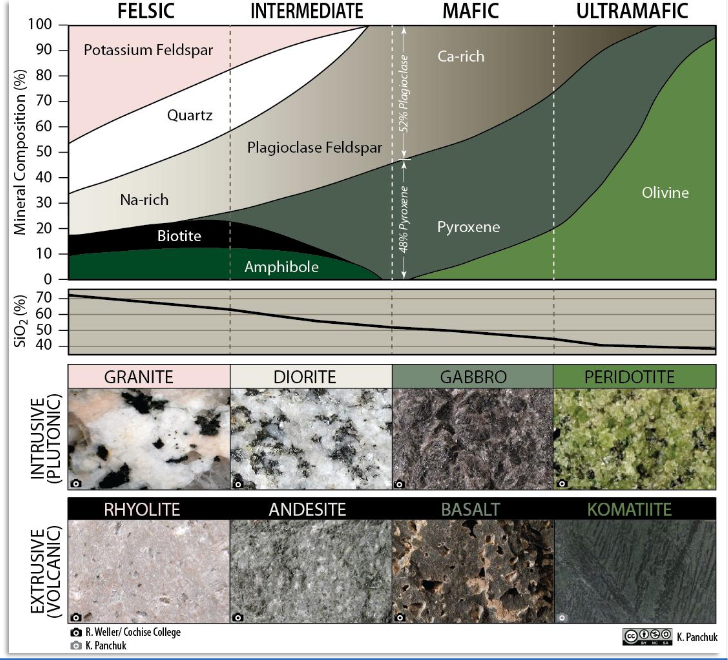
felsic, < 25%
IGNEOUS ROCK CLASSIFICATION (COLOR INDEX):
light colored, < ___% dark minerals
intermediate, 25-45%
IGNEOUS ROCK CLASSIFICATION (COLOR INDEX):
___ to ___% dark minerals
mafic, 45-85%
IGNEOUS ROCK CLASSIFICATION (COLOR INDEX):
dark colored, ____ to ___% dark minerals
ultramafic, > 85%
IGNEOUS ROCK CLASSIFICATION (COLOR INDEX):
dark to greenish colored, > ___% dark minerals
check mod 5 for igneous rock classfication based on mineral assemblage !
check mod 5 for igneous rock classfication based on mineral assemblage !
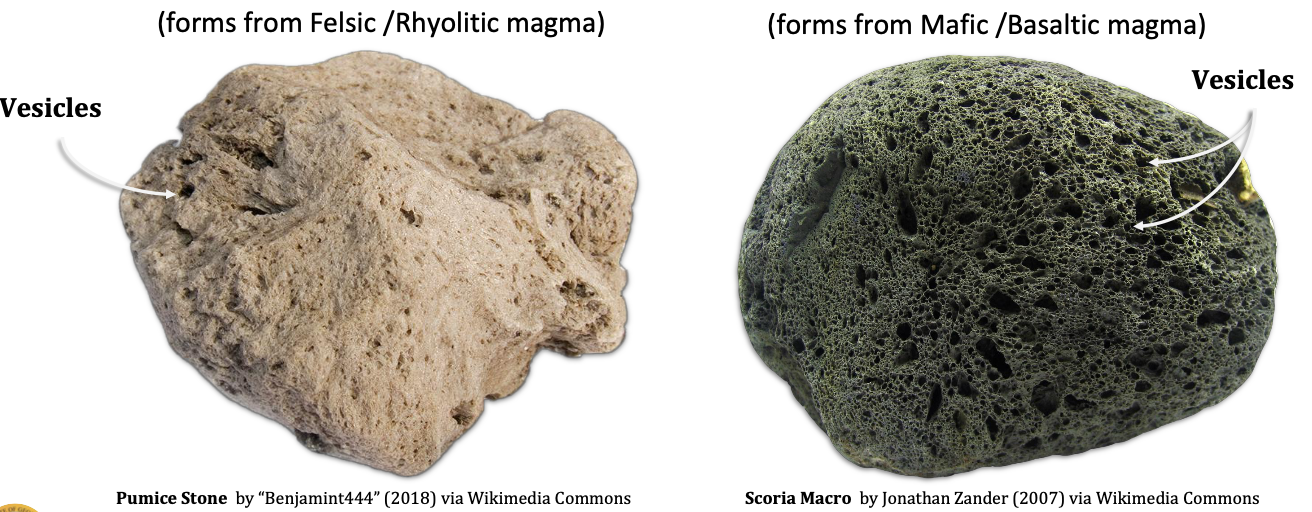
pumice
scoria
IGNEOUS ROCK CLASSIFICATION (COLOR INDEX FOR VESICULAR):
forms from felsic/rhyolitic magma
forms from mafic/basaltic magma
> 66%
52-66%
45-52%
45%
IGNEOUS ROCK CLASSIFICATION (WEIGHT % SILICA):
felsic/acidic/silicic: > ___% SiO2 (silica rich)
intermediate: ____ to ____% SiO2
basic / mafic: ___ to ____% SiO2
ultrabasic / ultramafic: < ___% SiO2; enriched with Fe & Mg
Batholith
INTRUSIVE IGNEOUS STRUCTURES:
plutons with surface exposures more than 100 km2
plutons: large body of intrusive igneous rock that forms when molten magma cools and solidifies deep underground within the Earth's crust

stock
INTRUSIVE IGNEOUS STRUCTURES:
plutons with surface exposures less than 100 km2

Concordant
2 INTRUSION CLASSIFICATIONS:
intrusion contacts oriented parallel to pre-existing layering
sill, laccolith, lopolith

Discordant
2 INTRUSION CLASSIFICATIONS:
intrusion boundaries oriented at a sharp angle to country rock layering;
neck, diatreme, dike

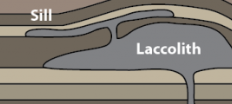
sill
CONCORDANT INTRUSIVE STRUCTURES:
tabular, concordant pluton that looks like tabletops

Laccolith
CONCORDANT INTRUSIVE STRUCTURES:
blister-like concordant pluton with flat floor and domed roof
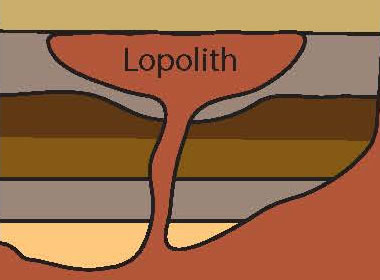
Lopolith
CONCORDANT INTRUSIVE STRUCTURES:
dish to funnel-shaped concordant plutons that have relatively flat roofs
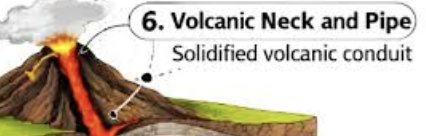
Neck
DISCORDANT INTRUSIVE STRUCTURES:
cylindrical plutonic dikes that were ancient conduit pipes
Diatreme
DISCORDANT INTRUSIVE STRUCTURES:
carrot-shaped, cylindrical pipe that developed from explosive intrusions from deep within the mantle;
discordant

Dike
DISCORDANT INTRUSIVE STRUCTURES:
tabular intrusion that cross-cut the country rock;
discordant

geothermal energy
this refers to energy stored in the form of heat beneath the earth's surface;
Steam produced from heated underground water is used to power turbines to produce electricity;
Renewable and sustainable

third, ~14%
GEOTHERMAL ENERGY:
Philippines is the ___ largest geothermal producer & geothermal energy is around ___% of the country’s energy mix.

Tongonan, Makiling-Banahaw, Tiwi
OPERATING POWER PLANTS & GEOTHERM CAPACITIES (2026):
T_____- 722.7 MW
M____-B____- 458.5 MW
T____- 234 MW
Palinpinon- 192.5 MW
Bacon-Manito- 130 MW
Mindanao (Mt. Apo) - 108.5 MW
Nasulo- 49.4 MW
Maibarara- 20 MW
