ceutics biologics
 Call Kai
 Learn
 Practice Test
 Spaced Repetition
 Match
 Flashcards
 Knowt Play
1/67

There's no tags or description
Looks like no tags are added yet.
68 Terms
biologics can be composed of which things
1. sugars, proteins, or nucleic acids
2. living entities: cells and tissue
t/f: biologics can only be isolated from natural sources
false. can be isolated from natural sources (human, animal, microorganism) OR produced by biotech
t/f: biologics include a wide range of products such as vaccines, clotting factors, allergenics, somatic cells, and tissues.
true
compare standard chemical drugs to biologics based on:
weight, structure, production, variability, stability, immunogenicity
1. weight
drug: low molecular weight
biologics: high molecular weight
2. structure
drug: simple
biologics: complex (folding, domains, etc)
3. production
drug: chemically, standardized
biologics: living cells, specialized
4. variability
drug: low
biologics: variability among batches (protein folding)
5. stability
drug: stable
biologics: sensitive to storage/handling
6. drug: non-immunogenic, bioequivalence
biologics: immunogenic
t/f: biologics do not share bioequivalence from person to person due to variation in immune system response
true
what lead to an exponential increase in life expectancy in 1700s
-vaccination discovery (smallpox)
- sanitation systems
Smallpox
forms:
transmission:
disease spectrum:
Sx:
Incubation:
forms: variola major and minor
transmission: air borne
spectrum: hemorrhagic to mild (wide)
Sx: fever, body ache, 3 week rash
incubation: 7 to 17 days
describe Edward Jenner's experiment and how it lead to the smallpox vaccine
1. COWpox from milkmaid is collected
2. boy is inoculated with COWpox [varolation]
3. boy falls ill
4. SMALLpox collected from other pt
5. inoculate boy w SMALLpox
6. boy is NOT affected by smallpox disease

In Jenner's smallpox experiment, he used cowpox material from dried pustules and gave it to another person. this is known as
varolation
attenuated virus
a weakened form of the virus that cannot cause disease
the first vaccine was a _______________ virus
live attenuated (weakened)
[smallpox]
2 main goals of body's response to immunization
1. formation of memory adaptive immune cells
2. second response to pathogen is bigger, faster, better
t/f: the body's reaction to a pathogen after vaccination is usually slower due to its previous acquaintance with it
false. the second response to a pathogen after vaccination is bigger, faster, better= hence protecting us
what are the 2 functions of antigen presenting cells (innate immunity)
1. phagocytose virus/bacteria-> break down into peptides/antigens
2. load peptides/antigens onto MHC class 1 or class 2 and present to adapted immune cells

which cells are present in the innate immunity of a vaccine response
antigen presenting cells (dendritic cell, macrophage)

what are the antigen presenting cells
dendritic cell, macrophage, B cells, NK cells

t/f: all humans have the same MHC molecules
false. MHCs differ person to person= leads to different responses of immune system

which 3 things need to be "right" during the innate immunity process for antigen recognition to occur
right MHC, right antigen, right T cell receptor

signal 1 vs signal 2 in T cell activation
signal 1: T cell receptor+antigen on MHC complex
signal 2: co-stimulatory receptor/ligand
(ex: CD80, CD86, OX40, CD40)

t/f: in T cell clonal expansion, signal 1 is sufficient enough to activate a T cell
false. needs signal 2 (co-stimulatory receptor/ligand).
we are constantly presenting antigens so if it was activated upon every single antigen, our T cells would be going off every time
what happens after signal 1 and signal 2
T cell clonal expansion
1. effector cytotoxic T cells= kill infected cells
2. helper T cells= support B cell maturation
3. memory T cells= circulate and wait for 2nd exposure to start immune response
types of T cells
1. effector cytotoxic T cells= kill infected cells
2. helper T cells= support B cell maturation
3. memory T cells= circulate and wait for 2nd exposure to start immune response
what is the first step in B cell development that majorly contributes to genetic diversity
VDJ recombination
light chain: VJ
heavy chain: VDJ

what are CDRs
CDRs are antigen binding sites. mutations help alter the shape of the sites. over time, these mutations will select for an antibody that is very high affinity for its antigen. Igs who get mutations that are NOT high affinity do not survive

what is B cell clonal expansion
the random VDJ antibody recombinant on B cell recognizes an antigen-> B cell is activated= preferentially selected to grow and survive (compared to B cells that haven't recognized antigen)-> differentiates into plasma cells (make antibodies) and memory cells

describe somatic hypermutation during B cell affinity maturation
enzymes introduce random mutations into CDR loops after each B cell proliferation= receptor slightly changes and allows for better binding to antigen over time (selective advantage to B cells that have better mutations= better antibodies)
downsides to inactivating a virus (ex: polio vaccine)
inactivation takes too long, complicated, may not be fully inactive (we no longer give these vaccines)
compare immunogenicity vs tolerability of
replicating (live attenuated) virus
non-replicating (inactivated) virus
-live vaccine generates high immunogenicity but has low tolerability= person may have high immune response and still succumb [ex: smallpox]
-inactivated virus has less immunogenicity and slightly more tolerability. BUT may not be fully inactive and cause harm [ex: polio]
compare immunogenicity vs tolerability of
subunit (split) virus
purified antigens (recombinant proteins) virus
-subunit vaccine has only parts of virus that generate immune response but cannot replicate [ex: Pertussis]
-purified antigens have less immunogenicity and more tolerability [ex: influenza]
describe the evolution of types of vaccines based on immunogenicity and tolerability
1. replicating (live attenuated)- smallpox
2. non-replicating (inactivated)- Polio
3. subunit (split virus)- Pertussis
4. purified antigens (recombinant)- influenza
Why are adjuvants added to vaccines?
enhance and modify the immune response to a vaccine (increase immunogenicity)
how do vaccine adjuvants enhance immunogenicity
target activation of APCs (innate immunity) to allow for
1. higher inflammation/ immune activation= production of cytokines that recruit more cells
2. increase amount of antigen presentation that occurs
(so more cells recruited and more antibodies made)
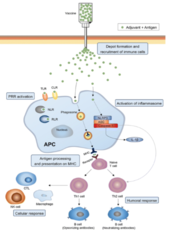
3 things that make up vaccine
1. antigens
2. stabilizers (ex: PEG)
3. adjuvants
t/f: adjuvants are often given to "challenging populations" with an impaired immune system such as elderly, children, and immunocompromised
true. increase the level of an immune response
t/f: booster vaccines are often needed for vaccines with adjuvants
false. adjuvants prolong the duration of an immune response, requiring less boosters
t/f: adjuvants often require a higher amount of antigen
false. adjuvants need less material to generate an immune response (this also helps if there are supply problems! increases production)
mRNA vaccine advantages and disadvantages
1. advantages
-rapid development
-ease of design (just need antigen sequence)
-all in one adjuvant and antigen (bc mRNA is immunogenic)
2. Disadvantages
- poor stability
- delivery (how to give? half life?)
first antibody-based therapy
Diphtheria anti-toxin (nome, alaska)
describe behring's and kitasato's passive immunity experiment regarding tetanus/diphtheria toxins that earned them the first nobel prize
1. give toxin to mouse-> mouse dies
vs
1. give toxin to rabbit-> collect rabbit serum
2. rabbit serum + toxin to mouse-> mouse survives
diphtheria anti-toxin
significance? hows it made?
-first antibody therapy
- gave diphtheria to horse and harvested serum that had antibodies
describe the physical structure of an antibody
1. variable region= Fab= antigen binding
2. constant region= Fc= effector response
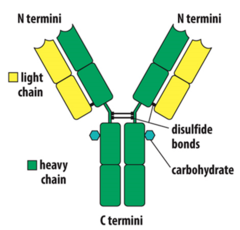
which area of an antibody is necessary for an immune response
the constant Fc region= generates effector response
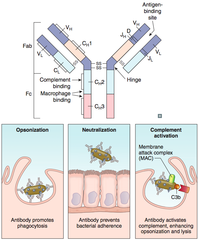
what is the only antibody-effector mechanism that does not require an Fc region
neutralization of an antigen using only Fab region
what happened in mouse studies when an antibody with an Fc region and an antibody without it was given to mice with flu antigen
mice that received the antibody with NO Fc were less likely to survive (antibody was not functional)
which 2 types of IgG antibodies are largely inert
IgG2 and IgG4
most therapeutics use which class of antibodies? which number exactly?
IgG-> IgG3
where does IgG glycosylation occur
Fc region
what are the effects of glycosylation on IgG antibodies
more sugars= anti-inflammatory; reduced phagocytosis/activity
less sugars= inflammatory; increased phagocytosis/activity
(so think of adding sugar-> messing up Fc/ smaller pocket-> less response)
what effect would removing fucose from the Fc region have on antibody activity
more inflammation; greater response
t/f: most antibodies given in tumor therapy are fucosylated
false. they are afucosylated (no sugar) to generate a large immune response against tumors
GI tract challenges for biologics
1. protease degradation (break down Ig)
2. pH changes (denatures protiens)
3. size and charge for uptake
t/f: kidney filtration, receptor clearance, and antibody clearance-immunogenicity are all examples of absorption challenges for biologics
true
main routes of administration for biologics
IV, SC, IM (depends on blood/lymph for distribution)
t/f: biologics are confined to the intracellular space
false. confined to extracellular space due to their large size (cannot be taken into cell)
how are biologics metabolized/eliminated
1. protease degradation
2. liver clearance
3. kidney filtration
4. receptor clearance
5. antibody clearance-immunogenicity
what is receptor clearance
Ig engages receptor on cell-> cell endocytosis Ig with its ligand and degrades it
how are small biologics metabolized? large?
small= susceptible to all (degradation/liver/kidney/etc)
large= receptor clearance
summarize the strategies used to improve pharmacokinetics and avoid early metabolism of biologics
1. fusion proteins (ex: albumin)
-> Ig fused w protein that has low clearance
2. glycosylation
- sialyation= avoid liver clearance
3. PEGylation
- increases hydrodynamic radius (larger= reduces kidney filtration)
ex: GLP1/ semaglutide
4. Lipidation
- increase protein binding (like to albumin)
ex: GLP1 liraglutide
GLP-1 is a naturally occurring hormone in our bodies. half life? what works to keep the time low?
half life: 2-3mins
mech: protease cleaves it at alanine, removing His= inactive
what was noticed in exenatide from Gila monsters that resulted in their GLP1s having longer half lifes
their GLP1s have glycine instead of alanine-> protease does not work. extended half life to 2.4hrs
what were the 2 issues with exenatide from Gila monsters?
1. eliminated via glomerular filtration
2. anti-peptide antibodies emerged to Gila's GLP1
How does FcRn extend half life?
fusion protein that only binds albumin to IgG1. upon uptake by cell, the endosome goes back to surface and recycles the FcRn and antibody= keeps in circulation/extends half life

what allowed for GLP1s to be given orally without challenges like enzymatic degradation and pH induced changes
GLP1 is formulated with absorption enhancer SNAC
- noncovalent interaction w semaglutide prevents oligomerization
-localized pH buffer; GLP1 is released in stomach
- fluidizes plasma membrane of stomach-> allows GLP1 to absorb

vaccines have been developed for which pathogens?
A. rabies
b. group B meningococcal
c. ebola
d. typhoid
e. all of the above
e
which of the following is not a type of vaccine?
a. toxoid
b. mRNA
c. live attenuate
d. subunit
e. vector
e
which of the following are antigen presenting cells?
a. macrophages
b. dendritic cells
c. B cells
d. NK cells
e. all of the above
e
which is the correct sequence of events in B maturation?
1. somatic hypermutation
2. antigen engagement
3. VDJ recomb
4. clonal expansion
a. 4,2,1,3
b. 3,2,4,1
c. 2,3,4,1
d. 1,3,1,4
e. 2,4,3,1
b
which is required for a vaccine response?
a. clonal expansion of T cells
b. clonal expansion of B cells
c. antigen presentation
d. formation of memory adaptive immune cells
e. a and b
f. b and c
g. all of the above
g