Pharmaceutical Chemistry: Enzyme Inhibition and Kinetics
 Call Kai
 Learn
 Practice Test
 Spaced Repetition
 Match
 Flashcards
 Knowt Play
1/20

There's no tags or description
Looks like no tags are added yet.
21 Terms
What is the relationship between enzyme affinity for substrate and product?
An efficient enzyme has a high affinity for the substrate and a lower affinity for the product.
What are competitive reversible inhibitors?
Inhibitors that bind to the active site without undergoing a reaction, reducing the apparent affinity of the substrate.
What determines the degree of inhibition by competitive reversible inhibitors?
The inhibitor's affinity for the active site and its concentration.
What is an example of a competitive reversible inhibitor?
Galantamine, used to treat mild to moderate Alzheimer's.
How does a non-competitive irreversible inhibitor work?
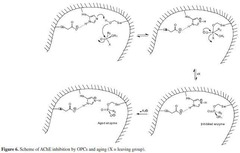
It binds irreversibly to the active site, forming covalent bonds and permanently excluding the substrate.
What is Sarin?
An irreversible acetyl cholinesterase inhibitor that reacts with a serine residue in the active site.
What are non-competitive (allosteric) reversible inhibitors?
Inhibitors that bind to an allosteric site, inducing a conformational change that prevents substrate binding.
What is Fasciculin-II?
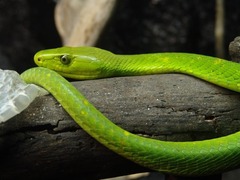
An active peptide in green mamba venom that binds to acetyl cholinesterase in a non-competitive reversible manner.
What does 'affinity' refer to in enzyme inhibition?
The strength of interaction between the inhibitor and the enzyme.
What is IC50?
The concentration required to achieve 50% inhibition of enzyme activity.
What does Ki represent?
The apparent inhibition constant for the equilibrium between the enzyme and inhibitor.
How do competitive inhibitors affect enzyme kinetics?
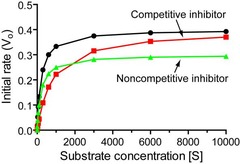
They decrease the effective substrate concentration, resulting in a higher KM value.

What effect do non-competitive inhibitors have on VMAX?
They lower VMAX by decreasing the effective enzyme concentration.
What is the primary action of allosteric inhibitors?
They bind to a different site than the substrate, causing a conformational change in the enzyme.
What is the main difference between competitive and non-competitive inhibitors?
Competitive inhibitors bind to the active site, while non-competitive inhibitors bind to an allosteric site.
What happens to the substrate concentration in the presence of non-competitive inhibitors?
Increasing substrate concentration does not reverse the inhibition.
What is the effect of non-competitive irreversible inhibitors on enzyme activity?
They permanently modify the active site, preventing substrate binding.
What is a key characteristic of non-competitive irreversible inhibitors?
They form covalent bonds with the enzyme, permanently inhibiting its activity.
What is the significance of the serine residue in the action of Sarin?
It is catalytically important and is the site where Sarin binds irreversibly.
What is the impact of enzyme inhibitors on enzyme kinetics?
They alter either KM or VMAX depending on their mode of action.
What is the role of drug design in enzyme inhibition?
To generate non-substrate molecules that bind with higher affinity than the substrate.