AQA A level Chem 3.09 Carboxylic Acids and Derivatives
 Call Kai
 Learn
Learn Practice Test
 Spaced Repetition
 Match
Match Flashcards
 Knowt Play
1/8

Earn XP
Description and Tags
Name | Mastery | Learn | Test | Matching | Spaced | Call with Kai | Chat |
|---|
No analytics yet
Send a link to your students to track their progress
9 Terms
Explain how carbon dioxide causes global warming (2)
C=O bonds in CO2 absorb infrared radiation (of 2350 cm-1) (1)
IR radiation emitted by the earth does not escape (from the atmosphere) (1)
Acyl chlorides are useful reagants in synthesis. They react with aromatic compounds also with alcohols.
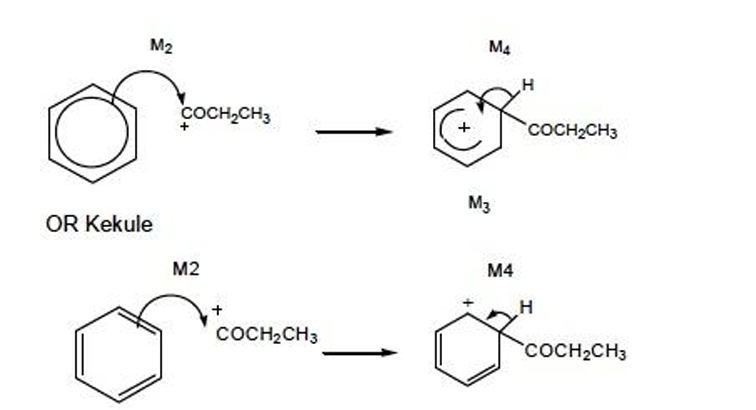
CH3CH2COCl reacts with benzene in the presence of AlCl3 to form the electrophilic substitution reaction.
Give an equation for the reaction of CH3CH2COCl with AlCl3 to form the electrophile
Outline a mechanism for the reaction of this electrophile with benzene (4)
AlCl3 + CH3CH2COCl → CH3CH2-+C=O + AlCl4 (1)
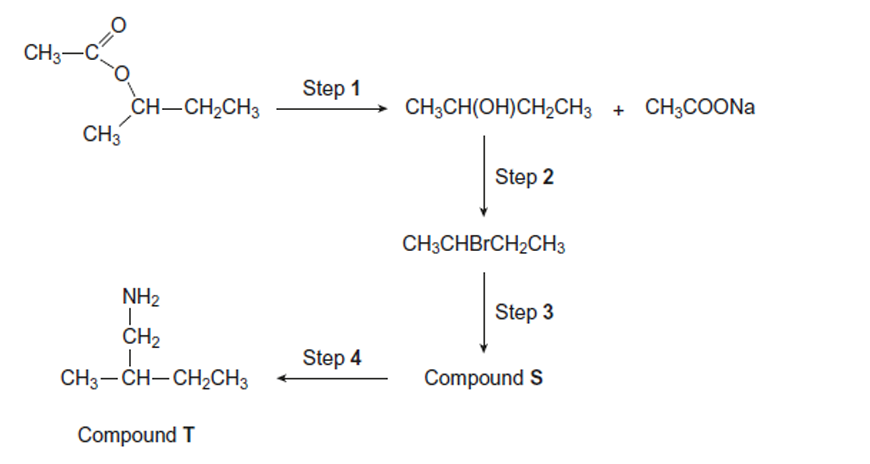
A four-step synthesis of compound T is shown.
Give the reagent and conditions for Step 1. State how you could obtain a sample of the alcohol from the reaction mixture formed in Step 1. (3)
NaOH (1)
Aqueous (1)
Fractional distillation (1)

A four-step synthesis of compound T is shown.
Draw the structure of compound S. For each of the steps 3 and 4, give a reagent and one condition, other than heat (5)
S is CH3CH(CN)CH2CH3 (1)
KCN (1)
Alocholic/(aqueous) (1)
H2 (1)
Ni (1)
Suggest why aqueous ethanol is a suitable solvent when heating the coconut oil with KOH. Give a safety precaution used when heating the mixture. Justify your choice. (3)
reason - Allow to dissolve both oil and KOH (1)
safety precaution - use a water bath for heating mixture (1)
Prevents risk of fire/ethanol is flammable (1)
The crude aspirin can be purified by recrystallisation using hot ethanol (boiling point = 78oC) as the solvent.
Describe two importance precautions when heating the mixture of ethanol and crude aspirin (2)
Ethanol is flammable so use a water bath to heat (1)
Heat to temperature below boiling point (1)
The pure aspirin is filtered under reduced pressure. A small amount of cold ethanol is then poured through the Buchner funnel
Explain the purpose of adding a small amount of cold ethanol (1)
To remove soluble impurities (1)
A sample of the crude aspirin is kept to compare with the purified aspirin. Describe one difference in appearance you would expect to see between these two solid samples. (1)
Pure product will have larger crystals (1)
Aspirin can be produced by reacting salicylic acid with ethanoic anhydride. An incomplete method to determine the yield of aspirin is shown.
Add about 6 g of salicylic acid to a weighing boat.
Place the weighing boat on a 2 decimal place balance and record the mass.
Tip the salicylic acid into a 100 cm3 conical flask.
Reweigh the empty boat
Add 10 cm3 of ethanoic anhydride to the conical flask and swirl.
Add 5 drops of concentrated phosphoric acid.
Warm the flask for 20 minutes.
Add ice-cold water to the reaction mixture and place the flask in an ice bath.
Filter off the crude aspirin from the mixture and leave it to dry.
Weigh the crude aspirin and calculate the yield.
Suggest two ways in which the melting point of the crude aspirin collected in step 9 would differ from the melting point of pure aspirin (2)
Value is lower (1)
Range of values (1)