Topic 6: AD and LRAS curves shifts
 Call Kai
 Learn
 Practice Test
 Spaced Repetition
 Match
 Flashcards
 Knowt Play
1/18

There's no tags or description
Looks like no tags are added yet.
19 Terms
Default equilibrium for exam questions
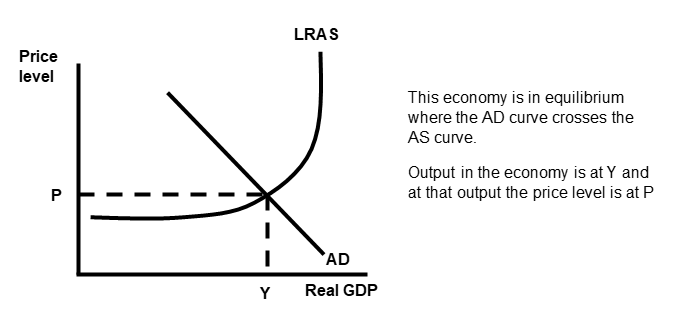
An increase in AD in an economy with lots of spare capacity

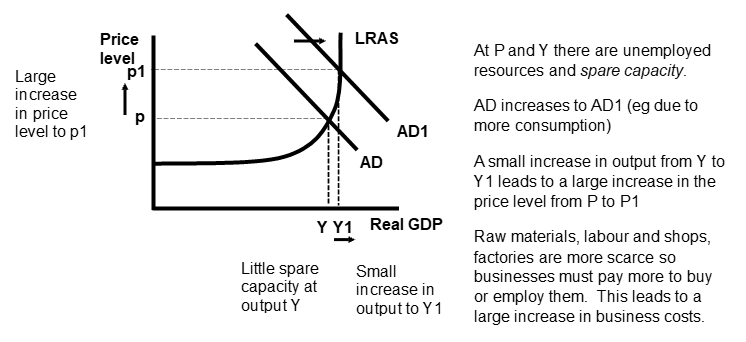
An increase in AD in an economy with some spare capacity

An increase in AD in an economy near full employment with little spare capacity
The effect of an increase in productivity

The effect of a lack of business investment in the economy

Factors which shift both the AD and LRAS curves
Any variable which changes investment (e.g. interest rates) - opening new shops, buying new machinery
Govt spending - spending long term fixed assets (e.g. new buildings such as schools, hospital, roads
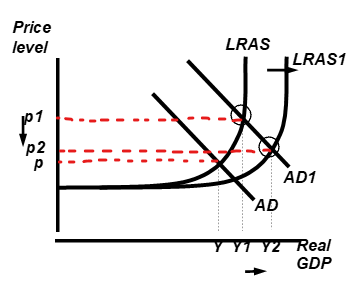
Investment and govt spending will shift the AD and LRAS curve
1) In the short run, the AD curve shifts to the right. This is because investment is a component of AD. An increase in investment means firms are buying more machinery and equipment and inventing new technology (tip to remember - businesses contribute to AD because they spend money on investment, such as buying machinery, equipment and factories, which increases total spending in the economy)
2) There is more demand in the economy so output rises
3) Cost per unit increases because spare capacity decreases. Workers can demand higher wages and the cost of raw materials rises because they are scarcer. This increases price level
4) In the long run the AS curve shifts to the right
5) This is because new machinery increases the productive potential of the economy
6) This increases the output
7) Businesses are more efficient because of the better technology. Workers are more productive which reduces the cost per unit so the price level falls
Income Tax
Changes in income can affect the AD and LRAS curves
This is because it affects households’ disposable income which affects consumption
It also affects workers’ motivation which affects productivity and therefore productive potential

Increase in income tax will shift the AD and LRAS curve
1) In the short run, the AD curve shifts to the left
2) There is less demand in the economy so output falls
3) The cost per unit falls because spare capacity increases. More workers are unemployed and therefore workers cannot demand high wage rises. Also there are more raw materials so supplier cannot demand high prices. Price level falls
4) In the long run the AS curve shifts to the left
5) This is because there may be less govt spending on a public service such as the NHS. This means workers may take more time off work because there are longer waiting lists
6) This decreases output
7) Workers are less productive so businesses are less efficient. This increases the cost per unit so the price level rises
2 different models of equilibrium output using the classical LRAS curve

Initial equilibrium - model 1 (rational expectations)

An increase in AD in the economy

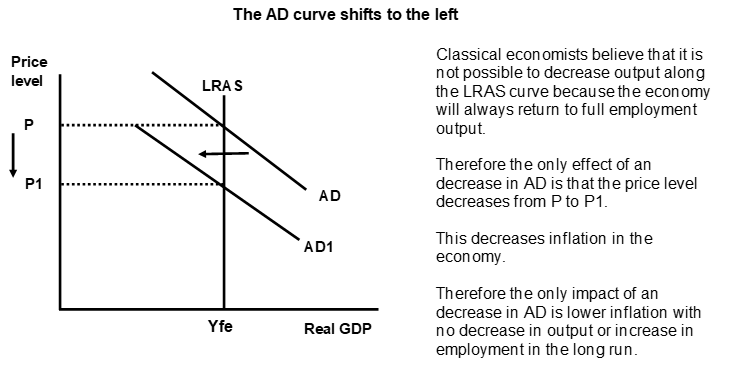
A decrease in AD in the economy
An increase in the productive potential of the economy

A decrease in the productive potential of the economy

Initial equilibrium - model 2 (adaptive expectations)

An increase in AD
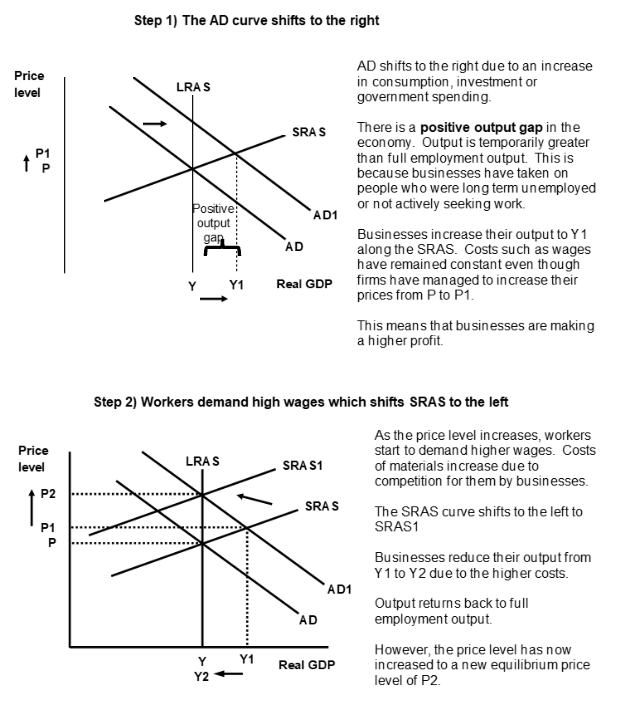
A decrease in AD
