Exam 1
 Call Kai
 Learn
Learn Practice Test
 Spaced Repetition
 Match
Match Flashcards
 Knowt Play
1/157

There's no tags or description
Looks like no tags are added yet.
Name | Mastery | Learn | Test | Matching | Spaced | Call with Kai | Chat |
|---|
No analytics yet
Send a link to your students to track their progress
158 Terms
Ecology
scientific study of interactions between organisms and their environments
Negative human impacts on the environment
habitat modification, greenhouse gas emissions/climate change, invasive species introduction, overfishing, wildlife trade, waste
Positive human impacts on the environment
habitat restoration, successful translocations, ex situ breeding programs, nature reserves, sustainable agriculture
Habitat restoration
taking an area that has been degraded by agriculture, deforestation, or urbanization and bringing it back to health
Individual scale
single organism of a particular species, behavioral and physiological ecology
Population scale
group of individuals that live in a particular area and interact with one another, evolutionary and population ecology
Community scale
an association of interacting populations of different species that live in the same area, community ecology
Ecosystem scale
collection of communities of organisms plus the physical environment in which they live, ecosystem ecology
Landscape scale
areas that vary substantially from one place to another, typically including multiple ecosystems, landscape ecology
Biosphere
all living organisms and their environments, global and climate change equality
What determines where organisms can live?
the physical environment including soil, climate, and elevation
Weather
short-term state of the atmosphere on a temporal scale of minutes, hours, days
Climate
long-term patterns of weather at a given location measured over years, decades, centuries
What is the primary driver of climate?
the sun
Causes of back radiation
clouds, aerosols, atmospheric gases, reflective surfaces
Back radiation
atmosphere traps the radiation close to the earth
Sensible heat loss
changing the temperature of an object
Latent heat loss
changing the physical state or phase of an object
Types of sensible heat loss
conduction and convention
Convection
energy transferred by movement of air and water currents
Conduction
energy transferred through the exchange of kinetic energy between molecules in direct contact
Types of latent heat loss
evaporation and transpiration
Evaporation
liquid turning into vapor
Transpiration
evaporation of water from inside plants
Why are temperatures warmer at the equator and colder at the poles?
solar radiation is not absorbed evenly due to earth’s curvature, so toward the poles the sun’s rays are spread over a larger area and take a longer path through the atmosphere
Uplift
rising of warm, less dense air in the atmosphere due to the heating of earth’s surface
Atmospheric pressure
force exerted by the molecules of air on the air and surface below it
Subsidence
sinking, downward movement of air in the atmosphere, usually over a broad area
Hadley cell
driven by heat, air is uplifted at the equator and subsides at about 30 degrees north and south
Polar cell
driven by lack of heat, air subsides at the poles, moves toward the equator when it reaches earth’s surface, and is replaced by air moving through the upper atmosphere from lower latitudes
Ferrel cell
located in mid latitudes between Hadley and polar cells, rotate in the opposite direction of polar and Hadley cells and function as gears
Surface winds
air flows from high pressure to low pressure
Downwelling
when warm surface waters reach the poles, they become cooler, denser, and more saline, leading them to sink to deeper depths and move toward the equator
Upwelling
when prevailing winds blow parallel to a coastline, surface waters flow away from the coast, leading to deep ocean water rising to the surface
Precipitation at the equator
low pressure causes heavy precipitation
Precipitation pattern of Hadley cells
low precipitation due to high pressure
Rain shadow effect
mountains force moving air upward causing it to cool and release precipitation on the windward slope resulting in lower levels of precipitation and soil moisture on the leeward side
Climatic variations within latitudes is caused by
ocean currents, distribution of land and water, elevation
How does distribution of land and water impact climate?
water has a higher heat capacity than land, so air temperatures show greater seasonal variation than air temperatures over the ocean
How does the el nino southern oscillation work?
when trade winds drop, warm surface water flows eastward toward South America. Low pressure formed by warm, moist air rising near South America causes condensation and heavy rainfall. Dry air sinks over Australia leading to clear skies, increase in temperature, and decrease in rainfall.
Biome
major division of the terrestrial environment distinguished by predominant plants’ morphology and adaptation
Aspects of plants that define biomes
size, deciduous/evergreen/succulent
Deciduous
plants that seasonally drop their leaves
Succulent
specialized tissues for holding onto water
Why do we define biomes based on plant life?
primary producers, can’t move between biomes, more visible, highly adaptable
Tropical rainforest
high temperature and precipitation biome found between 0-10 degrees, generally absent seasonality, dominated by broad-leaved evergreen and deciduous trees in the canopy and shrubs/forbs on the forest floor
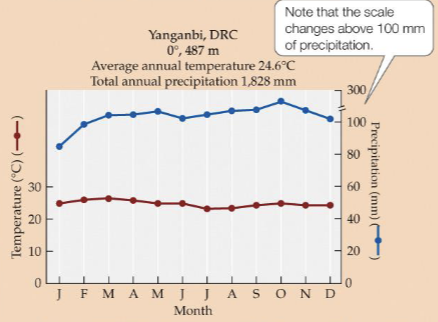
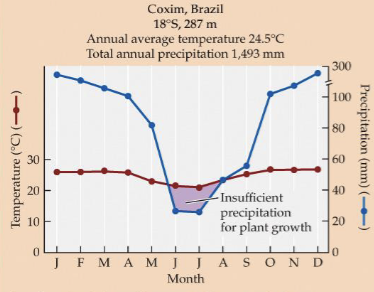
Tropical/seasonal forest/savanna
high temperature, seasonal precipitation biome found between 0-23.5 degrees, seasonality driven by precipitation (wet vs. dry season), dominated by drought deciduous trees, thorn woodlands, grasses, shrubs
Desert
high temperature, low precipitation biome found around 30 degrees, some temperature seasonality, dominated by succulents, drought deciduous shrubs, grasses, short-lived annuals

Temperate grassland
seasonal temperature and precipitation biome found between 30-50 degrees with warm, wet summers and cold, dry winters, dominated by grasses

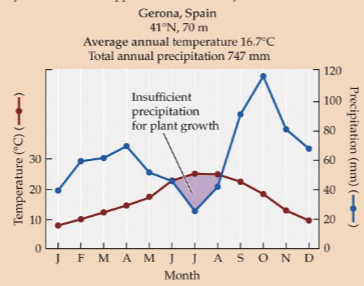
Temperate shrubland
seasonal (mild) temperatures and seasonal precipitation biome found between 30-50 degrees with warm, dry summers and cold-ish wet winters, dominated by an open canopy of short evergreen trees and shrubs
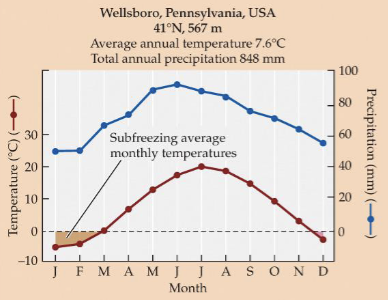
Temperate deciduous forest
seasonal temperatures and precipitation biome found between 30-50 degrees with hot, wet summers and cold, wet-ish winters, dominated by deciduous trees, smaller trees, shrubs/forbs below the canopy
Temperate evergreen forest
seasonal (mild) temperatures and precipitation biome found between 30-50 degrees with variable but often warm, wet summers and mild, wet winters, dominated by evergreen trees

Boreal forest
seasonal (cold) temperatures and low precipitation biome found between 50-60 degrees north with warm-ish summers and cold winters, dominated by conifers and deciduous birches

Tundra
seasonal (cold) temperatures and low precipitation biome found between 65-90 degrees north with cold dark winters, warm-ish bright summers, dominated by sedges, forbs, grasses, low-growing shrubs, lichens, mosses

What are aquatic biomes determined by?
velocity, temperature, clarity, salinity, oxygen concentration, nutrient status, pH
Lotic
flowing water
What order streams are considered major rivers?
6th order or higher
Benthic zone
just above the floor of the stream where invertebrates feed on detritus
Detritus
freshly dead or partially decomposed remains of organisms
Hyporheic zone
on the floor of a stream where rotifers, copepods, and insects live
Characteristics of lower order streams
fast flowing, CPOM is the main energy input, high oxygen content
CPOM
course particulate organic matter
Characteristics of intermediate order streams
deeper portions flow more slowly, finer sediments, main energy input is from algae and FPOM
FPOM
fine particulate organic matter
Characteristics of high order streams
photosynthesis is the main energy input so detritus is less important, richer communities
What type of rivers does the river continuum apply to the best and why?
temperate because of the freezing temperatures and seasonality
Lentic
still
Formation of lentic waters
glacial processes, geological events, biological processes
What depth of lakes are the most nutrient rich?
shallow
Littoral zone
close to the shore, tons of plant and animal life
Photic/epilimion
close to the surface, lots of algae and fish
Thermocline
transitional part
Aphotic zone
light cannot penetrate so there is no phytoplankton
Human impacts on aquatic ecosystems
sediment deposition, fertilizer run off, invasive species, dam construction, pollution, habitat destruction, overfishing, extreme weather, overuse of water
What are marine zones categorized by?
physical distance to shorelines and the ocean bottom
Nearshore
environments close to the shore that are influenced by local climate, tides, wave action and influx of freshwater
Estuary
freshwater from rivers meets saltwater from rising ocean tides, biological communities adapted to varying salinity
Primary threats to estuaries
pollution
Salt marshes
shallow zones rich in terrestrial sediments, dominated by vascular plants, biological communities adapted to salinity gradient
Primary threats to salt marshes
sea level rise, erosion, extreme weather
Mangrove forest
assemblages of salt-tolerant trees in shallow coastal estuaries and mudflats, the mangroves trap sediments and provide nutrients and shelter for many species
Primary threats to mangrove forests
coastal development, shrimp farming, pollution, diversion of inland freshwater sources, wood harvesting
Rocky intertidal zone
ocean meets land between high and low tides, large rocks, biological communities adapted to alternating marine and terrestrial conditions with tolerance for temperature changes, salinity, desiccation, wave action
Primary threats to rocky intertidal zones
coastal development, pollution, sea level rise, extreme weather
Sandy shores
dynamic coastal environment characterized by fine sands and sediments, limited biological communities due to sandy substrate, tidal fluctuations, and wave action
Primary threats to sandy shores
coastal development, erosion, rising sea levels
Shallow ocean zones
highly productive marine biological zones where sunlight reaches the ocean bottom leading to the establishment of sessile and mobile organisms
Coral reefs
colonies of coral polyps held together by skeletons made of calcium carbonate extracted from sea water
Coral and algae relationship
coral are reliant on photosynthetic algae that live on their bodies for food, and the coral provides protection/nutrients to the algae
Seagrass beds
meadows of submerged flowering plants found on subtidal marine sediments composed of mud or fine sand
Primary threats to coral reefs
ocean acidification, coral bleaching, invasive species, destruction
Primary threats to seagrass beds
pollution, disease, destructive fishing
Kelp beds
large stands of kelp anchored to solid substrate in shallow water
Primary threats to kelp beds
coastal development, pollution, extreme weather, changing water temperatures, predator removal
Pelagic zone
open ocean beyond continental shelves, vastness and depth make it hard to characterize distinct biological communities
Primary threats to the pelagic zone
overfishing, plastic pollution, changing water temperatures, ocean acificiation
Marine benthic zone
ocean bottom subject to near-freezing temperatures and high pressures
Threats to marine benthic zone
bottom contact fishing practices, seabed mining, acidification
Autotrophs
source energy from inorganic chemical compounds or sunlight
Heterotrophs
acquire energy from eating autotrophs