Lab Practical #1 A&P 1

0.0(0)
Studied by 0 people
call kaiCall Kai
learnLearn
examPractice Test
spaced repetitionSpaced Repetition
heart puzzleMatch
flashcardsFlashcards
GameKnowt Play
Card Sorting

1/226

encourage image

There's no tags or description

Looks like no tags are added yet.

227 Terms
1
New cards
term image


<p></p>
2
New cards
term image

Interphase, Prophase 1, prophase 2, MA 1 and 2, T, cytokinesis, two identical daughter cells

3
New cards
term image
4
New cards
term image
5
New cards
term image

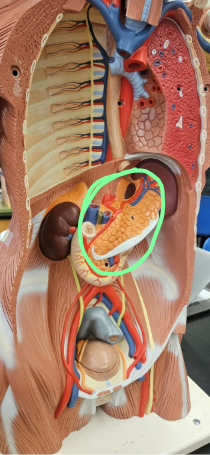
pancreas

6
New cards
term image

gallbladder

7
New cards
term image

spleen

8
New cards
term image

Simple Cuboidal Epithelium

9
New cards
term image

Simple Columnar Epithelium

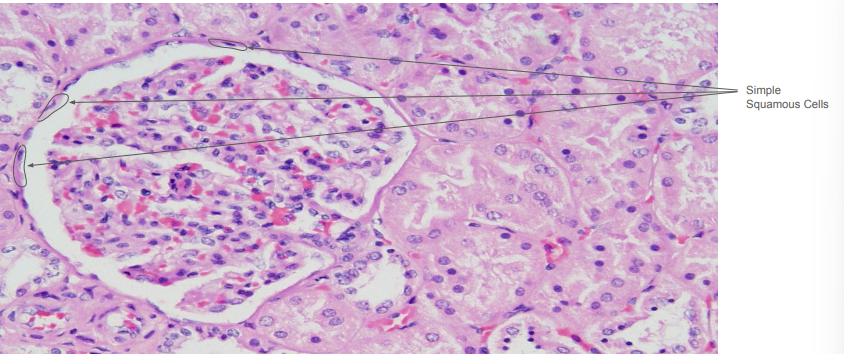
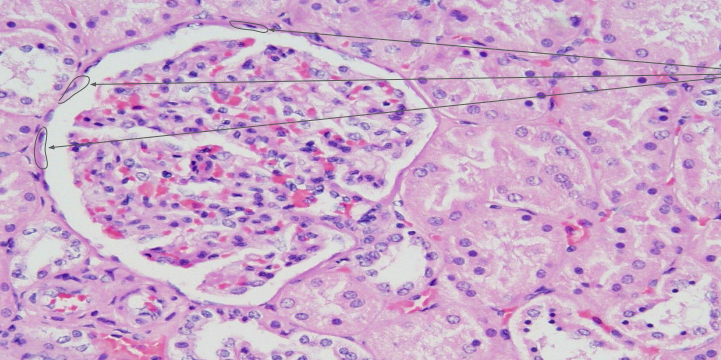
10
New cards
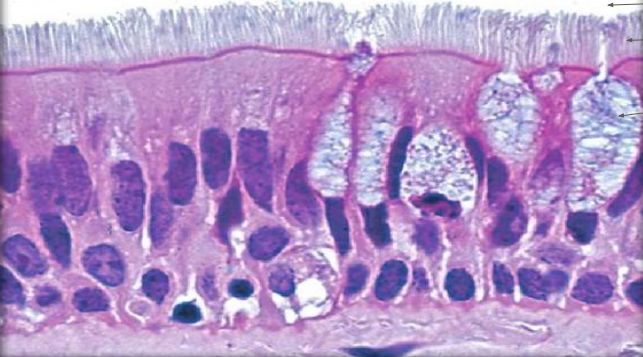
<p>name of tissue and label all arrows</p>

name of tissue and label all arrows

knowt flashcard image
11
New cards

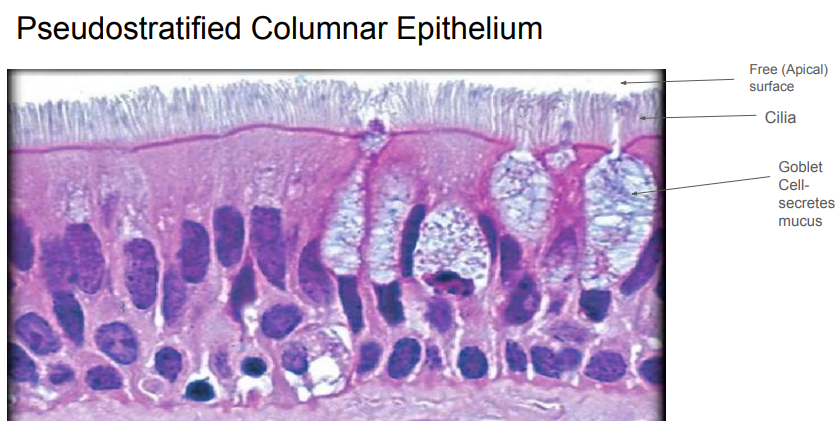
Pseudostratified Columnar Epithelium

In the ciliated respiratory form, mucus traps particles and cilia move it along.

Example: trachea and much of the upper respiratory tract

12
New cards
<p>What membrane is this pointing to? What tissue type?</p>

What membrane is this pointing to? What tissue type?

knowt flashcard image
13
New cards
term image

Transitional Epithelium

14
New cards
term image

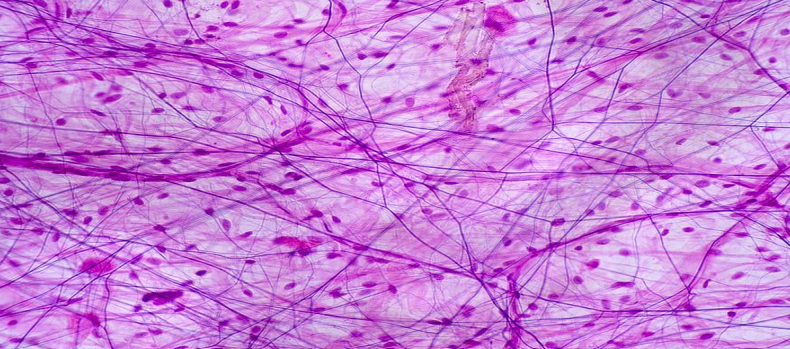
Areolar Connective Tissue

15
New cards
<p>Arrow? Tissue?</p>

Arrow? Tissue?

knowt flashcard image
16
New cards
term image

Dense Regular Connective Tissue

17
New cards
term image

Hyaline Cartilage

18
New cards

Hyaline Cartilage

Support with flexibility and cushioning. Examples: tracheal rings, costal cartilage, articular surfaces.

19
New cards
term image

Elastic Cartilage

20
New cards

Elastic Cartilage - location/job?

Maintains shape while bending.

Examples: external ear and epiglottis.

21
New cards
term image

Compact Bone Tissue

22
New cards
term image

Blood Tissue

23
New cards
term image

Smooth Muscle Tissue

24
New cards
term image

Teased Smooth Muscle Fibers

25
New cards
<p>Arrows? Tissue?</p>

Arrows? Tissue?

knowt flashcard image
26
New cards
<p>Arrows? Tissue?</p>

Arrows? Tissue?

knowt flashcard image
27
New cards
term image

Nervous Tissue

28
New cards
term image

Nervous Tissue

29
New cards
Superior
Toward the head; above. Also called cranial or cephalad.
30
New cards
Inferior
Away from the head; below. Also called caudal.
31
New cards
Ventral
Toward the front of the body. Also called anterior.
32
New cards
Dorsal
Toward the back of the body. Also called posterior.
33
New cards
Medial
Toward the midline of the body.
34
New cards
Lateral
Away from the midline of the body.
35
New cards
Proximal
Closer to the trunk, or to the point where a limb attaches.
36
New cards
Distal
Farther from the trunk, or from the point where a limb attaches.
37
New cards
Right
Toward the body's right side.
38
New cards
Left
Toward the body's left side.
39
New cards
Ipsilateral
On the same side of the body.
40
New cards
Contralateral
On the opposite side of the body.
41
New cards
Deep
Farther from the surface of the body.
42
New cards
Superficial
Closer to the surface of the body.
43
New cards
Sagittal plane
A vertical plane that divides the body into right and left parts. A midsagittal plane runs exactly down the midline; a parasagittal plane is off to one side.
44
New cards
Coronal plane
A vertical plane that divides the body into front (anterior) and back (posterior) parts. Also called the frontal plane.
45
New cards
Frontal plane
A vertical plane that divides the body into front (anterior) and back (posterior) parts. Also called the coronal plane.
46
New cards
Transverse plane
A horizontal plane that divides the body into upper (superior) and lower (inferior) parts. Also called the horizontal plane.
47
New cards
Oblique plane
A plane that cuts through the body at an angle, not along the sagittal, coronal, or transverse planes.
48
New cards
Parietal serosa
Lines the walls of a body cavity.
49
New cards
Visceral serosa
Covers the organs within a given cavity.
50
New cards
Simple Squamous Epithelium — job
Diffusion or filtration.
51
New cards
Simple Squamous Epithelium — location
Alveoli; endothelium of capillaries/blood vessels; parietal layer of the glomerular (Bowman's) capsule.
52
New cards
Simple Squamous Epithelium — how to identify it
One cell layer; flat, scale-like cells; flattened nuclei; usually lines a very thin surface.
53
New cards
Simple Cuboidal Epithelium — job
Secretion and absorption.
54
New cards
Simple Cuboidal Epithelium — location
Kidney tubules, small gland ducts, and the ovarian surface epithelium.
55
New cards
Simple Cuboidal Epithelium — how to identify it
One cell layer; round central nuclei; cells about as tall as they are wide; often forms tubules or ducts.
56
New cards
Simple Columnar Epithelium — job
Absorption and secretion.
57
New cards
Simple Columnar Epithelium — location
Digestive tract lining, gallbladder.
58
New cards
Simple Columnar Epithelium — how to identify it
One cell layer; tall rectangular cells; oval nuclei near the base; may include goblet cells or microvilli.
59
New cards
Pseudostratified Columnar Epithelium — job
In the ciliated respiratory form, mucus traps particles and cilia move it along.
60
New cards
Pseudostratified Columnar Epithelium — location
Trachea and much of the upper respiratory tract.
61
New cards
Pseudostratified Columnar Epithelium — how to identify it
Nuclei at different heights; cilia may be visible at the apical surface; goblet cells may appear pale/clear; actually one layer, not many.
62
New cards
Stratified Squamous Epithelium — job
Protection from abrasion.
63
New cards
Stratified Squamous Epithelium — location
Keratinized: epidermis. Nonkeratinized: mouth, esophagus, and vagina.
64
New cards
Stratified Squamous Epithelium — how to identify it
Many layers; cells near the surface are flattened; basal cells are more cuboidal/rounded; built to resist abrasion.
65
New cards
Stratified Cuboidal Epithelium — job
Protection and secretion.
66
New cards
Stratified Cuboidal Epithelium — location
Ducts of sweat, mammary, and salivary glands.
67
New cards
Stratified Cuboidal Epithelium — how to identify it
Usually two layers; surface cells are cuboidal; often surrounds a duct/lumen; more protection than simple cuboidal.
68
New cards
Transitional Epithelium — job
Allows stretching while forming a protective barrier.
69
New cards
Transitional Epithelium — location
Bladder, ureters.
70
New cards
Transitional Epithelium — how to identify it
Multiple layers; rounded/dome-shaped surface cells; cells flatten when stretched; often looks scalloped at the surface.
71
New cards
Areolar Connective Tissue — job
Wraps and cushions organs; attaches epithelium to deeper tissues; holds tissue fluid.
72
New cards
Areolar Connective Tissue — location
Under epithelia (packing material).
73
New cards
Areolar Connective Tissue — how to identify it
Loose, open arrangement; collagen and elastic fibers; fibroblast nuclei scattered throughout; abundant ground substance.
74
New cards
Adipose Connective Tissue — job
Energy storage, insulation, cushioning.
75
New cards
Adipose Connective Tissue — location
Under skin, around kidneys/eyeballs, abdomen.
76
New cards
Adipose Connective Tissue — how to identify it
Large empty-looking cells; thin cell borders; nuclei pushed to the side; little visible matrix.
77
New cards
Dense Regular Connective Tissue — job
Strong attachment; resists tension along one axis.
78
New cards
Dense Regular Connective Tissue — location
Tendons and ligaments.
79
New cards
Dense Regular Connective Tissue — how to identify it
Wavy parallel fibers; fibroblast nuclei squeezed between fibers; very little open space; all fibers run mostly the same direction.
80
New cards
Hyaline Cartilage — job
Support with flexibility and cushioning.
81
New cards
Hyaline Cartilage — location
Tracheal rings, costal cartilage, articular surfaces.
82
New cards
Hyaline Cartilage — how to identify it
Chondrocytes in lacunae; smooth glassy matrix; few visible fibers; often paired cells.
83
New cards
Elastic Cartilage — job
Maintains shape while bending.
84
New cards
Elastic Cartilage — location
External ear and epiglottis.
85
New cards
Elastic Cartilage — how to identify it
Chondrocytes in lacunae; dark elastic fibers in the matrix; more fiber texture than hyaline; flexible but keeps shape.
86
New cards
Compact Bone Tissue — job
Support, protection, leverage, and mineral storage.
87
New cards
Compact Bone Tissue — location
Dense outer portion of bones.
88
New cards
Compact Bone Tissue — how to identify it
Circular osteons/rings; central canals; small lacunae between concentric lamellae; hard mineralized matrix.
89
New cards
Blood Tissue — job
Transport gases, nutrients, wastes, and hormones; immune defense and clotting.
90
New cards
Blood Tissue — how to identify it
Many red blood cells; occasional white blood cells with nuclei; platelets may be tiny fragments; fluid matrix is plasma.
91
New cards
Skeletal Muscle Tissue — job
Voluntary movement, posture, heat production.
92
New cards
Skeletal Muscle Tissue — location
Attached to bones or skin.
93
New cards
Skeletal Muscle Tissue — how to identify it
Strong striations; long parallel fibers; multiple nuclei pushed toward the edges.
94
New cards
Cardiac Muscle Tissue — job
Pumps blood.
95
New cards
Cardiac Muscle Tissue — location
Only in the heart wall (myocardium).
96
New cards
Cardiac Muscle Tissue — how to identify it
Striations visible; branching cells; usually one central nucleus (sometimes two); intercalated discs between cells.
97
New cards
Smooth Muscle Tissue — job
Moves substances through hollow organs.
98
New cards
Smooth Muscle Tissue — location
Digestive tract, blood vessels, uterus, bladder.
99
New cards
Smooth Muscle Tissue — how to identify it
No striations; spindle-shaped cells; single central nucleus per cell; cells arranged in sheets.
100
New cards
Nervous Tissue — job
Rapid electrical and chemical communication; neurons receive and transmit signals; glial cells support, protect, and nourish neurons.