BISC 208 Final Exam; UDel (Mahaffy)
 Call Kai
 Learn
Learn Practice Test
 Spaced Repetition
 Match
Match Flashcards
 Knowt Play
1/274

There's no tags or description
Looks like no tags are added yet.
Name | Mastery | Learn | Test | Matching | Spaced | Call with Kai | Chat |
|---|
No analytics yet
Send a link to your students to track their progress
275 Terms
Evolution
change in allele frequency
Evolutionary Principles (3)
1) competition occurs when there are more individuals than can survive
2)when there is variation, the adaptive traits are passed on and increase in frequency in the population
3) Evolution is derived from natural and sexual selection
Microevolution
Small changes in allele frequency
Macroevolution
Creation of new species
Natural Selection Patterns (3)
1) Stabilizing
2) Disruptive
3) Directional
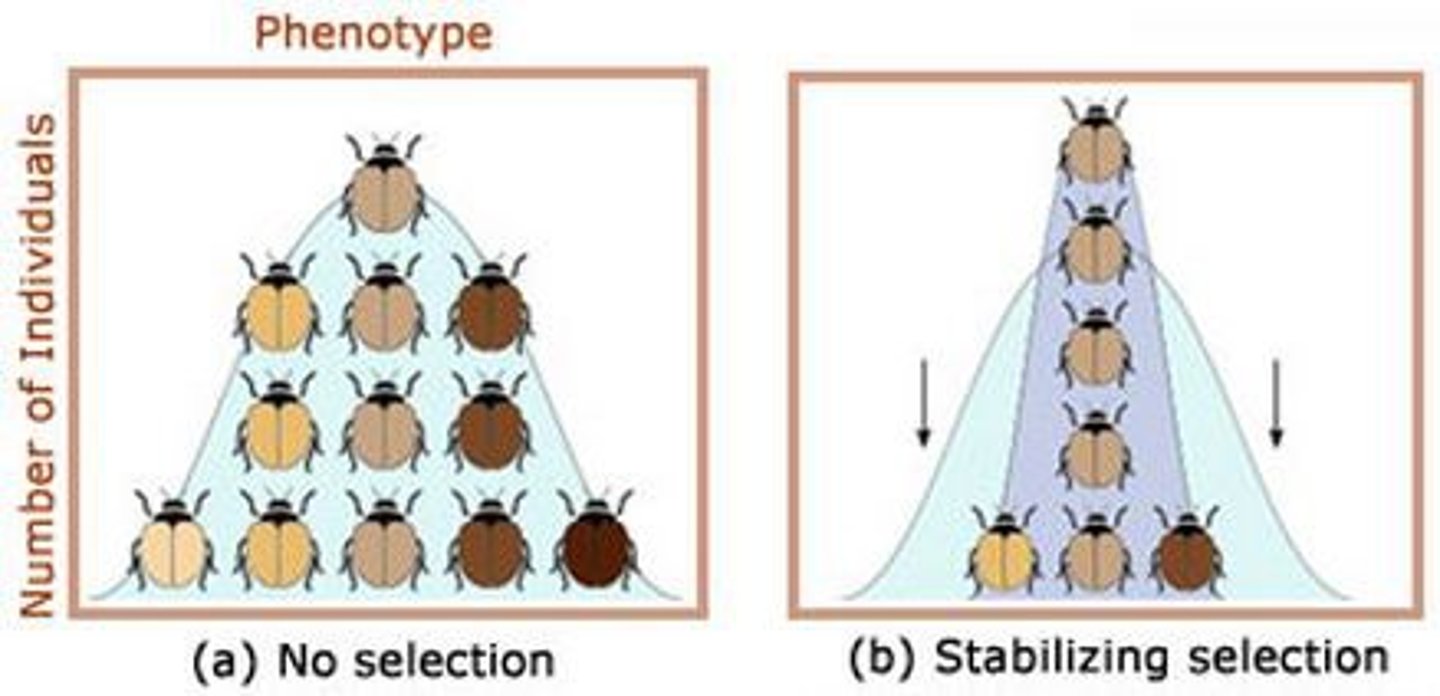
Stabilizing Selection
NS against the extremes
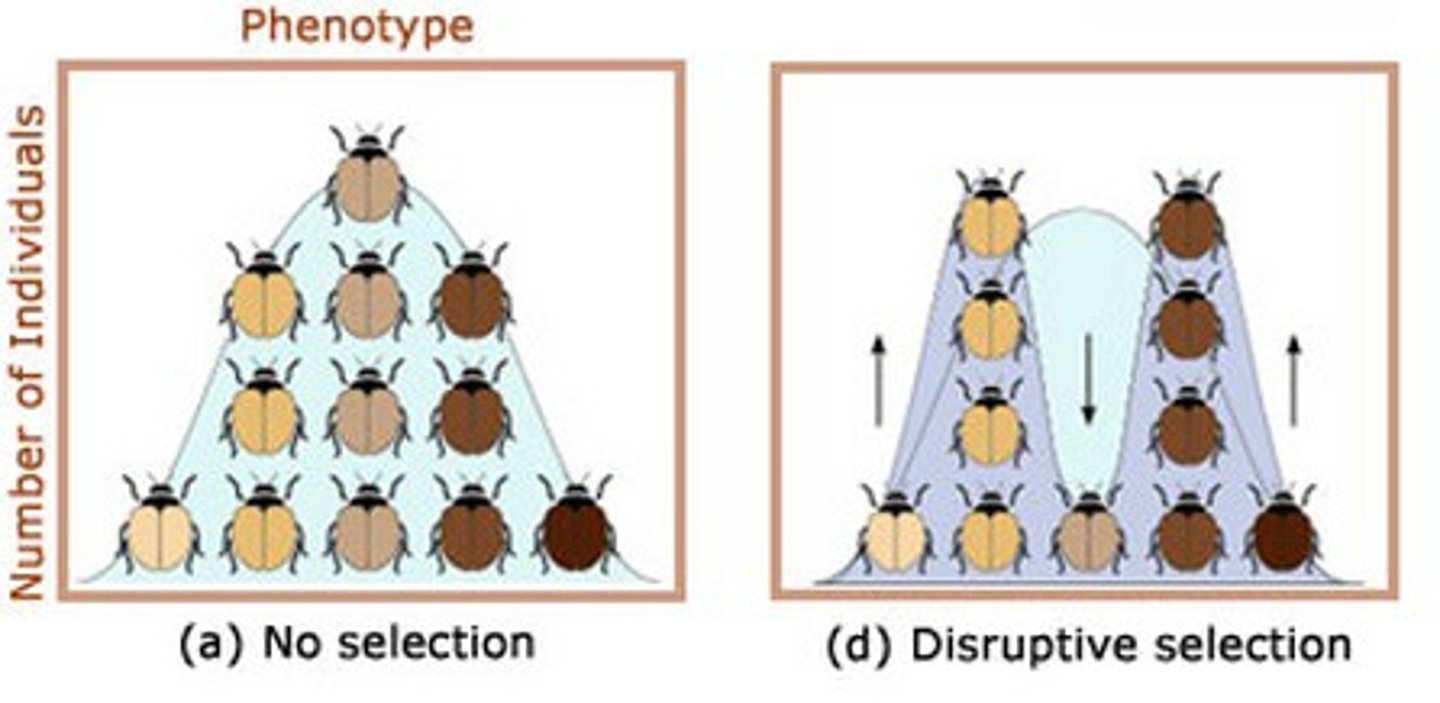
Disruptive Selection
NS against the average
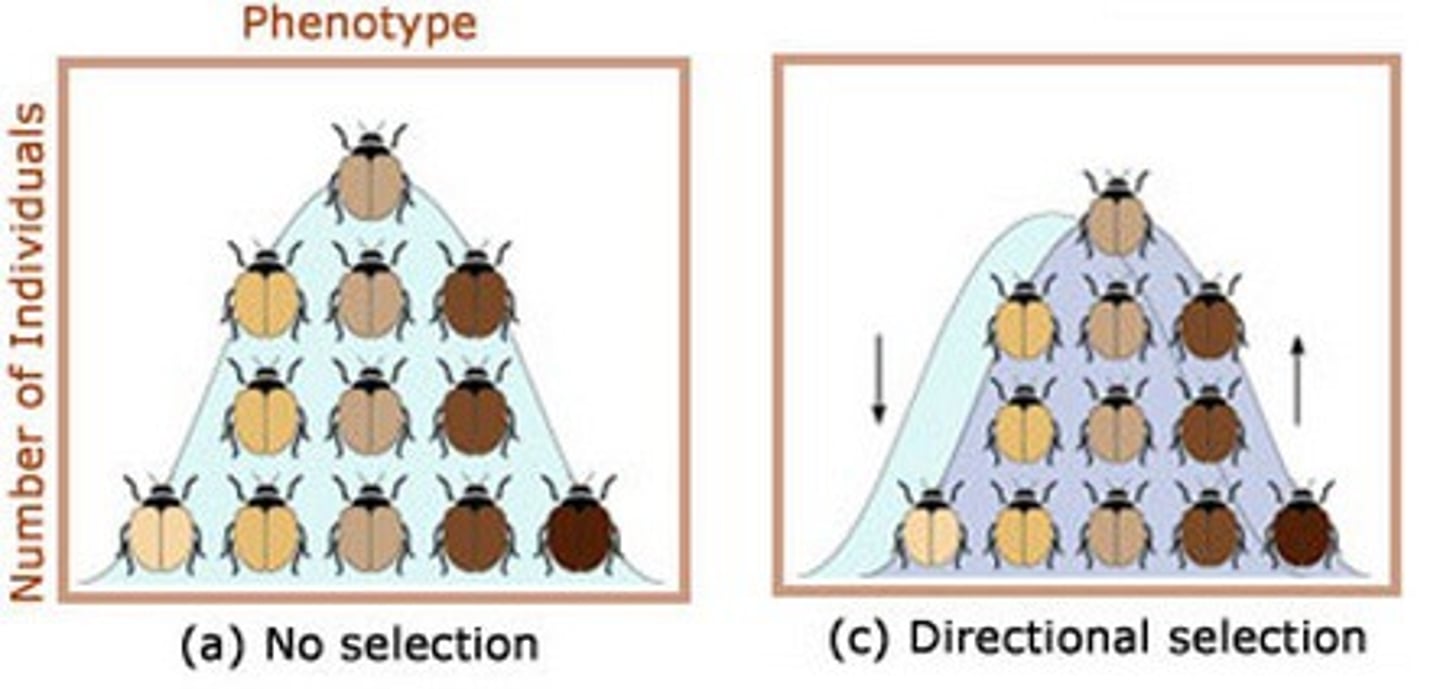
Directional Selection
NS against one extreme
Hadry-Weinberg Equilibrium
When conditions are met, allele freq. will not change
Hardy-Weinberg Principles (5)
1) No migration
2) Large population
3) Random mating
4) No mutation
5) No selection
Selection
The process by which certain traits or characteristics become more or less common in a population over time.
Selection Types (4)
1) Natural
2) Sexual
3) Artificial
4) Ecological
Genetic Drift
Random changes in the frequency of alleles--changes that occur w/o selection
Main Mechanisms of Genetic Drift (2)
1) Bottleneck
2) Founder Effect
Bottleneck Effect
population is suddenly reduced to a very small size because of events like natural disasters, disease, or hunting
Founder Effect
small group of individuals breaks away from a larger population and starts a new population
Genetic drift leads to (2)
1) loss of genetic variation
2) Inbreeding
Inbreeding leads to
An increase in the frequency of homozygotes in the population
Species
Has multiple definitions that depend on appearance, location, niche, and reproduction
Speciation
The formation of new and distinct species.
What leads to speciation
Reproductive Isolation
Allopatric Speciation
A type of speciation that occurs when populations of a species become geographically isolated from each other.
Sympatric Speciation
A type of speciation that occurs when two species reproduce but the populations fill different niches. Eventually the become so different they cant reproduce.
Polyploidy
Polyploidy is a condition in which an organism has more than two complete sets of chromosomes.
Normally, organisms are diploid (2 sets of chromosomes), but polyploid organisms may have:
3 sets (triploid = 3n)
4 sets (tetraploid = 4n)
or more.
Autopolyploidy
Autopolyploidy is a condition in which an organism has extra sets of chromosomes that all come from the same species.
Allopolyploidy
Allopolyploidy is a condition in which an organism has extra sets of chromosomes from two different species.
Prezygotic Speciation (6)
1) Geographic: separated by physical barriers
2) Ecological: two species live in same general area, but occupy different habitats or niches so they dont encounter each other
3) Behavioral: different species have different mating behaviors
4) Temporal: species reproduce at different species
5) Mechanical: physical differences
6) gametic: sperm and egg are incompatible
Postzygotic Speciation (3)
1) Hybrid Inviability: embryo may be weak, unable to survive
2) Hybrid Sterility: reproductive system does not work properly
3) Hybrid Breakdown: first generation of hybrids are healthy and fertile, future generations are weaker
Resource Partitioning
Over time, species may evolve specialized traits or behaviors that allow them to exploit specific resources, contributing to speciation
Hybrids
When two species mate and the offspring has no reproductive issues
Evolutionary Radiation
One ancestral species rapidly evolves into many different species
Anogenesis
Single species evolves into a single different species
Cladogenesis
Single species evolves into multiple new species
Nontracheophytes (3)
1) Mosses
2) Liverworts
3) Hornworts
Seedless Plants (4)
1) Whisk Fern
2) Club Mosses
3) Horsetails
4) Fern
Gymnosperms; Naked Seeds (4)
1) Ginkgos
2) Cycade
3) Gnetophytes
4) Conifers
Angiosperms; Fruiting Flowers (2)
1) Monocots
2) Eudicots
Monocots Traits (6)
1) Single cotyledon (embryonic leaf) seed structure
2) Parallel leaf venation
3) Floral parts in multiples of three
4) Fibrous root system (thin and branch out)
5) Scattered vascular bundles
6) Primary growth (upward)
Eudicot Traits (6)
1) Double cotyledon seed structure
2) Net-like leaf venation
3) Floral parts in multiples of four or five
4) Taproot system (central main root)
5) Ring-like vascular bundles (xylem and phloem are in neat circle or ring)
6) Secondary growth (thickness)
Secondary Metabolites
Organic compounds that are not directly involved in the normal growth, development, or reproduction of an organism. (Caffeine, Capsaicin, Etc)
What grown first in a seed
Root
Plant Organs (3)
1) Roots
2) Stem
3) Leaves
Roots Function
Absorb nutrients in soil, anchor plant, and store food
Root Meristem
A cluster of active, dividing embryonic cells at the tips of roots that generates new tissue and increases root length
Root Cap
A structure that covers the tip of a root, protecting the root from injury
Root Hairs
Tiny hair-like extensions that increase the surface area of the root allowing it to absorbs more water and nutrients
Vascular Cylinder Parts
1) Epidermis
2) Cortex
3) Endodermis
4) Pericycle
5) Phloem
6) Xylem
Stem Function
Support, transport, storage
Node
A region on a stem where a leaf, branch, or flower is or was attached
Internode
Segment of the stem between two adjacent nodes
Apical Bud
located near the shoot tip and causes elongation (primary growth) of a young shoot
Lateral Bud
Buds along the sides of a stem that give rise to new branches (secondary growth).
Leaves Function
Photosynthesis and gas exchange. Can be specialized for reproduction, etc.
Blade
Thin, flattened section of a plant leaf that collects sunlight
Petiole
The stalk of a leaf, which joins the leaf to a node of the stem.
Stomata
Small openings on the underside of a leaf through which oxygen and carbon dioxide can move
Guard Cells
Control the opening and closing of stomata
Stamen
The male reproductive organs of a flower
Anther
Produces Pollen
Filament
Supports the anther
Pistil
The female reproductive organs of a flower
Stigma
Receives pollen
Style
Connects stigma to ovary
Ovary
The swollen base of the pistil that contains one or more ovules. After fertilization, it develops into the fruit.
Plant Tissue Types (3)
1) Dermal
2) Vascular
3) Ground
Dermal Tissue
the protective outer covering of a plant
Trichomes
Tiny, spikelike projections on some leaves for protection
Cuticle
A waxy covering on the surface of stems and leaves that acts as an adaptation to prevent desiccation in terrestrial plants.
Vascular Tissue
Transports water and nutrients
Xylem
Carries water upward from the roots
Tracheids
Tube-shaped cells that carry water and minerals up from the roots
Vessel Elements
Structures that, along with tracheids, make up xylem
Phloem
Carries organic material downward
Sieve Tube Members
Cells in the phloem tissue that lack a nucleus, but are long and cylindrical for conducting carbohydrates
Companion Cells
The active cells found next to sieve tube elements that supply the phloem vessels with all of their metabolic needs
Casparian Strip
waterproof strip that surrounds plant endodermis cells
Ground Tissue
Tissue between the dermal tissue and vascular tissue of a non-woody plant that functions in photosynthesis, storage, and support
Pith
Interior to vascular
Cortex
Exterior to vascular
Plant Transport Routes (3)
1) Symplastic
2) Appoplastic
3) Cohesion-Tension
Symplastic Route
Water travels through cytoplasm and doesn't use casparian strip
Appoplastic Route
Water travels between cells & the casparian strip filters
Cohesion-Tension Theory
Water moves into the plant and continuously flows up the
xylem because of cohesion from water above it evaporating through the leaves pulling it up.
Animal Characteristics (5)
1) Monophyletic
2) Multicellualr Eukaryotes
3) Aerobic
4) Heterotrophic
5) 3 Embryonic layers
Animal Embryonic Layers (3)
1) Ectoderm
2) Mesoderm
3) Endoderm
Ectoderm
Outermost germ layer; Forms integumentary, nervous, and sensory system
Mesoderms
Middle germ layer; Forms internal structures (muscles, most organs, bones)
Endoderm
Innermost germ layer; Forms digestive tract, and respiratory system
Monophyletic
ALL descendants came from one common ancestor
Aerobic
Requires oxygen
Heterotrophic
Organisms that obtain their nutrients or food from consuming other organisms.
Hydrostatic
Hydrostatic refers to the pressure or support created by a fluid, usually water, in a confined space. Example: earthworms
Features For Grouping (5)
1) Symmetry
2) Cephalization
3) Gut type
4) Coelom type
5) Segmentation
Protostomes Characteristics (4)
1) Mouth => Anus
2) Spiral Cleavage
3) Coelom forms by splitting
4) Mosaic Embryo (no cell arrest)
Proifera
-Sponges, Corals
-Asymetrical
-No cephalization
-No gut type (Filter Feed)
-Acolemate
-No Segmentation
Cnidaria
-Jellyfish
-Radial Symmetry
-Limited cephalization (nerve net)
-sac gut
-acoelomate
-no segmentation
Platyhelminthes
-flatworms
-bilateral symmmetry
-cephalization
-sac gut
-acoelomate
-no segmentation
Rotifera
-microscopic organisms
-bilateral
-cephalization
-tube gut
-pseudocoelomate
-no segmentation
Nematoda
-roundworms
-bilateral
-cephalization
-tube gut
-pseudocoelomate
-no segmentation
Mollusca
-clams
-bilateral
-cepalization
-tube gut
-coelomate
-no segmentation