Chapter 10
 Call Kai
 Learn
 Practice Test
 Spaced Repetition
 Match
 Flashcards
 Knowt Play
1/55

There's no tags or description
Looks like no tags are added yet.
56 Terms
membrane structure
phospholipid bilayer (5 nm in height)
encloses the cells and defines their boundaries
maintains the essential/potential difference b/w the cytosol and the extracellular environment
proteins embedded in the membrane→ carry out most of the specific functions
ex: transport, catalysis, receptors and signaling, adhesion, etc
phospholipid structure
hydrophilic head and hydrophobic tails
constitute 50% of membrane mass in animal cells (5 × 10⁶ lipid mol/1 um2 area of the bilayer)
generic structure consists of:
choline, phosphate, glycerol and fatty acid tails (one has a kink due to cis-double bond)
what are the major phospholipid types in mammalian membranes?
phosphatidylethanolamine
phosphatidylserine
phosphatidylcholine
sphingomyelin
sphingosine
which phospholipid types are neutral in charge?
phosphatidylethanolamine
phosphatidylcholine
sphingomyelin
what phospholipid types are negative in charge?
phosphatidylserine
what phospholipid types are positive in charge?
sphingosine
cholesterol structure
polar head group
rigid steroid ring structure
nonpolar hydrocarbon tail
what is the ratio of cholesterol to phospholipids in the cell membrane?
1 mol:1 mol
how does cholesterol act in a lipid bilayer?
embedded in the lipid bilayer
cholesterol-stiffened region are tightly packed
decreases permeability to small water soluble molecules
makes membranes less fluid at high concentration, prevents phase transition at low temperatures
what is phase transition?
when hydrocarbon tails come together and crystallize at low temperatures; easier to break membrane
how does bilayer formation occur?
spontaneous packing; phospholipids can form micelles or bilayers
favorable and unfavorable formations of phospholipids
planar phospholipid or planar w/ edges exposed to water
not stable
energetically unfavorable
sealed compartment formed by phospholipid bilayer
aka the cell
more stable
energetically favorable
liposomes
present in different sizes
lipid bilayer is a 2D fluid
mobility of phospholipids w/in the lipid bilayer
lateral diffusion→ L to R movement
flexion→ side to side movement on the same side
rotation→ spins
flip-flop→ rarely occurs, from one side to another
fluidity of the membrane depends on:
the movement of phospholipids
composition and temperature
at high temperatures, the membrane is too fluid
at low temperatures, phase transition/crystallinity occurs
why do cells need fluidity?
cells need to withstand mechanical forces exerted on the body such as compression and flexion
the composition of a lipid bilayer determines its ____
fluidity
unsaturated hydrocarbon chains
contains cis-double bonds which provides kinks to the hydrocarbon tails
loosely packed
saturated hydrocarbon chains
no double bonds
tightly packed together
greater width/height than unsaturated chains
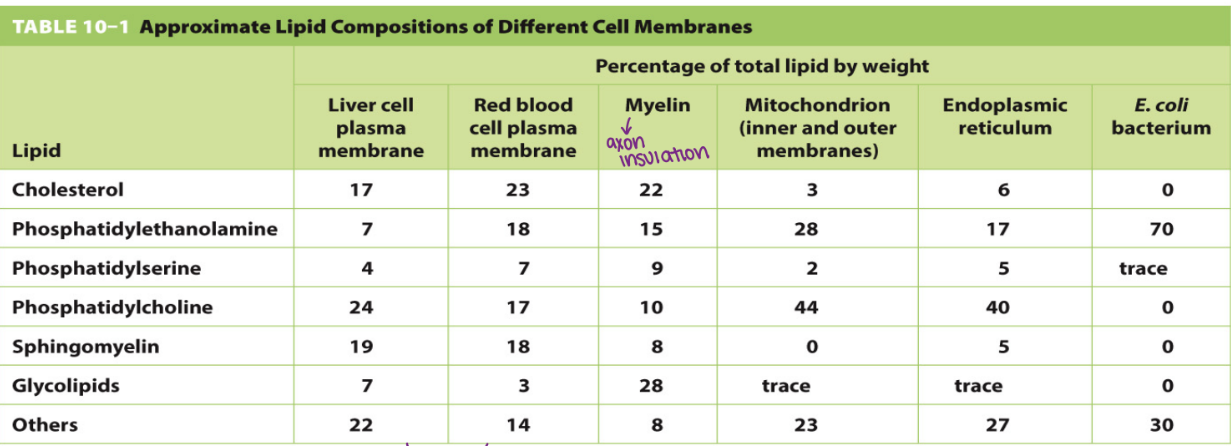
what conclusions can be derived based on the lipid compositions of different membranes?
cell membranes of different specialized cells have varying #s and compositions
the different cell membrane compositions are due to different environments and functions of the cell
eukaryotes are more complex than prokaryotes
no cholesterol present in the prokaryotic membrane

formation of lipid droplets
triacylglycerols and cholesterol esters accumulate in the droplet from the endoplasmic reticulum
contains a surrounding phospholipid monolayer with associated proteins embedded
appears as a form of exocytosis
lipids in the blood must be regulated to prevent accumulation/deposits
why is the asymmetry of the lipid bilayer functionally important?
for the conversion of extracellular signals into intracellular ones (ex: activation of protein kinase C requires negative charge for its activity)
protein binding → requires the presence of sugars on the ECM side
to distinguish between live and dead cells (apoptosis)
what are some characteristics of the components and orientation of the bilayer?
no negatively charged phospholipid heads on the extracellular space side
negatively charged amino acids are present on the cytosol side
glycolipids are on the extracellular space side
glycolipids are found on the ______ of all eukaryotic plasma membranes
surface
glycolipids
sugar containing lipids
asymmetrical distribution in the membrane→ found only on the outside
constitute 5% of lipids in outer monolayer
gangliosides are the most complex→ 40 types found; predominant in the nerve cells
ex: galactocerebroside, GM1 ganglioside, sialic acid (NANA)
the GM1 ganglioside is the most complex, commonly found in neurons
what are the functions of glycolipids?
protect membrane from harsh conditions (pH + digestive enzymes)
cell recognition
electrical conduction in nerves
cell surface receptors for bacterial toxin

different types of membrane proteins
1,2,5— transmembrane proteins (single/multipass; barrel)
3,4— exposed at only one side of the membrane
6— anchored to the cytosolic surface by an amphiphilic a-helix
7— attached via a covalent bound lipid chain (ex: prenyl group)
8— attached via an oligosaccharide linker (glycosylphosphatidylinositol, GPI anchor)
9,10— membrane associated proteins (peripheral membrane proteins)
barrel membrane proteins contain _______
B-pleated sheets
which membrane proteins are not physically bound to the membrane?
membrane associated/peripheral proteins
different types of lipid anchors
myristoyl anchor
amide linkage b/w terminal amino group and myristic acid
palmitoyl anchor
thioester linkage b/w cysteine and palmitic group
farnesyl anchor
thioether linkage b/w cysteine and prenyl group
in most transmembrane proteins, the polypeptide chain crosses the lipid bilayer in an _______ conformation
a-helical; the protein can be single or multi-pass
what is bacteriorhodopsin?
light sensitive protein in bacterial membrane

hydropathy index
score that measures the hydrophobicity and hydrophilicity of the membrane; hydrophobic regions are positive while hydrophilic regions are negative
aquaporin
specialized integral membrane proteins that serve as channels allowing water molecules to pass; contains 6 transmembrane domains
what does the formation of a multipass transmembrane protein do following its synthesis?
displaces some phospholipids in the membrane
hydrophilic amino acid regions assimilate together in the membrane
B-barrels
exist in prokaryotes and eukaryotes
forms large channels
the larger the barrel, the wider it is and the more space it occupies
different types of B-barrels
OmpA: receptor for a phage
OMPLA: lipase
porin: water transport
Fep A: transports iron ions across the bacterial outer membrane
single pass glycosylated transmembrane protein
contains inter and intrachain disulfide bonds, oligosaccharides, and sulfhydryl groups in the cytosol region
single pass transmembrane a helix
what is the purpose of the carbohydrate layer (glycocalyx) surrounding a plasma membrane?
protects the cell from harsh environments
what is the carbohydrate layer of the membrane composed of?
transmembrane glycoprotein
adsorbed glycoprotein
glycolipids
transmembrane proteoglycan
detergents ______ and ______ membrane proteins
solubilize; purify
what does it mean to be solubilized?
to be soluble in solution (removed from membrane)
critical (detergent) micelle concentration — CMC
minimum concentration of detergent in a solution at which molecules begin to self-assemble into micelles
below the CMC, detergent molecules dissolve independently or pack tightly on the liquid’s surface
above the CMC, surfactant requires a higher concentration of molecules in solution before micelles can be formed
indicates that the detergent is easier to remove from the system
what does a detergent like sodium dodecyl sulfate (SDS) appear like?
a fatty acid
what are the 3 common types of detergents?
sodium dodecyl sulfate (SDS)
triton X-100
B-octylglucoside
why are detergents important?
they can break membranes apart; hydrophobic ends of detergents bind to hydrophobic regions of membrane proteins and displace lipid molecules
detergent monomers w/ hydrophobic tails and hydrophilic heads can form detergent micelles
separates proteins from phospholipids in the bilayer by creating water-soluble protein-lipid-detergent complexes and micelles
how is the Na+/K+ pump isolated?
reconstituting functional membrane protein systems
detergent micelles and monomers are added to lipid bilayer
forms solubilized membrane proteins, lipid-detergent micelles
Na+/K+ pump is purified by adding phospholipids (mixed w/ detergent) and removing the detergent from it
bilayer is recreated w/ just the Na+/K+ pump incorporated into phospholipid vesicle
helps researchers study the function of the pump
many membrane proteins _____ in the plane of the membrane
diffuse;
in the presence of a human/mouse hybrid cell there is diffusion of plasma membrane proteins w/ time
lateral movement of mouse cell and human cell proteins
how is the rate of lateral diffusion of membrane fluorescent protein measured after photobleaching?
the fluorescence goes away in the bleached area
over recovery time, the fluorescence comes back due to protein movement
some intensity is reached, not the same as before bleach
cells can confine proteins and lipids to specific ______ w/in a membrane
domains
protein and lipid domains of membrane
localizes membrane proteins to 1 side; limiting its function
in a tight junction, 2 cells are attached and nothing (proteins) can go through them
protein domains in sperm
the components of a sperm are:
anterior head
posterior head
tail
each segment of the sperm was stained for a different type of protein
labelled w/ antibodies for specific proteins of a region
ex: egg penetrating proteins on the head, motor proteins on tail for mobility
four ways of restricting membrane protein movement
protein self-assembly into large aggregates
proteins are clumped together in specific parts of the cell
tethered by interactions w/ assemblies of macromolecules outside the cell
ex: bound to extracellular matrix protein such as collagen or fibroskeleton
tethered by interactions w/ assemblies of macromolecules inside the cell
ex: membrane protein is bound to a cytoskeleton protein
interact w/ proteins on the surface of another cell
protein complexes are stuck to one another on adjacent cells
what does the cytoskeleton provide to the membrane?
mechanical strength; resistance to compressive forces
restricts membrane protein diffusion
glycophorin
transmembrane protein that contains a junctional complex consisting of:
actin
spectrin/spectrin dimer
adducin
tropomyosin
3 ways in which membrane-bending proteins shape membranes
hydrophobic region of the protein can insert as a wedge into a lipid monolayer
curved surface of a protein can bind to lipid head groups and deform the membrane or stabilize curvature
protein binding causing lipid clustering→ large head groups→ thereby bending the membrane