EDSP 259 CTT #2
 Call Kai
 Learn
Learn Practice Test
 Spaced Repetition
 Match
Match Flashcards
 Knowt Play
1/25

There's no tags or description
Looks like no tags are added yet.
Name | Mastery | Learn | Test | Matching | Spaced | Call with Kai | Chat |
|---|
No analytics yet
Send a link to your students to track their progress
26 Terms

Standardized assessment tools
The most formal, yet decontextualized format.
Allows for meaningful comparison of performance and used as eligibility criteria in many school districts (-25%/1.5 SD below mean)
One option for direct assessment


Criterion referenced tools
NOT compared to a normed sample, but can determine whether the child can attain a certain level of performance/ proficiency.
Often used to keep track of language goals
One option for direct assessment

Screening Tools
Quick and simple test
Identify children who are at risk
Covers wide range of abilities
May be standardized, with large normative sample
Evaluation vs Assessment
Evaluation: It is documentation at one point in time 9e.g., initial, annual)
Assessment: It is continual, ongoing documentation over a period (e.g., ‘daily basis’)

Ages and Stages Questionnaire -3 (ASQ 3)
It is an all domain screener/parent report
children’s 1 to 5 ½ years
age specific questionnaires
Covers multiple areas:
communication
gross motor
fine motor
problem solving
personal-social


Developmental Assessment of Young Children (DAYC-2)
All domain screener [direct assessment]
For birth to 5 yrs and 11 months
cognitive
communication (recepetive/expressive)
social emotional
physical development (gross motor/fine motor)
adaptive behavior (toileting, feeding, dressing, taking personal responsibility)
![<p>All domain screener [direct assessment]</p><ul><li><p>For birth to 5 yrs and 11 months </p><ul><li><p>cognitive </p></li><li><p>communication (recepetive/expressive)</p></li><li><p>social emotional </p></li><li><p>physical development (gross motor/fine motor)</p></li><li><p>adaptive behavior (toileting, feeding, dressing, taking personal responsibility) </p></li></ul></li></ul><p></p>](https://assets.knowt.com/user-attachments/c6ead82c-7f07-4b66-9bed-cc01d97cfac5.jpg)

MacArthur-Bates CDI
A communication specific screening tool [parent questionnaire]
Children 8 to 37 months
8-18 months: words and gestures
16-30 months: words and sentences
30-37 months: CDI-III (measuring expressive vocabulary and grammar)
Adaptations (NOT TRANSLATIONS) available in many different languages
Must contact the adaptation developers
Mostly used for research purposes
![<p>A communication specific screening tool [parent questionnaire] </p><ul><li><p>Children 8 to 37 months </p><ul><li><p>8-18 months: words and gestures</p></li><li><p>16-30 months: words and sentences </p></li><li><p>30-37 months: CDI-III (measuring expressive vocabulary and grammar)</p></li></ul></li><li><p>Adaptations (NOT TRANSLATIONS) available in many different languages </p><ul><li><p>Must contact the adaptation developers</p></li><li><p>Mostly used for research purposes </p></li></ul></li></ul><p></p>](https://assets.knowt.com/user-attachments/34dbc511-9c49-4879-87f8-18e5fbbb3599.jpg)
What is Informal Play-Based Screenings?
most qualitative information compared to standardized tests
Asks parents permission if the session can be recorded for review at later point in time
May be slightly more time consuming than checklist and parent questionnaires but may give clinician better picture of the child’s abilities

Battelle Developmental Inventory -3
All domain standardized test
cognitive
adaptive skills'
communication (expressive/receptive)
motor
social emotional
Batelle early Academic Survey (3+)
mathematics and literacy
Birth- 7 years and 11 months
Usually administered by EI team
In the IFSP (used for initial evaluation)
Hawaii Early Learning profile (HELP)
All domain, but NOT standardized
sensory
cognitive
language
gross/fine motor
social'
self help
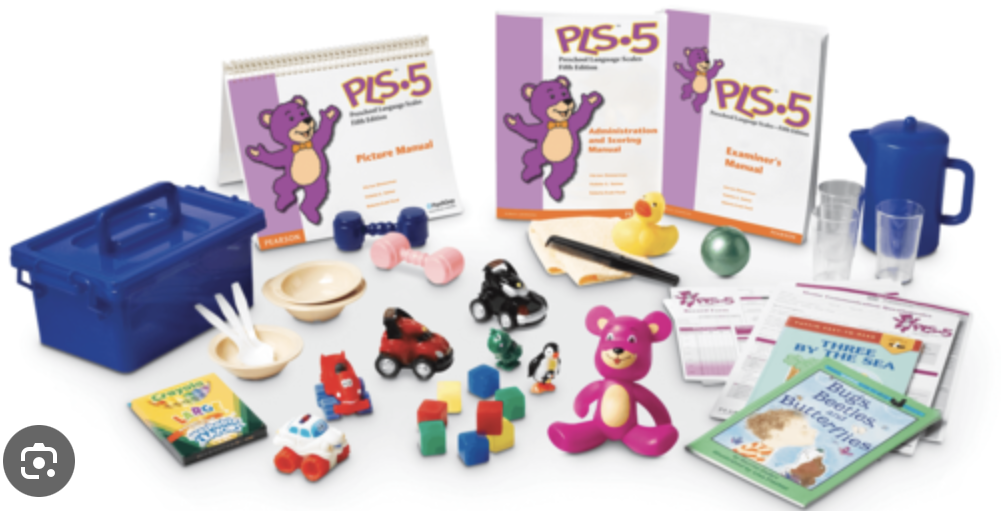
Preschool Language Scale 5 (PLS 5)
Receptive and Expressive Language test
understanding and producing morphemes, grammar, vocabulary, and concepts
articulation
pragmatics
Home communication questionnaire is also included in the kit for parent/caregiver input.


Receptive-Expressive Emergent Language Test-4 (REEL 4)
parent/caregiver interview
birth to 36 months
receptive and expressive language
supplementary vocabulary inventory test


What is Language Sampling?
It samples language production from different context
Play
conversation
narrative retell
expository
persuasion
Some language sample analysis tools give you standardized results
Lexical diversity (total # of different types of words/ total # of words)
Very useful for evaluating narrative discourse skills
Often uses in research

Assessing Linguistically Diverse Children In EI?
Dual Language learners:
Most prevalent w/ bi/multilingual children in EI
learn two or more languages simultaneously from infancy
Successive or sequential English lang learners
May be parents
Learn second language after first is established
SLPs must recognize that each child and family is an individual situation
SLPs document all words uttered, no matter the language, which may require interpretation from parents/caregivers

Assessing Linguistically Diverse Children: Alberta Language and Development Questionnaire (ALDeQ)
It is a parent report measure of the first language development of English language learners
can be used for research or clinical purposes
if you are unsure of the presence of language impairment due to bi/multilingualism, this instrument could be helpful in ID-ing children with language impairment
Assessing Linguistically Diverse Children: Language Experience and Proficiency Questionnaire (LEAP-Q)
created by bilingualism and psycholinguistics research laboratory in northwestern university
extensive research conducted with this tool
available in many languages!!!
What are consistent patterns of development in dual language learners?
initial period of word acquisition in one language
may become silent for a period of time to observe
may use common utterances
quickly able to keep 2 languages separate, but may still use 1st language in 2nd language setting
code mixing words in 2 languages
recognize when to use which language
may resort to alternate modes of communication
create sentences = functional communication
What is the Pragmatic Checklist?
Used for children from birth to 3 years
looks at perlocutionary (Unintentional communication)
looks at Illocutionary ( Intentional communications)
look sat nonverbal/ verbal behaviors
Developmental age: the most “P”
The ‘P’ is scored by:
present (observed at least 3x)
emerging (obs 1 or 2x)
not evidenced (-)
Need to be mindful that checklist is based on English norms

What is Language Sample Analysis?
Transcribes language sample and calculate MLU
Keep in mind: MLU of more than 4.0 no longer correlates with general language ability
May not be appropriate for younger children (1-2 yrs old) with emerging language
What is the approximate timeline of play development?
<18 mos: Not much pretend play. Brief demonstration that baby understands how to use the object
18-24 mos: pretend play is present on self
24-36 mos: Includes others in pretend play & multiple sequences of actions while engaging others
PRETEND PLAY IS THE KEY FOR LANGUAGE THERAPY AROUND THIS AGE
SPACE ASSESSMENT : Short Play and Communication Evaluation
it is criterion referenced
specific to the JASPER model for children with autism
It is played based but also has a format and structures that’s needs to be followed [might not work for all families because it could seem rigid]

JASPER: Choosing toys
see play skill before targeting
the goal now is to increase that play skill


JASPER: Simple Play
It involves:
Indiscriminate acts: exploring everything in the same way [mouthing, banging, spinning etc]
discriminate acts: simple purposeful act [push a button, roll a car]
take apart: separate items that are combined
![<p>It involves:</p><ul><li><p><em><mark data-color="blue" style="background-color: blue; color: inherit;">Indiscriminate acts:</mark> </em>exploring everything in the same way [mouthing, banging, spinning etc]</p></li><li><p><em><mark data-color="#d999ed" style="background-color: rgb(217, 153, 237); color: inherit;">discriminate acts</mark>: </em>simple purposeful act [push a button, roll a car]</p></li><li><p><em><mark data-color="green" style="background-color: green; color: inherit;">take apart:</mark> </em>separate items that are combined</p></li></ul><p></p>](https://assets.knowt.com/user-attachments/75cb78ca-18b4-4e7f-97c0-5ff0d546406f.jpg)

JASPER: Combination Play
presentation: Put together objects in designated spot [velcro pizza]
general: Put together objects in any way [stacking]
![<ul><li><p><em><mark data-color="blue" style="background-color: blue; color: inherit;">presentation:</mark> </em>Put together objects in designated spot [velcro pizza]</p></li><li><p><em><mark data-color="green" style="background-color: green; color: inherit;">general:</mark> </em>Put together objects in any way [stacking]</p></li></ul><p></p>](https://assets.knowt.com/user-attachments/6c3a0460-90bf-466d-a3f1-898a57e7643d.jpg)

JASPER: Pre-symbolic acts and combinations
play takes on a ‘pretend’ quality, but play is NOT yet symbolic
Pretend self: Take familiar actions towards self [eating, drinking etc]
Physical combination: Put items together to make something specific [building a house]
Child as agent: extend familiar action to a figure [putting a sponge on the baby to give it a bath
Conventional combination: Combine things that go together in real life [putting a chair to a table, blanket on a bed]
Single Scheme Sequence: Extend one action to multiple figures [brush two babies hair]
![<p><mark data-color="yellow" style="background-color: yellow; color: inherit;">play takes on a ‘pretend’ quality, but play is NOT yet symbolic</mark></p><p></p><ul><li><p><em><mark data-color="#ff7777" style="background-color: rgb(255, 119, 119); color: inherit;">Pretend self:</mark> </em>Take familiar actions towards self [eating, drinking etc]</p></li><li><p><em><mark data-color="green" style="background-color: green; color: inherit;">Physical combination</mark>: </em>Put items together to make something specific [building a house]</p></li><li><p><em><mark data-color="red" style="background-color: red; color: inherit;">Child as agent: </mark></em>extend familiar action to a figure [putting a sponge on the baby to give it a bath</p></li><li><p><em><mark data-color="#aee3e5" style="background-color: rgb(174, 227, 229); color: inherit;">Conventional combination: </mark></em>Combine things that go together in real life [putting a chair to a table, blanket on a bed]</p></li><li><p><em><mark data-color="#f289ec" style="background-color: rgb(242, 137, 236); color: inherit;">Single Scheme Sequence: </mark></em>Extend one action to multiple figures [brush two babies hair]</p></li></ul><p></p>](https://assets.knowt.com/user-attachments/bbf839e5-4e7b-4cd0-a428-7baedb72428c.jpg)

JASPER: Symbolic Play
Involves the representational use of objects
Substitution with object: Pretend one object is something else [a lego is a cellphone]
Substitution without object: Pretend something is there when its not [using a pretend bandaid]
Doll as agent: Pretend doll has life; doll performs action [snoring noises pretending doll is asleep]
Multi-scheme sequence: Doll performs multiple actions [Doll wakes up, brush hair, teeth etc]
Sociodramatic play: Enact a familiar role [child is teacher]
Thematic play: Enact a fantasy role [ninja etc]
![<p>Involves the <u>representational </u>use of objects</p><p></p><ul><li><p><em><mark data-color="yellow" style="background-color: yellow; color: inherit;">Substitution with object:</mark> </em>Pretend one object is something else [a lego is a cellphone]</p></li><li><p><em><mark data-color="blue" style="background-color: blue; color: inherit;">Substitution without object:</mark> </em>Pretend something is there when its not [using a pretend bandaid]</p></li><li><p><em><mark data-color="red" style="background-color: red; color: inherit;">Doll as agent:</mark> </em>Pretend doll has life; doll performs action [snoring noises pretending doll is asleep]</p></li><li><p><em><mark data-color="purple" style="background-color: purple; color: inherit;">Multi-scheme sequence:</mark> </em>Doll performs multiple actions [Doll wakes up, brush hair, teeth etc]</p></li><li><p><em><mark data-color="green" style="background-color: green; color: inherit;">Sociodramatic play:</mark> </em>Enact a familiar role [child is teacher]</p></li><li><p><em><mark data-color="#f6aff3" style="background-color: rgb(246, 175, 243); color: inherit;">Thematic play:</mark> </em>Enact a fantasy role [ninja etc]</p></li></ul><p></p>](https://assets.knowt.com/user-attachments/705b7371-1929-4f34-a812-52164841e5a9.jpg)