Week 11c — Emotion in Motivation (Nov 20)
 Call Kai
 Learn
 Practice Test
 Spaced Repetition
 Match
 Flashcards
 Knowt Play
1/29

There's no tags or description
Looks like no tags are added yet.
30 Terms
What is motivation?
Motivation is a process that energizes, directs, and maintains behavior.
What two functions does emotion serve in motivation?
Emotion provides information about the world and is itself an objective toward which people strive, under the hedonic principle of seeking pleasure and avoiding pain.
What is Capgras syndrome?
Capgras syndrome is a delusion that loved ones have been replaced by replicants or robots, associated with neurological dysfunction in limbic (affective) and prefrontal areas and damage to the connections between them, so the person looks right but does not feel familiar.

What did the skin conductance study find in Capgras syndrome? [Figure: capgras-scr.png]
Normal and psychiatric controls show a larger skin conductance response to familiar than unfamiliar faces, but Capgras patients show no familiar–unfamiliar difference, while their skin conductance response to repeated tones habituates normally, so the deficit is specific to face familiarity.
What double dissociation links Capgras syndrome and prosopagnosia?
Prosopagnosia patients cannot overtly recognize faces but show an intact covert skin conductance response, while Capgras patients overtly recognize faces but lack the covert emotional response, implying separate overt and covert routes from cortex to the limbic system.
How does mood provide information about the world?
People use their moods as information, reporting better life satisfaction on sunny than rainy days and believing they have a higher chance of winning the lottery when in a good mood.
What is the "emotional oracle effect" (Pham et al., 2012)?
Across eight studies, people with high trust in their feelings predicted future events better than people with low trust in their feelings.
How was trust in feelings manipulated?
Participants recalled either 2 situations (high trust — easy to recall) or 10 situations (low trust — hard to recall) in which they trusted their feelings and were right, and the manipulation did not change mood, confidence, or task engagement.
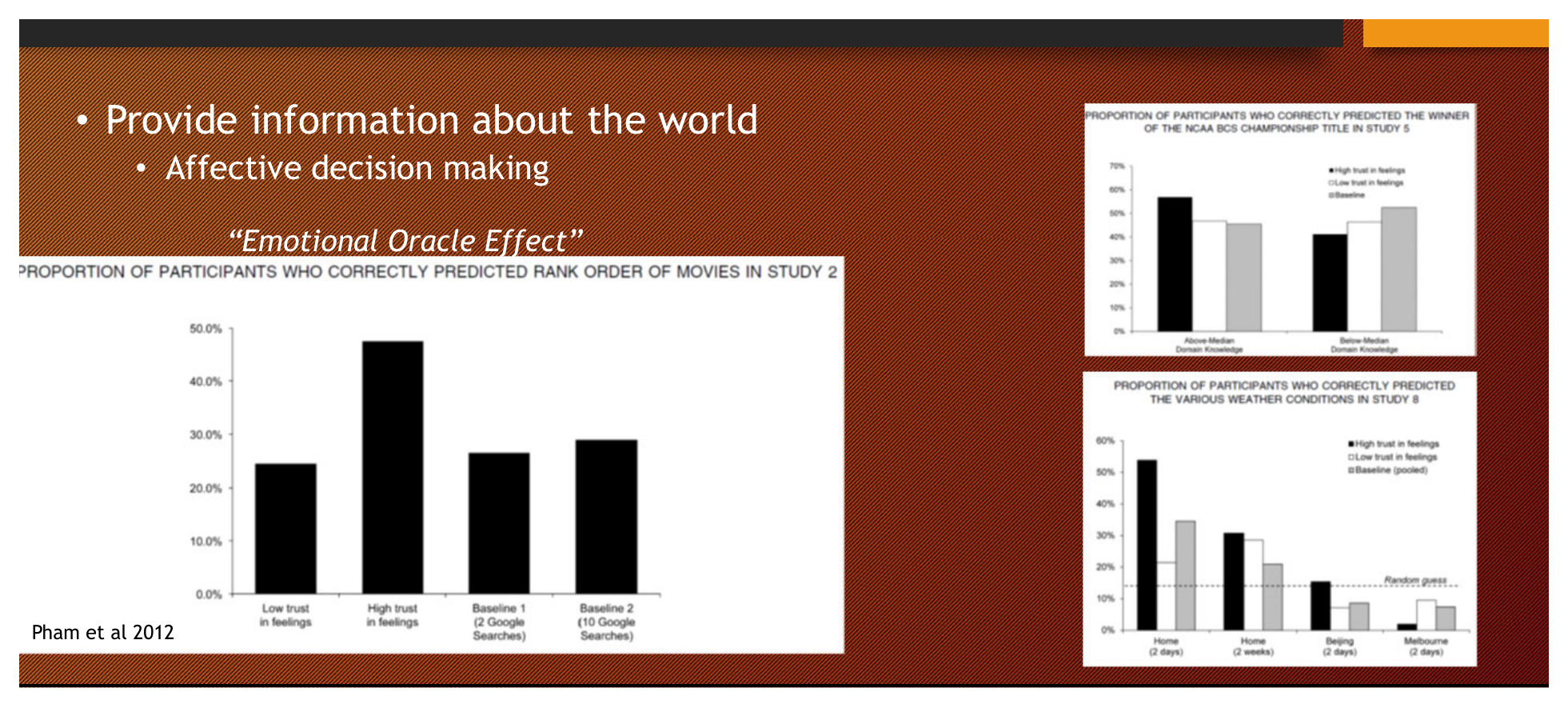
What did the movie-prediction study find? [Figure: emotional-oracle.png]
High-trust participants correctly predicted the rank order of three new movies ~47% of the time vs. ~25% for low-trust participants, while the Google-search control groups (~27% and ~29%) did not differ.
When does trusting your feelings help prediction?
Trusting your feelings helps only with some domain knowledge (college-football predictions improved only for above-median-knowledge fans) and only for predictable, near-term, familiar events (weather 2 days out at home, not 2 weeks out or in Beijing or Melbourne).

What was the car-choice study (Mikels et al., 2011)? [Figure: mikels-car-choice.png]
Participants heard attributes for four cars — one best (75% positive attributes), two middling (50%), one poor (25%) — and then chose a car, while focusing either on their feelings about each attribute or on remembering the details.
What did the first car-choice experiment find?
With 12 attributes (complex), feeling-focused participants chose the best car ~68% of the time vs. ~27% for detail-focused participants, while with 4 attributes (simple) the two groups did not differ (~32% vs. ~47%).
What did the second car-choice experiment find?
After a 3-minute delay, deliberating helped detail-focused participants a little (~58% chose the best car vs. ~47% after distraction), but feeling-focused participants stayed good after distraction (~58%) and got worse after deliberating (~27%), so affective strategies can beat deliberation for complex choices.
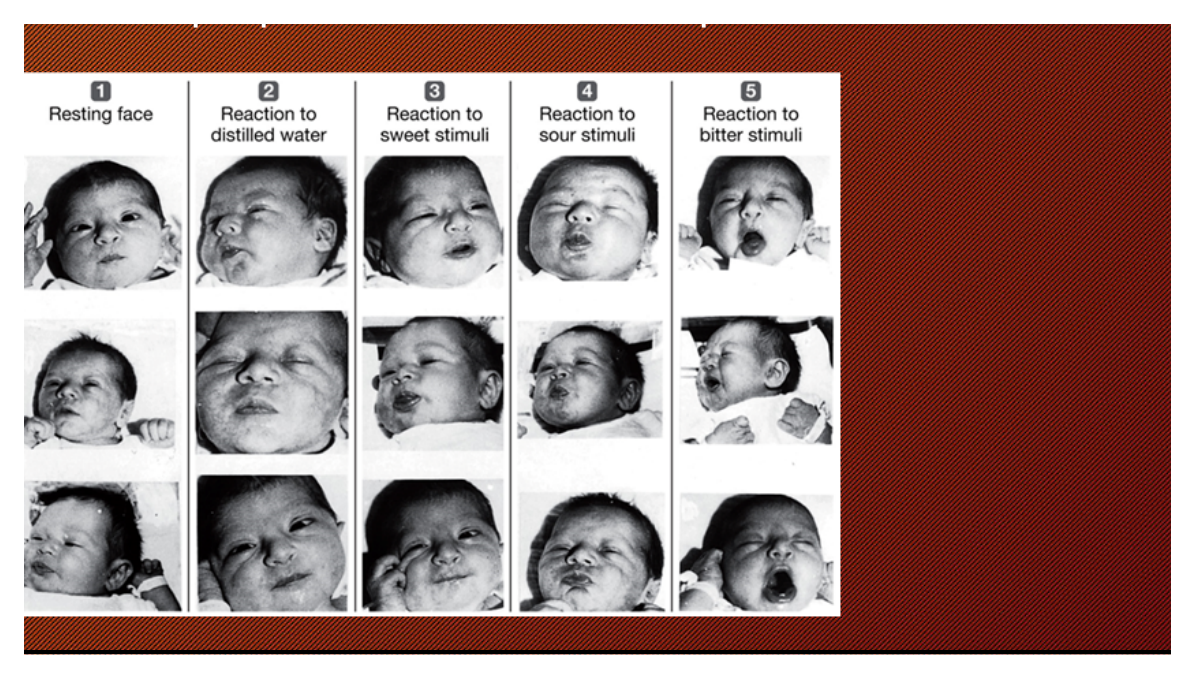
What is the hedonic principle? [Figure: infant-faces.png]
The hedonic principle is that all people are motivated to experience pleasure and avoid pain, visible in infants' obvious pleasure at sweet tastes and disgust at sour and bitter ones, as if emotion were a gauge from bad to good that we try to push toward good.
How does delayed gratification fit the hedonic principle?
Delayed gratification means doing something unpleasant now because it will nudge the emotional gauge toward good in the future, as with going to medical or graduate school.
What is the evolutionary model of motivation?
Some motivational systems evolved because the behaviors they promote supported survival or reproduction, with major motives including hunger, thirst, body-temperature regulation, oxygen, and sex.

What is drive reduction, and what is the difference between a need and a drive? [Figure: drive-reduction.png]
Drive reduction says a depleted physiological system drives us to restore balance, where a need is a biological or social deficiency (e.g. lack of food) and a drive is the psychological state that motivates action (e.g. hunger) — and it is the reduction of the drive, not the food itself, that is rewarding.
What is homeostasis?
Homeostasis is physiological equilibrium or balance around an optimal set point, so movement away from the set point motivates corrective action.

What is the Yerkes–Dodson law? [Figure: yerkes-dodson-curve.png]
The Yerkes–Dodson law says moderate levels of arousal lead to optimal performance, while too little arousal (weak performance) or too much arousal (impaired performance, e.g. from strong anxiety) is suboptimal.
What did the sensory-deprivation studies find?
In 1950s sensory-deprivation studies people could not remain in isolation for more than a couple of days even for high monetary rewards, developing hallucinations and concentration difficulties — a "pathology of boredom" with implications for solitary confinement.
What is flow (Csíkszentmihályi, 1990)?
Flow is an optimal state of consciousness where we feel our best and perform our best, when skills are fully engaged in overcoming a challenge that is just manageable, and the optimal arousal level depends on the person and the task (pupils dilate as a task gets harder).

What is Maslow's hierarchy of needs? [Figure: maslow-pyramid.png]
Maslow's hierarchy runs from physiological needs (hunger, thirst, warmth, air, sleep) through safety, belonging and love, and esteem to self-actualization, with lower needs supposedly satisfied before higher ones are felt.
Why is Maslow's hierarchy questioned?
There is very little empirical support for Maslow's hierarchy despite its popularity in education and business, and counterexamples like hunger strikes and monks who skip lower needs for higher ones show the ranking is not that straightforward.
What is the difference between intrinsic and extrinsic motivation?
Intrinsic motivation is doing an action because it is itself rewarding (enjoyment, mastery, autonomy, purpose), while extrinsic motivation is doing it for an outside reward or punishment, and extrinsic rewards can undermine intrinsic motivation.

What did the daycare fine study find (Gneezy & Rustichini, 2000)? [Figure: daycare-fine.png]
After a fine for late pickup was imposed at week 4 in 6 of 10 Israeli daycare centers, late arrivals rose from ~8 to ~20 per week and stayed high (~19) even after the fine was removed at week 16, while control centers stayed at ~8–12, because the fine turned lateness from a guilt-inducing favor into a purchasable service.
What is delayed gratification, and what did the marshmallow experiment show?
Delayed gratification is engaging in behavior that brings greater rewards in the future, and 4-year-olds who waited for two marshmallows instead of eating one were judged ten years later to be more intelligent, more socially competent, and to have higher SAT scores.
What are approach and avoidance motivation?
Approach motivation is a motivation to experience positive outcomes (promotion focus), avoidance motivation is a motivation not to experience negative outcomes (prevention focus), and avoidance tends to be more powerful.
What is the BIS/BAS scale?
The BIS/BAS scale is a self-report measure of approach vs. avoidance tendency, where high-approach people are happier when rewarded ("When I get something I want, I feel excited and energized") and high-avoidance people are more anxious when threatened ("Criticism or scolding hurts me quite a bit").
What did the anagram framing study find?
Promotion-focused people performed better when told they would get $4 plus a $1 bonus for 90% of the words, while prevention-focused people performed better when told they would get $5 but lose $1 for missing 90%, showing identical cost–benefit outcomes differ by framing.
How does motivation change with aging?
With aging there is a tendency to be more avoidance-motivated, according to a small literature, which may affect memory performance in approach- vs. avoidance-framed tasks.