NPB 101: Respiratory System 2: Lec 28- Compliance and Exchange
 Call Kai
 Learn
 Practice Test
 Spaced Repetition
 Match
 Flashcards
 Knowt Play
1/29

There's no tags or description
Looks like no tags are added yet.
30 Terms
Asthma
Episodes of airway smooth muscle excessive contraction
Resistance increases, producing “wheezing” sound
Generally associated w/ inflammation in airways
What therapies would we use to treat Asthma?
Steroids → Reduce inflammatory response
Bronchodilators → Medication that relaxes smooth muscles around airway (bronchi)
Epinephrine → Relaxes bronchial smooth muscle (bronchodilation via β₂ receptors)
Lung Compliance
Opposite of stiffness
Less stiff → more compliant → easy to stretch out
More stiff → less compliant
Lung Compliance Equation
Compliance = Δ Lung Volume / Δ (Palv - Pip) = Δ V / ΔPtp
Compliance = Change in lung volume / change in transpulmonary pressure
Lung Compliance depends on:
Connective tissues → Holding capillaries to alveoli, has to stretch out
Surface tension within alveoli
Excessive Compliance
Reduces elastic recoil → Inflates lungs too much, can cause rupture
Low Compliance
Increases required work for breathing → Big changes in transpulmonary pressure in order to move same amount of air
What happens in pulmonary fibrosis?
Pulmonary fibrosis → Build up of connective tissues , more glue = harder to inflate
Decreased compliance → Lungs become stiffer = Harder to inflate them (work harder to breathe)
Surfactant
Type II alveolar cells secrete detergent like substance surfactant
Reduces cohesive forces bw H2O molecules on the alveolar surface
Surfactant effect on Surface Tension
Surfactant thus lowers surface tension → Increases lung compliance
Interrupt interaction bw cells / reduce surface tension → increase compliance → easier to expand lung
Pathway of Pulmonary Surfactant
Lowers surface tension of H2O layer at alveolar surface → increases lung compliance → easier for lungs to expand
Law of Laplace
P = 2T / r
P = Pressure
T = Surface tension
r = Radius
Smaller alveoli will collapse into larger alveoli
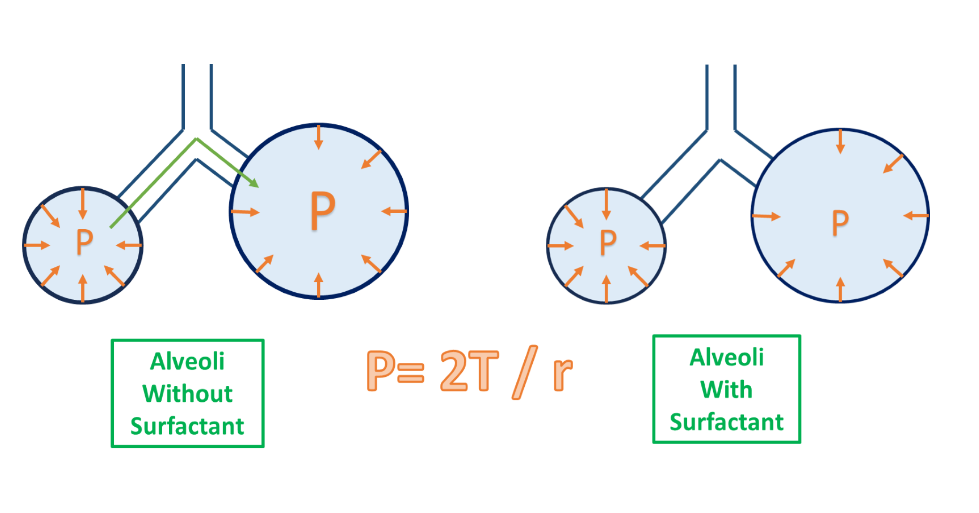
Surfactant / Law of Laplace
Surfactant dynamically lowers surface tension in small alveoli
Prevents small alveoli from collapsing , no uncontrolled expansion → helps stabilize smaller alveoli
Important facts ab Pulmonary Surfactant
Mixture of phospholipids / protein
Secreted by type II alveolar cells
Lowers surface tension of H2O → increases lung compliance → easier for lungs to expand
Effect is greater in smaller alveoli → stabilizes the alveoli
Production of Surfactant in Fetal Lung
Production occurs in late gestation , stimulated by the increase in cortisol secretion that occurs then
Why do premature infants often need to be intubated?
Born before late gestation → surfactant not produced
Surfactant absence → low compliance → more stiffness = need more pressure in order to inflate
Diaphragm muscles not strong enough to combat low compliance → need intubation until they can start making low surfactant
Lung Volumes and Capacity
Tidal Volume → Amount of volume that goes in/out each breathe
Inspiratory reserve volume → Maximum possible inspiration (air in)
Expiratory reserve volume → Maximum voluntary expiration (air out)
Vital Capacity → How much air you can move in/out in total (can adapt based on contraction of skeletal muscles)
Minute Ventilation (Ve)
Ve = TV * f → Tidal volume x respiratory rate
f = (Respiratory rate)
Typically mL/min
Is it more effective to breathe twice as fast or twice as deep?
Twice as deep → End goal : Deliver more O2
Dead Space (Vd)
Volume of inspired air that isn’t involved in gas exchange
Alveolar dead space
Some air gets stuck in conducting zone (mouth/nose, trachea, bronchi)
Air that doesn’t participate in exchange, just stays in conducting zone and leaks during exhalation
Dead Space Formula
Alveolar ventilation = ( Tidal volume - Dead Space) x Respiratory rate
VA (mL/ min) = (Vt (mL/breathe) - VD (mL/breathe) ) x f
Substracts the anatomical dead space (airways like trachea/bronchi where no gas exchange occurs.
How is alveolar ventilation different than minute ventilation?
Minute Ventilation
Total volume of air inhaled or exhaled in one minute. Measures all air moving in/out of respiratory system, including anatomical dead space (Vd)
Alveolar Ventilation
Volume of air that actually reaches alveoli per minute to participate in gas exchange. Subtracts anatomical dead space (where no gas exchange occurs)
If you had a long enough snorkel could you go 10 meters under water?
No!
The snorkel becomes dead space, conducting zone extends.
Too long = more dead space → no air reaching alveoli to participate in gas exchange
If you dilate exchange part, conducting zone increases and decreases ability to exchange
Partial Pressure
Independent pressure exerted by a particular gas contained within a mixture of gases
Directly proportional to percentage of that gas in the total air mixture
Total atm. pressure = 760 mmHg
Partial pressure of N2 = 600 mmHg (79% N2)
Partial pressure of O2 = 160 mmHg (21% O2 )
Is there less percentage of oxygen molecules in the air on top of Mt. Everest ?
Pressure drops, air pressure is lower → % of O2 molecules ab the same → partial pressure decreases
O2 and CO2 Exchange
O2 diffuses from alveoli to blood
Change in pressure = 65 mmHg
O2 diffuses from blood to tissues
CO2 diffuses from tissue to blood
CO2 diffuses from blood to alveoli
Pressure = 6 mmHg

Pulmonary Edema
Fluid fills the lungs
Limit ability of O2 to diffuse across → not able to get as much air into the blood
Which way does the curve shift during exercise when cardiac output increases?
Right → Oxygenated later on, flowing through a lot faster than it can actually use
Hypoventilation
Underbreathing, Breathe too slowly or too shallowly → Taking in less O2 than you are using
Retains CO2 → drop in blood pH → often low blood oxygen
Hyperventilation
Overbreathing, Taking in more O2 than body’s metabolic demand
Alveolar partial pressure increases, gets rid of more CO2 → low blood CO2 and rise in blood pH