Chemistry self made flashcards
 Call Kai
 Learn
 Practice Test
 Spaced Repetition
 Match
 Flashcards
 Knowt Play
1/57

There's no tags or description
Looks like no tags are added yet.
58 Terms
what is a rxn order and what effect do different rxn orders have on ROR?
rxn orders (i.e. m & n) demonstrate the rate of rxn’s dependance on the concentration of the respective reactant.
If conc. of given reactant is doubled:
Zeroth (n = 0) : Rate is unaffected (2[A]0 = 1 ∴ 𝒙 ⨉ 1 = 𝒙)
First (n = 1) : Rate is doubled
Second (n = 2) : Rate quadruples
Third (n = 3) : 8 ⨉ Rate
(2^n)
How do you find the overall rxn order?
Sum the rate law powers
What is the rate law?
rate of rxn = k[A]m[B]n
k = rate constant
[A] & [B] are reactant concentrations
m & n are rxn orders
Rate law k units?
rearrange for k and solve units, mol L-1 = M
0th : mol L-1 s-1
1st : s-1
2nd : L mol-1 s-1
3rd : L2 mol-2 s-1
What graphs respond to what orders of rxn?
0th : Linear, -kt
1st : Natural log, ln([A]) - kt
2nd : Inverse, 1/[A] + kt
How to do half life questions?
Solve decay question for k (k = (ln(2)/thalf)
Amount left = initial amount ⨉ e-k(t)
At = Aie-kt
What is the Arrhenius equation and what does it mean?
how does the rate constant change w.r.t to activation energy, EA, and Temperature, T.
(R is gas constant)

What is a complex rxn? (Hint: “and ∴ a elementary rxn”)
A complex rxn is a rxn that takes a path of elementary rxn’s to reach its final products
n & m if a rxn is xA + yB → zC
n, m = x, y
e.g. 3A + 2B gives the rate law k[A]3[B]2
What’s the difference between a catalyst and a intermediate?
A catalyst (X) is used in one part of the reaction then reproduced later
An intermediate (Y) is produced in one part of a rxn then is later used up

What is a rate determining step?
The slowest of the elementary reactions which therefore determines the rate at which the reaction will occur.
(Think of a pipe with sections with different sized holes)
In the Beer-Lambert Law (A = ε c l), what are the name and generally used units for the symbol ε?
Molar absorptivity with units L mol-1 cm-1
What is the Beer-Lambert law?
The Beer–Lambert Law states that light absorbance is directly proportional to both the concentration of a solution and the path length the light travels through it. Expressed as A = ε ⋅ c ⋅ l
What is an equilibrium constant?
It tells us which side equilibrium is favoured (products over reactants)
K >> 1 | Products favoured |
K << 1 | Reactants favoured |
K ≈ 1 | Neither strongly favoured |

What is the reaction Quotient and how is it different from the equilibrium ȼ?
Reaction quotient gives a value for any concentration of reactants/products in a rxn which when compared with the known eq. ȼ will tell us if the rxn is forward or backwards.

What are the activities used in equalibrium equations?
pure liquid = 1
pure solid = 1
gas = P(paskal) / 1 bar (100 000Pa)
What is the condition for Kc = Kp
Equilibrium constant for concentrations and partial pressures are equal when there is no change in the number of moles of gas in the overall rxn
What is Kp?
Kp is the equalibrium constant calculated with partial pressures (same eq as Kc but w/ pressure of gasses instead of conc.)
What happens if the pressure a rxn is happening at changes? (Le Châtelier’s)
The direction with fewer gaseous particles is favoured
What happens if the temperature of the rxn environment is decreased? (Le Châtelier’s)
The more exothermic direction is favoured
What happens if the Volume of the rxn environment is decreased?
the direction with the fewer gaseous particles is favoured
Rxn changes effects on K?
Rvs rxn: 1/K (Inverse)
Multiply coefficents by n: K^n
Adding rxn’s: multiply K’s together
What is the 3rd law of thermodynamics? (For CHEM111)
The entropy of a perfect crystal at 0K is 0.
∆Ssurroundings = -∆H/T = Sf - Si
∆rS = ∑viS(products) - ∑viS(reactants), where vi is the stoichiometric coefficient
e.g. A(g) + 3B(g) → 2C(g), gives ∆rS = 2Sc - (SA + 3SB)
What is G?
Gibbs free energy, which is a concept that determines the thermodynamic favourability of a rxn and which direction it will evolve, i.e. whether a rxn is favourable or not w/ ȼ: T, P
What are the formulae for G?
∆G = -T/∆Suniverse
∆G = ∆H - T∆S
What are the directionalities related to G?
At constant Temp. and Pressure

How do you solve dilution questions?
Given C1, V1, and V2 you can use C1V1 = C2V2 to find the new concentration. Do for each step of the dilution process.
OR
Shortcut by multiplying by dilution factors i.e. 10ml of a / 100ml flask: 10/100
Cf = Ci (Dn)
Light spectrum values:
<400nm Ultraviolet UV
400 - 700nm Visible spectrum
700nm + Infrared (IR)
1mm - 1m Microwave
Big = Radiowave
What is a catalyst?
A catalyst provides an alternative rxn pathway with a lower Ea, increasing the rxn rate of both fwd AND rvs rxn’s.
K DOES NOT shift
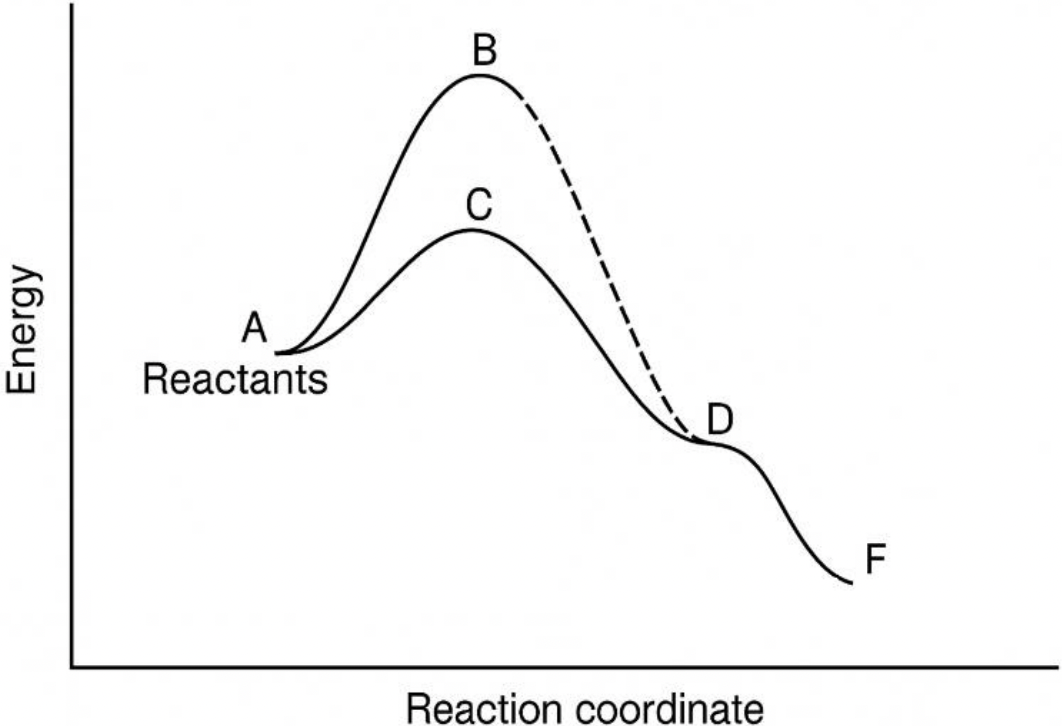
What are A, B, C, D and F?
A: Starting energy (reactants)
B&C: Transition states (uncatalysed and catalysed)
D: Intermediate
F: Final energy (products)
What is generally the rate determining step?
The step with the highest activation energy (increase in energy with previous step) generally takes the longest to fully react.
What is a psudo-nth-order rate law?
When one of the reactants are in comparatively significant excess then the value can be ignored in the rate law
What do you need to find the Rate of rxn w/ Temperature change.
molar ∆rH of the rxn and Q = mcsol∆T
0th order rxn’s final conc. questions approch?
recognise conc. change pattern and extrapolate
Why does temperature increase reaction rate?
Think of the Arrhenius equation, larger T results in less negative exponent and thus higher k in the rate law.
What is heterogeneous catalysis?
The catalyst is a different state (aq, s, l, g) from reactants
Homogeneous is where they are the same state
What is an enzyme?
A biological catlyst
Weak-acid/base equilibrium constants
[H+] = [A-] or [OH-] = [A+]
U and S values for a gas expansion into a insulated vacuum volume?
U = 0 (no ∆T)
Ssys > 0
How can you determine the sign for entropy in a rxn?
Which side has more disordered state moles.
Why can’t you determine the spontaneity of a rxn off solely entropy?
Because spontaneity is determined by Gibbs energy, ∆G = ∆H - T∆S and the rxn will only be spontaneous if G is negative
What are the laws of thermodynamics?
1st : Energy is conserved
2nd: The entropy of an isolated system can’t decrease
3rd : A perfect crystal has zero entropy at 0 K
How is molar entropy related to molecule size?
Smaller molecules have smaller entropy’s because they have less ways to store energy

What is the sign of ∆G?
Positive, Gf - Gi > 0
(Right is higher than left)
Why does water form a meniscus?
Because the H2O forms Hydrogen bonds with the glass
Adding a salt to water does what to its boiling point?
Increases it
Bonds breaking is… endo/exothermic?
Endothermic
Forming bonds is endo/exothermic?
Exothermic
What happens when water evaporates from a saturated salt solution containing excess solid, at constant temperature?
More solid precipitates, but the equilibrium ion concentrations stay the same because (Ksp) is constant.
How do you approach Ksp questions for ZY given solubility of XY questions
X = Z = Ksp/[Y]

What is a conjogate acid/base?
NH4+ is the conjugate acid of NH3

How do you get pH from pKa and conc. of acid/base-conjugatebase/acid pair?

What is Kw?
1 × 10-14 = [OH-][H3O+]
How do you prepare a buffer with pH = pKa using a weak acid and NaOH?
Add enough NaOH to neutralise half the weak acid, producing equal amounts of HA and A-
How do you find pKa from Ka?
pKa = -log(Ka)
∴ Ka = 10-pKa
What does pKa actually represent?
intra vs intermolecular bonds: