W5 Rigid Lenses Fitting and Measurement
 Call Kai
 Learn
 Practice Test
 Spaced Repetition
 Match
 Flashcards
 Knowt Play
1/25

There's no tags or description
Looks like no tags are added yet.
26 Terms
What is the process of rigid CL fitting?
Px selection
Preliminary measurements
Diagnostic CL’s
Diagnostic CL’s selection
Fitting assessment
CL ordering
What rule should be followed when choosing TD?
TD should be 2mm smaller than HVID
Usually in range 8.50-10.50mm
What size is BOZD?
1mm or larger than pupil in average illumination
Narrow peripheral curve width hard to measure
What do ill-fitting corneal lens cause?
Alters corneal integrity
Changes corneal physiology
Distorts corneal surface
Alters corneal curvature
Changes eye refractive status
What are optimum characteristics for a patient?
Highly motivated- will adapt to CL quicker
Moderate to high rx- desire for an alternative to glasses is higher
Corneal toricity- px with significant against the rule corneal toricity have less success with spherical CL due to CL decentration and residual astigmatism
Myopic control- GP CL have been shown to stabilise myopic rx
What preliminary measurements are taken?
Keratometry reading
Corneal diameter (HVID)
Lid characteristics
Pupil size
Spectacle rx
Ocular health
What’s the TD and HVID?
CL total diameter will be 2.3mm-2.5mm less than horizontal visible iris diameter
How do we assess lid characteristics?
Position of upper and lower lids
Positions where the lid margins cross the upper & lower limbus
Inter-palpebral aperture
How do we measure pupil size?
Size of pupil in both bright and dim illumination should be measured
Dilated pupil size is important for selection of appropriate BOZD
If optical zone is too small, visual disturbances can occur
Which factors dictate the suitability of the chosen BOZR?
Corneal toricity
BOZD
Dynamic fitting characteristics
Do we use a smaller or larger BOZD?
Smaller BOZD for steeper corneas
Larger BOZD for flatter corneas
Whats the shape of plus power CL’s?
0.5mm larger than average to help maintain good centration- CL must be produced with minimum thickness where possible to reduce unnecessary weight
What happens to a CL with a high BVP?
> +8.00DS CL’s are made larger than average to allow for adequate lenticulation of the front peripheral design
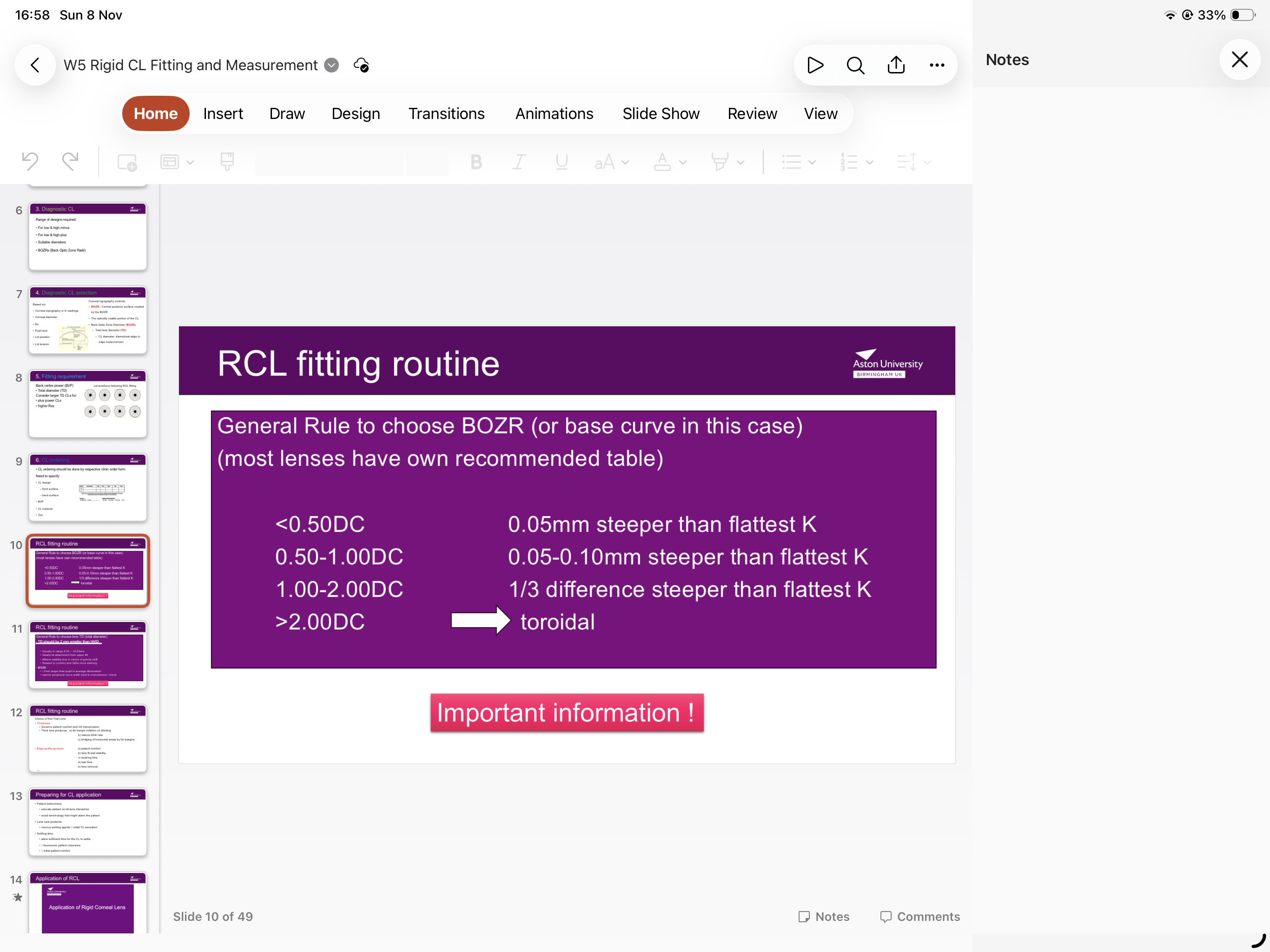
Whats the rule with BOZR regarding cyl power?
Less than 0.50DC- 0.05mm steeper than flattest K
0.50 to 1.00DC- 0.05mm to 0.1mm steeper than flattest K
1.00DC to 2.00DC- 1/3 difference steeper than flattest K
Bigger than 2.00DC- toroidal
What is lens settling time?
Time taken for watering to subside- perhaps 10 mins
How do we grade comfort?
1 is incredibly uncomfortable, 10 is very comfortable
How is coverage graded?
From -2 to +2
If lens is 1mm smaller than HVID then coverage is 0
If lens is between 0.5mm smaller than HVID then coverage is +1
If lens is the size of the limbus then coverage is +2
If lens is 1.5mm smaller than HVID then coverage is -1
Is lens is 2mm smaller than or greater than HVID then coverage is -2

What is centration?
If lens edges are contained within the limbus and neither edge is touching limbus ,this is C
If lens crosses the pupil in dim light conditions, this is P
If lens crosses the limbus, this is L
What falls under dynamic fit?
Position and movement
How do we assess movement?
Reduce slit size (2-12mm)
Observe lens movement when px blinks
What is the movement inter-blink?
If lens moves more than 2mm, this is in excess and we write +2
If lens moves 1.6mm-2mm, this is +1
If lens moves 1mm-1.5mm, this is optimal and we write 0
If lens moves 0.5mm-1mm, we write -1
If lens moves less than 0.5mm, we write -2

What do central zone gradings mean?
-2: no fluorescein bearing, no tear film, very dark zone and background tissue very visible
-1: faint fluorescein pooling
0: optimal- medium fluorescein pooling
+1: dark fluorescein pooling
+2: significant fluorescein pooling, background tissue not visible

What is the grading for edge zone or clearance?
+2: band is bigger than 2mm
+1: roughly 1.5mm band
0: roughly 1mm band
-1: 0.5mm band (optimal?)
-2: no visible band
Why might alterations to the edge profile be done?
Producing an edge with a well-rounded, centrally, or posteriorly located apex for maximum comfort
A thin edge causes less CL-lid interaction, increasing comfort
What happens if the CL is made thicker?
CL removal is more difficult as there’s reduced tear meniscus as TD reduces
Whats the value of BOZR?
If cyl is more than 2 it is toroidal. If cyl is less than 2.00DC it’s a 1/3 difference steeper than flattest K