microbio exam 3
 Call Kai
 Learn
Learn Practice Test
 Spaced Repetition
 Match
Match Flashcards
 Knowt Play
1/78

There's no tags or description
Looks like no tags are added yet.
Name | Mastery | Learn | Test | Matching | Spaced | Call with Kai | Chat |
|---|
No analytics yet
Send a link to your students to track their progress
79 Terms
microbial growth
cell division that repoduces new (daughter) cells and increases cell population
can be studied in controlled lab settings but we can only grow 1% of all known bacterial species
binary fission
cell reproductive option
cell replicates DNA, creates chromosomes, and pinches along the middle to divide
budding
cell reproductive option
new growth forms on one end of a cell and is eventually sealed off while remaining attached to the cell
spore forming
cell reproductive option
cells extend long hyphae out while “spore” cells divide out from the ends and detach
generation time
the time it takes for a species of cell to divide
1 cell becomes 2, then 4, then 8, etc in exponential growth
calculated by (growth time in minutes) ÷ (# of generations)
lag phase
first distinct growth phase that occurs when using a closed pure batch system
cells adjust to new environment and may not divide much

log phase
second distinct growth phase that occurs when using a closed pure batch system
if environment is good/optimal, bacteria will divide exponentially (steep population growth)

stationary phase
third distinct growth phase that occurs when using a closed pure batch system
as nutrients are depleted and metabolic waste accumulates, the population reaches a plateau
the number of cells dividing = the number of cells dying

death phase
fourth and final distinct growth phase that occurs when using a closed pure batch system
cells start dying and population declines. some individuals survive on adapting and feeding on dead cell remains
less steep population decrease

extreme thermophiles
temperature growth requirement scale
can survive/thrive in MUCH hotter than human body temperature (98.6)
thermophiles
temperature growth requirement scale
can survive/thrive in hotter than human body temperature (98.6)
mesophiles
temperature growth requirement scale
can survive/thrive in temperatures similar to the human body (98.6)
most pathogens
psychrotrophs
temperature growth requirement scale
can survive/thrive in colder than human body temperature (98.6)
psychrophiles
temperature growth requirement scale
can survive/thrive in MUCH colder than human body temperature (98.6)
acidophiles
pH growth requirement scale
prefer acidic pH levels (lower concentration of OH- molecules)
neutrophiles
pH growth requirement scale
prefer neutral pH levels
most pathogens
alkaliphiles
pH growth requirement scale
prefer basic (alkaline) pH levels (higher concentration of OH- molecules)
halophiles
most microbes require moderate salinity BUT halophiles are adapted to HIGH SALT environments
obligate anaerobes
oxygen growth requirements (microbes vary in how they use/don’t use oxygen)
cannot survive survive in aerobic environments; can not use oxygen

obligate aerobes
oxygen growth requirements (microbes vary in how they use/don’t use oxygen)
require oxygen for survival; can use oxygen
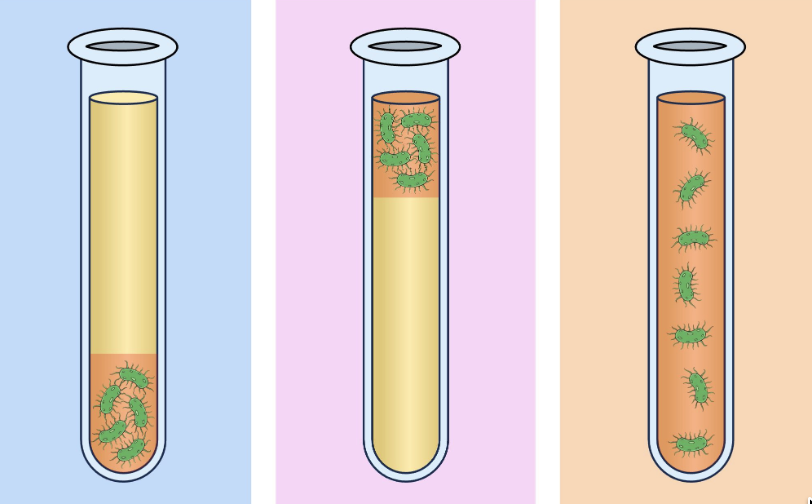
facultative anaerobes
oxygen growth requirements (microbes vary in how they use/don’t use oxygen)
prefer osygen but can survive without it

nutrients
elements (carbon, nitrogen, oxygen, etc) required for growth and energy
autotrophs
can generate energy with nutrients via sunlight
heterotrophs
must get energy and nutrients from other organisms, often by consuming them
growth factors
organic molecules (amino acids, vitamins, nitrogenous bases, etc) are required for growth; some microbes cannot make these themselves and require them from a host
liquid
physical culture media
these are broth media and are ideal for growing large quantities of microbes

solid
physical culture media
substances like agar, which are useful for isolating colonies

semisolid
physical culture media
less dense agar that lets microbes penetrate deeper into the substance

defined media
chemical composition culture media
synthetic substance where we know all the ingredients and their concentrations; more specific

complex media
chemical composition culture media
mixture of many substances (blood, milk proteins, yeast extract) where we don’t know the precise concentration of all ingredients; less specific

differential media
functional culture media
allows growth of multiple species of microbes but provides visual indication to distinguish the species

selective media
functional culture media
encourages growth of a specific target microbe while containing substances that inhibit the growth of others

streak plate technique
way of quantifying microbes
microbial culture is diluted on an agar plate so that separate colonies (tiny mounds) will grow on the surface
use an inoculating loop to spread culture streaks at 90 degree angles around the plate; or use counting chamber

flow cytometer
way of quantifying microbes
add fluorescent molecular “labels” to a specific kind of microbe. as you pass a sample of cells through a tube, a laser shoots through the tube, and a detector determines if the light that passes through comes from fluorescent-tagged cells

spectrophotometer
indirect way of quantifying microbes
machine shoots light through a liquid sample and measures turbidity (how cloudy) the sample is → the cloudier the sample, the more cells/microbes are present

disinfection (D) vs. sterilization (S)
various levels at which we decrease the population of microbes; physical agent
D→ reducing microbial numbers
S→ eliminating all bacteria, viruses, endospores, etc
refrigeration
come back to this
dry heat
physical agent
S→ incineration or hot air ovens @ sufficient temp will dehydrate and kill most microbes
moist heat (D)
physical agent
D→ boiling and pasteurization will kill many microbes
moist heat (S)
physical agent
S→ autoclaving AKA applying steam heat with intense pressure will sterilize
radiation
physical agent
high energy electromagnetic waves
ionizing radiation
physical agent
S→ gamma rays and x-rays that generate reactive ions that kill microbes
non-ionizing radiation
physical agent
D→ UV rays that denature DNA, leading to severe mutations and often cell death
filtration
mechanical removal
barrier with tiny pores that lets air or liquid molecules pass through, but microbes or viruses
D→ air filter (ex: HEPA)
S→ liquid membrane filters (ex: cellulose nitrate)
alcohols
chemical agent
D→ organic molecules with an OH- group that denature proteins and break down liquid membranes
aldehydes
chemical agent
S→ similar to alcohols, but the O is by itself and acts to denature cellular structures
ex: formaldehyde
phenols
chemical agent
D→ specialize in breaking down bacterial cell walls (ex: used in personal hygiene items, like mouthwash, soap, and lysol disinfectants)
halogens
chemical agent
D→ act to oxidize cellular components (ex: chlorine, iodine, etc)
detergents
chemical agents
D→ amphipathic molecules (can attach to both hydrophobic and hydrophilic substances and are then washed away)
ex: dawn dish soap
infectious disease
illness caused by a pathogen
true pathogen
do not require weakened hosts
opportunistic pathogen
only cause disease when they shift locations or the host is weakened in some way
endemic infections
routinely occuring infections (ex: common cold)
sporadic infections
isolated events (ex: ebola outbreak)
epidemic vs pandemic
e: widespread disease outbreak
p: multiple countries
zoonotic diseases
spread from animal to humans
most are noncommunicable (don’t spread from person to person) but some can mutate into communicable forms
subjective vs objective
during active infection, a patient can show objective indicators (fever, blood in stool) or subjective indicators (pain, fatigue)
reservoir
habitat where pathogen is naturally found (soil, water, inside an organism)
source
means of pathogen disseminating from reservoir to new hosts
exogenous source
source outside the host
endogenous source
sourse within the host
direct contact transmission
host comes into physical contact with source of pathogen
vertical transmission
special tyoe of direct contact transmission where pathogen passes from mother to offspring during pregnancy, childbirth, or breast feeding
indirect contact transmission
pathogen spreads without physical contact with source
airborne
type of indirect contact transmission
pathogen enters through respiratory route. these spread via respiratory droplets or smaller aerosols
vehicle
type of indirect contact transmission
pathogen spreads via contaminated substance/surface
vector
type of indirect contact transmission
pathogen spreads via an organism that carries it to the host
incubation period
first stage of infectious disease
time between infection and earliest symptoms; could be hours for one disease and years for another

prodromal phase
second stage of infectious disease
patient experiences first symptoms which are often not severe

acute phase
third stage of infectious disease
patient experiences full-blown and most severe version of symptoms associated with disease (this is a symptomatic case)
it is possible for someone to move through these stages with mild or none-existent symptoms (this is an asymptomatic case)
patient is most likely to die in this stage

period of decline
fourth stage of infectious disease
pathogen replication decreases and symptoms decline

convalescent period
fifth (and final) stage of infectious disease
pathogen is eliminated or declines to normal/healthy levels. some pathogens may remain and become dormant

epidemiology
study of how diseases occur in populations of people
goals: describe nature, cause, and extent of diseases; intervene to protect and improve health in populations
epidemiological triangle
the “who”/”what”?”where” of a disease
includes environmental, host, and etiological factors
host factors
aspect of epidemiological triangle
health, sex, age, ethnicity, life, etc of host individual
environmental factors
aspect of epidemiological triangle
climate, water source, geographic location, etc
etiological factors
aspect of epidemiological triangle
type of agent (bacteria, virus, parasite, prion, fungus, etc)
quarantine
person with infection (or potentially infected) undergoes a period of confinement away from the general population
wait for potential incubation period to pass to see if symptoms occur
vectors
agents that spread pathogens