Sperry
 Call Kai
 Learn
 Practice Test
 Spaced Repetition
 Match
 Flashcards
 Knowt Play
1/29

Earn XP
Description and Tags
Biological area
30 Terms
Outline the background research by Gazzaniga
Animal experiments by Gazzaniga, which severed the corpus callosum of monkeys, showed lateralisation of function in animals. The monkey was taught to tap the triangle, in a selection of shapes, through reinforcement, whilst only being able to see with one visual field (one eye - the monkeys had severed optical chiasms as well which we can’t do in humans). This meant it was only learnt by the hemisphere which processed info from that visual field, and when the researchers changed the visual field the monkey was using (changed which eye was being covered), the monkeys became confused and couldn’t complete the task as the hemisphere controlling the visual field had not learnt the information and couldn’t receive it from the other hemisphere as the corpus callosum was severed.
Diagram of the organisation of the hemispheres
everything controlled by the left hemisphere is blue, right hemisphere is red
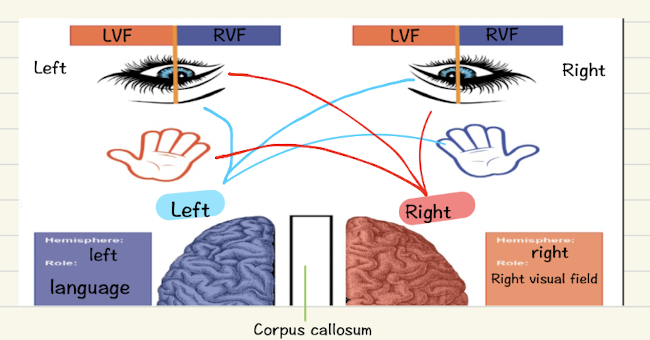
fill in the gaps.
· Your brain is split into 2 ___1___ - right and left
· the 2 halves are connected by a bundle of nerve fibres called the ____2____
· functions in the brain are lateralised to one of the hemispheres, meaning they’re controlled by ___3___ half of the brain (lateralisation of function)
· one of the roles of the left hemisphere is to control ___4____
· your right hand is controlled by your ___5___ hemisphere
· your left hand is controlled by your ___6___ hemisphere - this is called contra-lateral control
· each of your eyes can observe both a left and right visual field.
· the left hemisphere controls the ____7____ visual field for both eyes, the right hemisphere controls the ____8____ visual field for both eyes
hemispheres
corpus callosum
only one
language
left
right
right
left
what was the aim of Sperry’s study?
to study the psychological effects of hemispheric disconnection in split-brain patients. To understand how the hemispheres function in “normal” individuals. Sperry wanted to find the answers to the following questions:
· do the hemispheres perform different functions? Visual, tactual, lingual functional lateralisation tasks
· does each hemisphere have its own memories, perceptions, and concepts (store of conscious awareness)?
what sampling method was used?
opportunity
outline the sample used
opportunity sample of patients referred to the White Memorial Centre in Los Angeles.
11 ps who were patients with severe epilepsy which could not be treated with drugs. They had already had their corpus callosum split as treatment for this condition:
· 9 had been operated on too recently to carry out a therapeutic evaluation to determine whether any unintentional injury had been caused to the brain, resulting in an impairment in functioning beyond that caused by severing the corpus callosum. 2 of these patients were still experiencing seizures.
· 1 patient was a man who had been operated on 5 and a half yrs before who showed no symptoms of epilepsy and no significant impairments
· 1 patients was a mother and housewife in her 30s who had been operated in over 4 yrs before, also seizure-free.
Why can the results from this sample not be generalised to explain the lateralisation of function in the “neurotypical” population?
Neurotypical people don’t have a severed corpus callosum so brain function may differ in a person with a “split-brain” and a neurotypical person (with an “intact” brain) and so is not generalisable to them
evaluate the sample
only American: ethnocentric & low pop val
small sample size - less generalisable to a larger pop, due to individual diffs
only people with epilepsy who had their corpus callosum split
range of diff occupations within the sample
what method was used?
Quasi exp, a case study
what is a case study and what is an advantage of conducting a case study?
a small group of people (often specific) in-depth, usually conducting multiple measures over time.
Case study makes it more holistic as it looks at multiple factors
what is the IV?
severed corpus callosum or assumed control group (not tested bc neurologically typical individuals’ functioning & performance on tasks was already know) - use pre-existing data
What was the DV?
ability to perform tasks measured through a controlled observation - low ecological val due to highly controlled env & tasks: not representative of real life as it reduces extraneous variables. Controlled observation also open to researcher bias
What is the weakness of the way ability to function was measured?
low ecological validity due to controlled observation and therefore not representative of real life as it eliminates extraneous variables
What is the strength of a case study? How would this affect the conclusions of this study?
more holistic as it looks at multiple factors and allows the researcher to focus on the small group
What is the weakness of a case study? How would this affect the conclusions of this study?
lacks population validity as it is only a small group and therefore less generalisable to a larger population
What type of data was collected, how, and what is an advantage of this?
Qualitative data was collected as they were asked to describe/draw what they saw - gave rich, in depth detail about the effects of the split brain op
outline the procedure of Sperry’s study
Sperry carried out a number of visual and tactile tasks with the ps. Each ps was tested independently.
For the visual tasks: the ps (with one eye covered) gazes at a fixation point on an upright transluscent screen. A tachistoscope (a device that present visual info for a v brief, controlled period of time) is used with 35mm slides arranged in a standard projector. Images on these slides are projected either side of the fixation point (into one visual field or the other) for 1/10th second. To the left of the fixation point is the LVF, and to the right is the RVF.
Example of a visual task: 2 words are presented simultaneously. One to the LVF, one to the RVF:
the word KEY is presented to the LVF, this info is transmitted to the right hemisphere, the right hemisphere does not control language & so the ps will not be able to say that they saw the word KEY, but the left hand (controlled by the right hemisphere) will pick out the key.
The word CASE is presented to the RVF, this info is transmitted to the left hemisphere (which control language) so the ps will say that they saw the word CASE and will spell CASE with their right hand look at diagram on notes
Tactile task: there is a gap underneath the screen. The ps could reach objects but not see their hands. Objects were then placed in the ps' right/left hand/both hands. Information about objects placed in the left hand is processed by the right hemisphere and vice versa
Why was the info flashed for only 1/10th sec to one VF during the visual task?
done as a control bc if they were given longer, their eye may readjust, and the image would enter both visual fields and both hemispheres
Why do the tasks lack ecological validity?
the task is not representative of real life; it is highly controlled & unrealistic task for real life. For the visual task; irl both visual fields would access the info and so both hemisphere. For the tactile task: you would usually be able to see what you are touching - unrealistic
outline the results form the visual task
info presented in one visual field is only remembered if it's presented again to the same visual field. That's because only that one hemisphere has seen it. The other one can't recognise it, bc it's never seen it before!
when an object is displayed in the RVF the ps is able to describe the object in speech & writing - this is bc the left hemisphere controls language / speech
when an object is displayed in the LVF, ps insist they have not seen anything. But if asked to use the left hand to point to a matching object on the table, can do so, while still insisting nothing was seen - this is bc the LVF and left hand is controlled by the right hemisphere and the left hemisphere controls language and can't recognise the object as it has not seen it.
When a $ sign is presented to the LVF, and a ? to the RVF, the ps draws $ with their left hand but will say that they drew the ? - this is bc language is controlled by the left hemisphere and the left hand is controlled by the right hemisphere. The left hemisphere has not seen the ? and the right hemisphere cannot say it has drawn a ? as it doesn't control speech.
outline the results form the tactile task
when objects are placed in the right hand for identification by touch, ps described the object in speech and writing - this is bc the right hand is controlled by the left hemisphere which controls speech.
when objects were placed in the left hand for identification by touch, ps made wild guesses about what the object was (they could not name the object using speech or writing), but they could correctly pick out the object again from a selection using their left hand - this is bc the right hemisphere controls left hand, but the left hemisphere controls speech, so the right hemisphere lacks the function to communicate what it saw verbally, but they can point at it and recognise it.
When two different objects were placed in each hand - then hidden for retrieval in pile of items, each hand searched for its own object but ...If the left hand picks up the object which the right hand is looking for, the object is rejected, but the other hand continues to search.
If a participant is asked to pick up an object with his left hand (info flashed to RH), if the object was not there, participants would pick up a related object. This shows that the RH is capable of sorting objects into meaningful categories. Using number shapes, participants also showed that they can solve simple arithmetical problems by pointing to the correct answer. This shows that the 2 hemispheres of the brain are NOT equal with respect to intellectual functioning. The right hemisphere has some reasoning ability.
outline the conclusions drawn from the visual and tactile tasks
People with split brains have two separate visual inner worlds, each with its own train of visual images.
- Each hemisphere sees only what one visual field attends to. However, in real life, both eyes usually focus on the same things.
Split-brain patients have a lack of cross-integration where the second hemisphere does not know what the first hemisphere has been doing.
- When the participant is asked to say what object they have been shown/ felt with the RVF or Right Hand they either incorrectly guess, say there was nothing, or don’t know.
Split-brain patients seem to have two independent streams of consciousness, each with its own memories, perceptions and impulses i.e. two minds in one body.
- The Right hemisphere has no memory or awareness of what the Left hemisphere has experienced as it is unable to communicate using language with the other hemisphere.
evaluate the biological determinism of the study
biological determinism - ps all suffered from severe epilepsy for many yrs which may have resulted in brain injury, & the op may also have damaged areas peripheral to the corpus callosum, meaning that the impaired function (inability to complete tasks) may be due to brain injury & not due to lateralised functions - this means the individual lacks free will as individuals with brain injury cannot compensate for impairements in functioning, as they cannot consciously repaire physiological injuries. However, Sperry does suggest that there is some free will in overcoming impaired functioning through practicing ipsilateral control, & adapting strategies such as saying things aloud to transfer them from the left to the right hemisphere
why did the study have low population validity?
Low pop val - sample consisted of 11 neurologically atypical epileptic patients, who had all undergone surgery severing their corpus callosum. The findings are therefore not generalizable to neurotypical people, & may not be representative of lateralisation of function in the majority of individuals. However, the ps represented a variety of ages, occupations, and both genders
why did the study have low ecological validity?
low ecological validity - study was conducted in a controlled artifical environment, where ps were tested, using specialised equipment (tachistoscope) which restricted ps' view of stimuli to just one VF & restricted their view of their hands. IRL ps would be able to compensate for the loss of the corpus callosum by viewing the stimuli in both VFs & looking at the objects in their hands, thus transferring the info to both hemispheres. Therefore, it is difficult to generalise these findings to explain functioning of split brain patients in their daily lives. However, although the study is difficult to generalise to real life, the artificial environment makes it easier to control for extraneous variables and therefore internal validity is improved
why did the study have low internal validity?
Low internal validity - the study explains behaviour through lateralised functions in the brain; if particular areas in the hemispheres are injured or the corpus callosum is severed, it will result in impaired functions, such as inability of the right hemisphere to communicate with the left hemisphere. This would confound the results of the study as the tests would not be measuring only the functions of each hemisphere. However, as it is conducted in a controlled env, extraneous environmental variables are controlled for.
why did the study have high internal reliability?
ps were all tested in the same environment using the same equipment (e.g. same tachistoscope, in a controlled lab environment) - this standardisation means that all ps had a consistent experience. However, the ps were all given diff tests. Some were studies more extensively than others, which means ps' experiences over the testing period were inconsistent.
evaluate the research method & techniques
use of objective tests to measure patient's capabilities provides an unbiased means of assessing the effects of the operation, so high internal val. (e.g. showing $ and ? signs to diff VFs to see which could be described verbally
quasi exp - confounding variables may not be controlled (e.g. diffs in pts behaviour in tests, compared to ps w/ an intact brain could be due to their epilepsy and not their split brain
evaluate the reliability of the study
ps were tested on a variety of tasks, carried out the same way each time
results were consistent (e.g. LH always responded only to info presented to RVF, so tasks have some degree of reliability
evaluate the ethics of the study
repeated testing and realisation of effects of brain surgery may have cause psychological harm (e.g. distress as they realise how they may have been affected)