Lecture 1 mammals
 Call Kai
 Learn
Learn Practice Test
 Spaced Repetition
 Match
Match Flashcards
 Knowt Play
1/128

There's no tags or description
Looks like no tags are added yet.
Name | Mastery | Learn | Test | Matching | Spaced | Call with Kai | Chat |
|---|
No analytics yet
Send a link to your students to track their progress
129 Terms
Mammals are all at some point in development ___ (3 traits)
Hirsute - hair
lactogenic - milk production
endotherms - internal heat production
Soft anatomy traits (12)
1. Hair
2. Mammary Glands
3. Endothermy
4. Viviparity (except Monotremes)
5. 4-chambered heart
6. Enucleated red blood cells
7. Muscular diaphragm
8. No renal portal system
9. Complex integumentary structures (horns, sweat glands, etc.)
10. Nitrogenous wastes excreted as urea
11. Complex facial dermal muscles
12. Extreme expansion of the cerebral cortex of the brain
Viviparity
Live birth with the exception of monotremes. Has a placenta and amniotic egg.
4 chambered heart
Facilitates separation of blood and deoxygenated blood.
Better movement and respiration through the body.
Enucleated blood cells
Without nucleus - more surface area for oxygen to bind to = more oxygen to body and easy moving through body
Muscular diaphragm
Separates thoracic cavity from abdominal cavity = allows for more lung capacity and more oxygen
No renal portal system
No stop off at the kidneys which allows for more efficient blood movement and speeds up moving oxygen around
Complex integumentary structures
Horns, sweat glands, other glands
Waste as urea
Non toxic way of getting rid of waste - the liver allows mammals to do this
Complex facial dermal muscles
Whiskers to sense the environment and pass information to brain
Expansion of the cerebral cortex of the brain
Allowing for more coordination of movement
Soft characteristics as a whole are allowing mammals to __
be more efficient (especially oxygen transfer)
Hard anatomy traits (14)
1. Double occipital condyle
2. Epiphyseal line on long bones
3. Lower jaw in single bone on each side (= dentary bone)
4. Dentary-squamosal jaw articulation
5. 3 middle ear ossicles (= malleus, incus, and stapes)
6. Tympanic bone present
7. Teeth are restricted to the perimeter of the jaws
8. Dentition usually heterodont
9. Dentition diphyodont (only 2 sets of teeth: milk teeth and adult teeth)
10. Hard secondary palate
11. Thoracic ribs only (no lumbar ribs)
12. Calcaneus (heel bone) present (= specialized tarsal bone)
13. Phalangeal formula (finger-toe bones) reduced to 2-3-3-3-3
14. Shoulder girdle reduced to one, sometimes 2, elements
(scapula, clavicle)
Double occipital condyle
Allows organism to rotate neck - more flexible head movement
Epiphyseal line on long bones
Line where growth occurs = harden early during dev = harder to break as opposed to if growth was in the middle of the bone = stronger bones and joints
Growth is restricted to the ends of the bone
Lower jaw in single bone on each side (= dentary bone)
single bone in jaw
Dentary-squamosal jaw articulation
Jaw bone articulates with one bone in skull
3 middle ear ossicles (= malleus, incus, and stapes)
Small bones go to the ear = better hearing for mammals
Tympanic bone present
Surrounds and suspends the eardrum = separates inner ear from middle ear and houses tiny middle ear bones
Teeth are restricted to the perimeter of the jaws
One line of teeth
Dentition usually heterodont
Multiple different types of teeth
Dentition diphyodont
2 sets of teeth in a lifetime - milk and adult teeth
Hard secondary palate
Clear separation of nasal and oral cavity = eat and breathe at same time
Thoracic ribs only (no lumbar ribs)
More flexibility and ribs do not restrict us
Calcaneus (heel bone) present (= specialized tarsal bone)
increase speed
Systematics definition
Science of classifying organisms based on their evolutionary relationships - how are organisms related to each other?
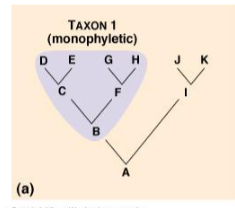
Monophyletic (monophyly)
Includes all organisms descended from a single most recent common ancestor
Polyphyletic (polyphyly)
Composed of unrelated organisms descended from more than one common ancestor (does not include most recent common ancestor)

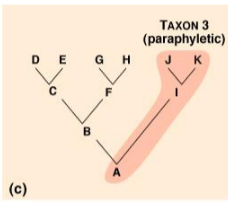
Paraphyletic (paraphyly)
Does not include all organisms descended from a common ancestor
Synapomorphy
trait shared by two or more taxa (shared derived trait)
Sympleisiomorphy
a shared ancestral character state (all have it)
homologous/homology
structures with similar evolutionary/phylogenetic origin but not with a similar function/behavior/identical structure

analogous
structures in two or more organisms that have similar function but the similarity is not the result of descent from a common ancestor

evolution
change through time in a population/lineage
evolutionary trend
directional change through time within a lineage
Convergent evolution
Evolutionary trend observed in distantly-related organisms where each lineage shows independent evolution of superficially-similar features. These lineages converge on the same trend/morphology via different developmental pathways

Parallel Evolution
Evolutionary trend observed in 2 lineages whom share a fairly recent common ancestor where each shows independent evolution of a similar feature via similar development pathways

Homoplasy
A similarity in a character in two different species that arises from evolutionary convergence or parallelism, not common ancestry (noise)
Convergent evolution examples (3)
Desert rodents - distantly related and all evolved for desert efficiency with long big legs for jumping - Desert rodents and lizards - all developed similar colors
Marsupial vs placental mammals - similar features (ex. sugar glider vs flying squirrel, Tasmanian tiger vs wolf, wombat vs groundhog)
Diastema - loss of premolars in horses, rodents, marsupials, multituberculata
Parallel evolution example
aquatic adaptations in piinipeds phocidae and otariidae - related but not sister taxa - hindlimbs
Paleozoic era major events
Permo-triassic crisis = glaciation, warming, volcanos
Greatest extinction 96% marine 70% terrestrial 57% all families 83% all genera
Synapsids
mesozoic era major events
Entering a warming period
Age of dinosaurs and mammals - diversifying after extinction
Pangea breaking = gondwana and laurasia
Land animals becoming stranded (vicariance)
Further separtion in jurassic
Late cretaceous major events
multituberculates widespread and therians
marsupials in north america dispersing south
placentals in asia dispersing west
Kpg/KT boundary
Extensive mountain building (rockies pushed up for 2nd time)
Massive extinction from dust cloud or volcanos or microbes
chicxulub crater yucutan - deccan traps in india
Cenozoic era major events
Marsupials dispersing
grasslands evolving
placentals dispersing
last glaciation (wisconsinan)
major mammal extinctions - large animals
mountains building
Future world
pangaea ultima
The position and orientation of continents affects
climate and circulation of oceans
Vicariance
The geographic isolation of populations of a once widespread species by the development of a physical barrier within the ancestral species range. Results in interrupted gene flow, genetic differentiation, and possibly speciation of isolated populations (PASSIVE)
Dispersal
the one-way movement or spreading of organisms from natal to new area (ACTIVE)
Barriers = oceans, deserts, mountains, climate
Speciation pump models
(also called cyclical vicariance model) A model that attributes the high diversity of tropical communities in South America to repeated fragmentation and reconnection of tropical forests caused by the glacial and interglacial cycles of the Pleistocene
Gondwana effect
There is higher diversity/endemicity in the south
Madagascar organisms are related to Africa and India
Types of dispersal
Corridors - connect similar habitats
Filter zones - connect different regions and habitats
Sweepstakes routes - of variable surrounding habitats
North to south
Increase in diversity as you go south (lower latitude) Could be because of climate or vegetation
West to east
Higher diversity in the west could be because of mountains, elevation, or time based
Effects of glaciers
kettle lates
ice dams - cut off rivers = big lakes
pluvial lakes
Glaciation 3 major effects
habitat
change dispersal routes
climate
-species need to move, adapt, or go extinct
Species pumps
dispersal south/north or east/west in response to glacier movement (tracked by fossil record)
Rivers are able to
facilitate or prevent dispersal
Chordata characteristics
o Bilateral Body Plan
o Notochord
o Dorsal Neural Tube
o Pharyngeal Gill Slits
o Muscular Post-Anal Tail
o Groove/Pocket in Pharynx (Endostyle – stores Iodine)
Amniotic egg
Membrane with a semi-permeable shell allowing for gas exchange with the environment. Contains yolk for nutrition and a membrane to store waste.
Can lay eggs on land and facilitate terrestrial variation
Temporal Fenestrae
Anapsid - no fenestra
Synapsid - one (synapsis/mammals)
Diapsid - two (archosaurs)
Synapsids were the first _
amniotes to radiate in terrestrial habitats
Therapsida
middle permian, replace pelycosaurs
more mammal like - temporal bar, sagittal crest, hetero/diphyodonty, hard 2ndary palate
Dinocephalia
Anomodontia
Teriodontia
Cynodontia - Galesauridae
Dinocephalia
large, incisors, pachyostasis/thickened bones (headbutting), hinge jaw movement
Anomodontia
toothless, beaked turtlelike bill/pads to smash food
temporal openings enlarged
sliding jaw articulation
permo-triassic crisis - lineages decimated
Theriodontia
land dwelling mammal like
precise dental occlusion
versatile jaw movements
moveable quadrate bone
Pelycosauria
Sphenacodontidae -Dimetrodon
paraphyletic, early permian dominant, excting by end of permian, very large
dimetrodon had heterdont dentition and a modified skull to rip prey, reflected lamina, large sail
Synapsida
small/agile
water ties
amniotic egg
dominant in permian and top preditors in triassic
Paleozoic - late perm
pangea , lots of mountain building
permo-triassic
end of permian = greatest exctinction of all time 99% of life
Cynodontia
small
nocturnal
carnivore
dentary squamosal jaw articulation
hard 2nd palate
occipital condyles
warm blooded with hair
Galesauridae
first with dentary squamosal jaw articulation
single lower jaw = inc strength
hard 2nd palate
large brains
depend on hearing and smell
2/3 of mammalian history went extinct in
the mesozoic
Jaw changes over time
1 jaw bone and small bones go to ear =improve sound transmission
we can see this in opossum development
The hard secondary palate is possibly
the origin of lactation = facilitate liquid diet - young organisms dont need teeth while growing - can lead to 2 sets of teeth
Precise occusion
allows the grinding and breaking up of food
Post cranial changes over time
legs went from splayed out like a crocodile to being under the body which allows for better locomotion for terrestrial movement
Prototherians
- Morganucodontidae/Tricodonta ex
- Docodonta ex
- Multituberculata (Subclass Allotheria) ex
- Monotremata (Subclass Prototheria)
Therians
- Symmetrodonta
Kuehneotheriidae ex
- Eupantotheria
Dryolestidae ex
Peramuridae ex
Boreosphenida ex
Methatheria (Infraclass)
Eutheria (Infraclass)
Prototherians
dentary squamosal
large cochlear region
2 occipital condyle
locomotion
mammalian body posture
What are the 3 extinct groups of prototherians?
Morganucodontidae/Tricodonta
Late Triassic to mid Cretaceous
Insectivorous/carnivorous
Three-cusped tooth
Docodonta
Middle Jurassic to early Cretaceous
Descriptions based on teeth and jaws
Omnivores
Complex teeth – molars rectangular
Ancestral jaw articulation (reptilian)
Multituberculata (Subclass Allotheria)
Herbivorous
Rodent-like incisors
Many cusps
Multituberculata went extinct because of
competition with placental rodents (eocene/oligocene)
Monotremata
oviparous
australia/new guinea
decreased with comp with marsupials
Tribosphenic molars
upper molar - paracone, metacone, protocone
lower molar - protoconid, paraconid, metaconid
talonid heel
precise occlusion
how did tribosphenic molars evolve
Concrescence Hypothesis
Merge teeth, and germinal buds of teeth, into 1
Expect reduction in number of teeth
Differentiation Hypothesis
Each tooth differentiates
Cusps are independent of the germinal root
Increase complexity without reduction in number of teeth
Are the origins of mammals monophyletic?
Yes theory - mammals all come from the cynodont (can see this with dentary squamosal jaw articultion)
No theory - the trait could have evolved independently
hair, lactation, endothermy, viviparity all help with _
metabolism, locomotion, terrestrial habits, nocturnal behavior, increased rate of feeding and respiration
Homeothermy
Maintaining a constant internal body temperature (e.g., modern mammals, birds, and some others)
Poikilothermic
Having a fluctuating internal body temperature depending on the local environmental conditions (e.g., typical reptiles and actinopterygiian fish
heterothermy
Oscillating between homeothermic and poikilothermic (e.g., bats, hummingbirds).
Ectothermy
Relying on the environment and behavior to regulate body temperature (e.g., typical reptiles)
Endothermy
Generating internal heat to moderate body temperature (e.g., modern birds and mammals. Independent evolution during the Mesozoic)
Endothermy is
costly! Compared to a similarly sized ectotherm (lizard), an endothermic mammal needs 10x amount of food & oxygen to generate heat
A small organism has a __ surface area to volume ratio
High ratio = lose heat
A large organism has a __ surface area to volume ratio
a low ratio = do not lose heat easily
Endotherms use __ to retain heat
insulatory structures (hair)
Why did hair and endothermy evolve?
evolved for sensory reasons first (whiskers to sense things at night) later used for insulation
Mammals are __
endothermic homeotherms
Viviparity evolved in the
cretaceous or earlier
possibly independent evolution
viviparity in marsupials vs placentals
marsupials - short gestation, long development
placentals - long gestation, short development
Metatherian ancestors are from
North america then dispersed south