Calculating for IV Medications and Infusions
 Call Kai
 Learn
 Practice Test
 Spaced Repetition
 Match
 Flashcards
 Knowt Play
1/55

There's no tags or description
Looks like no tags are added yet.
56 Terms
IV Solutions
IV solutions contain water, electrolytes, and may contain dextrose and other nutrients. Common IV solutions include:
Normal saline (NS):
Sodium chloride (NaCl) or saline solutions: .
Dextrose (D):
Lactated Ringer’s (LR, RL):
Combined solutions:
blood products
parental nutrition.
Normal saline (NS):
0.9% sodium chloride (NaCl) solution has the same concentration as that of body fluids.
Sodium chloride (NaCl) or saline solutions:
Solutions that have less or more concentration than normal saline or body fluids
Examples include:
0.45% NaCl (½ NS) and
0.225% NaCl (¼ NS).
as 3% sodium chloride
A few sodium chloride solutions have more than 0.9% NaCl. These are more concentrated than body fluids.
Dextrose (D):
Common component of IV fluids used to restore blood glucose levels and provide calories. Examples include D5W (5% Dextrose in Water) and D10W (10% Dextrose in Water).
Lactated Ringer’s (LR, RL):
Contains electrolytes, such as potassium, magnesium, and calcium chloride.
LR has the same concentration as body fluids.
Combined solutions:
Solutions that combine dextrose with saline or LR. Examples include:
D5/0.9% NaCl (D5NS),
D5/0.45% NaCl (D5½NS),
D5LR.
Potassium chloride (KCl)
Potassium chloride (KCl)
is a common additive to IV solutions. It is measured in milliequivalents (mEq), for example,
20 mEq KCl in D5/0.9% NaCl.
parental nutrition.
Provision of nutrients by the IV route when it is not possible to give nutrients by the GI tract.
A primary IV
is a large-volume IV, usually 1,000 mL for an adult.
The physician’s order of a primary IV includes:
Type of solution
Volume to be infused (liters or milliliters)
Time for the IV to infuse (total number of hours or mL/hour)

Most primary IV solutions come in plastic bags labeled with detailed information, including:
Components of the IV solution (solution name)
Volume in the IV bag
Storage information
Manufacturer’s name
Expiration date
Numbered markings
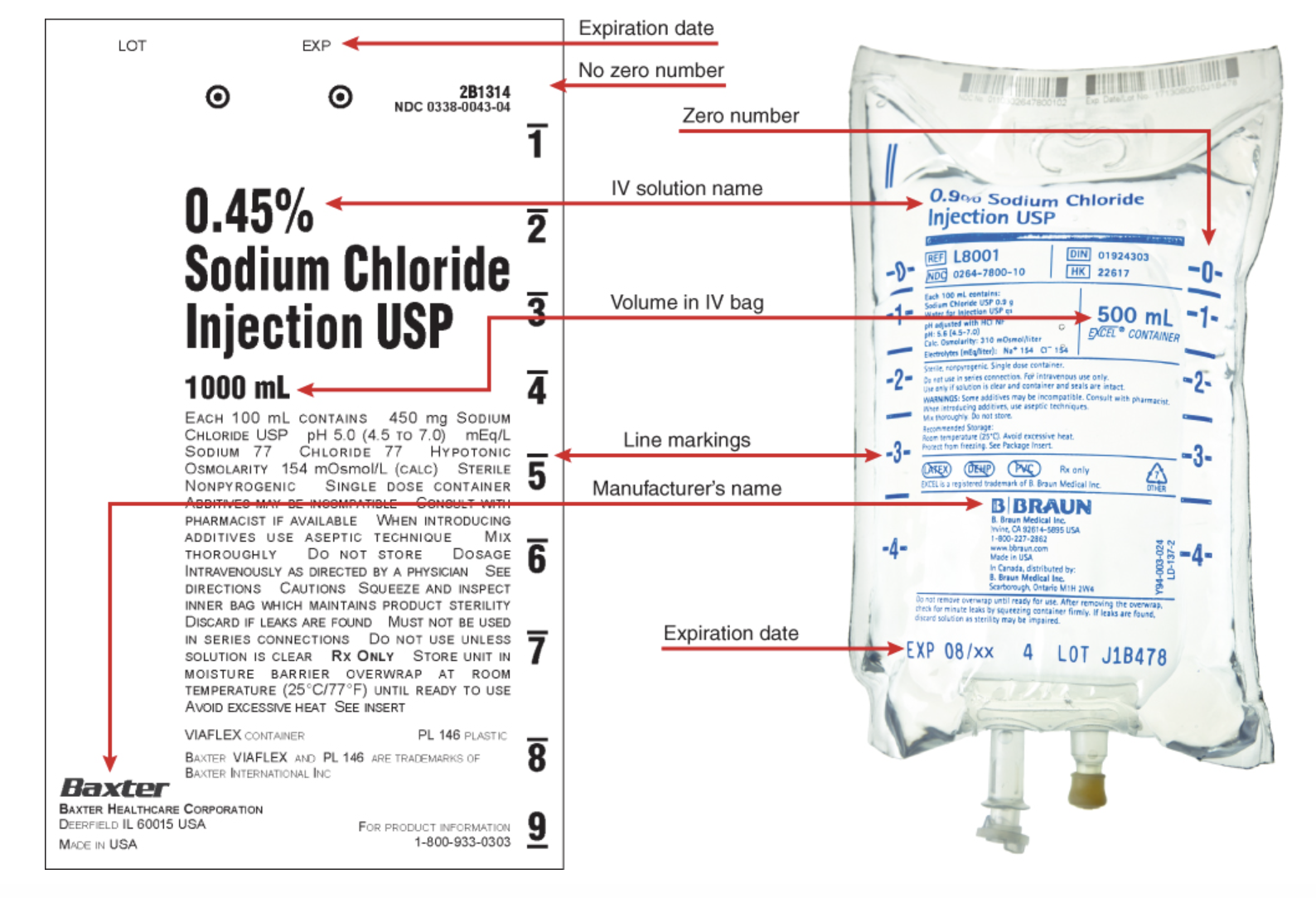
numbered markings
side markings found in primary iv bags volume 1,000 mL or 500 mL
There may or may not be a zero at the top of the IV bag.
The last number at the bottom of the IV bag is 9 (for a 1,000 mL bag) or 4 (for a 500 mL bag).
The numbers (each representing 100 mL) increase in value down the side of the bag.
The numbers represent the volume that has infused into the patient.
last number on the bottom of IV bags for numbered markings for both 1,000 mL & 500 mL
9 for 1,000 mL
&
4 for 500 mL
Identify the parts of IV line
spike, IV drip chamber, side clamp, roller clamp, injection port, IV tubing, connector

Roller clamp
The roller clamp compresses the tubing, allowing IV flow rate to be increased or decreased.
Line markings
IV line markings indicate how much IV fluid has infused into the patient.
IV drip chamber
flexible enlargement in the IV tubing that allows a clear view of the drops of fluid infusing through the tubing
Slide clamp
compresses the tubing to stop the flow of IV solution.
Injection port
Injection ports provide needle-less entry into the IV tubing.
it can have two ports: lower for IV push meds & upper for IV piggy back
IV tubing
The IV tubing is clear plastic to allow the nurse to view complications, such as blood or air in the tubing.
Connector
The connector attaches the IV tubing to the IV catheter in the patient’s vein.
Secondary IV or IVPB - IV Piggy Back
small volume IV (usually 50 or 100 mL).
IVPBs contain a medication diluted in an IV solution, such as normal saline or D5W.
The order for the IVPB includes:
The name of the medication
Dose
Route (differentiates from primary IV)
Time or frequency of administration
The IVPB bag includes:
The name of the IV medication
Dosage strength
Volume of solution in the bag
Solution in which the medication is diluted

Secondary IV Infusion Set
tubing line designed to facilitate the IVPB to “piggyback” into the primary IV

Methods of infusion for IV fluids and IVPBs
iv infusion pump or gravity drip
Infusion pumps
electronic devices that are programmed to deliver IV fluids and medications at precisely controlled rates. Nurses set the flow rate, volume to be administered
Pumps set to flow rate of 1 mL per hr
all pumps except elastomeric balloon pumps, which has no infusion rate set
Best practices for using IV pumps include
having a second clinician double-check settings with all high-risk medications and infusions and monitoring the patient and infusion according to best practices rather than relying on the pump settings and alarms.
Volumetric pump:
An electronic infusion device that pumps a set volume of IV fluid. It uses special tubing.

Syringe pump:
A motor-driven system that pushes the plunger of a syringe to deliver a small volume of fluid or high-potency medication at a precise rate of infusion.

Patient-controlled analgesia pump - PCA Pump
A specialized syringe pump that allows the patient to self-administer medication by pushing a button on the pump. Limits on the amount and frequency are programmed into the pump.

Ambulatory pump:
Small, light-weight pumps that are powered by battery and allow mobility for the patient.


Nonelectric pump
Disposable pump, such as the elastomeric balloon pump, that works by positive pressure inherent in the balloon.

Infusions by gravity
allow the nurse to regulate the flow rate (gtt/min) of an IV by means of the roller clamp on the IV tubing. It is used for infusion of IV fluids and some IVPBs.
how is flow rate of IV infusion pumps measured?
in mL/hr.
Physician orders can include the total number of hours for the IV infusion too
rounding when calculating flow rate
depending on the device, it can be rounded to the nearest whole number or decimal place such as tenth or hundredths place
how is flow rate of gravity IV’s measured?
Ti is measured in drops per minute (gtt/min).
Drop factor
The number of drops in a milliter; written as gtt/mL.
size of drops can vary based on the type of IV tubing: (macrodrip or microdrip)
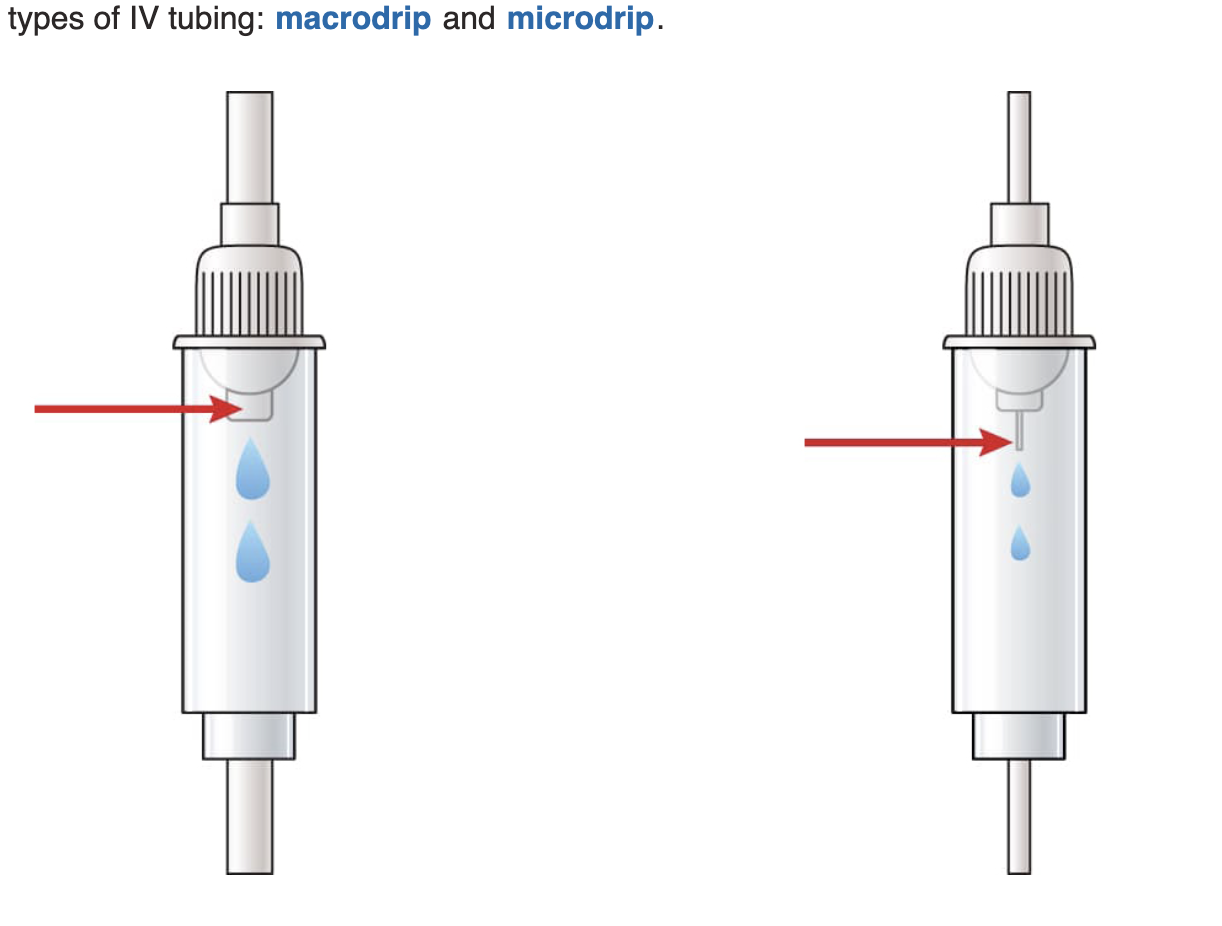
two main types of IV tubing
macrodrip (large drops):
microdrip (small drops):
Macrodrip drop factor
10 gtt/mL
15 gtt/mL
20 gtt/mL
microdrip drop factor
60 gtt/mL
Other names for microdrip sets are pediatric (pedidrip)
minidrip infusion sets: to infuse IVs with potent medications;
however, an IV pump is typically used for this purpose.
The information needed by the nurse to calculate flow rate in gtt/min is the:
drop factor of the IV tubing
volume (mL) to be infused
time the IV is to infuse (in minutes)
This is for gravity infusion
How to use calculations with a drop factor of 60 gtt/mL (microdrip tubing)
you don't need to perform a calculation.
Ordered infusion rate | Gravity flow rate |
|---|---|
40 mL/hr | 40 gtt/min |
75 mL/hr | 75 gtt/min |
100 mL/hr | 100 gtt/min |
125 mL/hr | 125 gtt/min |
Differentiate between drop factor, flow rate, and gravity flow rate
drop factor is how many drops in one mL : gtt/mL
flow rate is the volume infused over time: usually mL/hr
gravity flow rate is how many drops per minute: gtt/min
Infusion time
is the amount of time (hours and minutes) that it will take to infuse the ordered amount of IV fluid.
the total amount of IV fluid over a specific number of hours (EVERY 8 hrs)
the total amount of IV fluid and the specific hourly rate (mL/hr) (500 mL per hr)
Completion time
is the clock time (hours and minutes) when the ordered amount of IV fluid is completely infused into the patient.
to calculate completion time, you will need to know:
The start time of the IV in military time
The infusion time (in hours and minutes) of the IV
Primary IV
Also called the main IV line.
A large-volume IV infusion typically used to administer fluids and electrolytes continuously
IV lock (saline lock)
Allows intermittent administration of IV medications without continuous IV fluids
Also called a saline lock (SL) when flushed with normal saline to maintain patency.
A short IV catheter with an extension set and needleless access port
Accessed using a needleless connector and flushed according to facility protocol
Also called a heparin lock (hep lock) when maintained with heparin, although saline is more commonly used.
IV catheter
A small, flexible plastic tube inserted into a vein to administer fluids, electrolytes, and medications directly into the bloodstream.
Peripheral IV
Also called a peripheral line
An IV catheter inserted into a vein, typically in the hand or arm
Most primary IVs or IVPBs can be infused through this line
IVPB - Secondary IV
An IV infusion that is connected to the primary IV line and is commonly used to administer intermittent medications through the same IV access, such as antibiotics.
A smaller-volume IV infusion commonly used to administer medications intermittently, such as every 8 hours.
Central IV (central line)
An IV catheter whose tip terminates in a large central vein near the heart, allowing administration of certain medications and solutions that may irritate smaller peripheral veins
May be inserted through a vein in the neck or chest, such as the internal jugular or subclavian vein, or through a peripheral vein in the arm and threaded into a large central vein (PICC line)
Any type of IV (primary or IVPB) can be infused through this type of access.
A PICC line is considered a central IV
even though it is inserted into a peripheral vein in the arm.
The nurse has a new order to infuse 1 L Lactated Ringer’s by gravity over 10 hr. The available IV tubing set has a drop factor of 20 gtt/mL. To calculate the flow rate, the nurse needs to know: (Select all that apply.)
a. the number of mL in a L
b. the number of drops in a L
c. the conversion of hr to min
d. that 1 min = 60 hr
e. that the answer will be in mL/hr
f. that the answer will be in gtt/min
Calculate the flow rate
The nurse needs to know:
a. the number of mL in a L,
c. the conversion of hr to min, and
e. that the answer will be in mL/hr.
33 gtt/min