DTHY 370: Powered instruments
 Call Kai
 Learn
Learn Practice Test
 Spaced Repetition
 Match
Match Flashcards
 Knowt Play
1/34

There's no tags or description
Looks like no tags are added yet.
Name | Mastery | Learn | Test | Matching | Spaced | Call with Kai | Chat |
|---|
No analytics yet
Send a link to your students to track their progress
35 Terms
- utilize air turbine as energy source
- convert air pressure -> high freq. sound waves -> produce vibrations ofpwoered working end
- low frequency: 3,000-8,000 cycles per second
sonic scalers
- convert electrical energy tp high freq sound waves which makes rapid vibrations
- higher freq: 18,000-50,000
ultrasonic scalers
piezo: uses electrical energy to activate crystals in handpiece to make vibrations on working end
magnetostrictive: transfer electrical energy to metal stacks or ferrous rod to produce vibrations of working end
piezoelectric vs magnetostrictive
- sonic was invented in the 50's
- in 60's and 70's it was used only for heavy supra calc
- late 80's: slim ends, but doesnt work with all powered devices
- today: many tip designs, as effective as hand instruments
history of powered instuments
vibration of working end causes microfractures which makes deposit removal
modes of action: mechanical action
- formation of tiny bubbles when water stream contacts vibrating working end
- bubbles collapse which makes shock waves and destroys bacterial cell walls
modes of action: cavitation
- generated by ultrasound in presence of fluid environment
- has potential to destroy or disrupt bacteria
modes of action: acoustic microstreaming
therapeutic washing of sulcus and root surface to remove endotoxins and loose debris
fluid lavage
- water is used as a coolant
- chlorhexidine gluconate can provide pocket reduction
water line/reservoir for powered instruments
low water volume= increased tip heat and warmer water, for pt with cold sensitivity
high water volume= less heating of tip and cold water
water volume vs temp of water
- speed of movement
- number of cycles per second
frequency
- distance of tip displacement during one cycle
- determined by power settings: high power= long, forceful stroke
low power= short, less forceful stroke
amplitude
lowest, for client comfort and tip design
what power setting do we always start with
- frequency+amplitude
- low freq+low amp-> deplaquing
- high freq+high amp -> tenacious calc
cleaning efficiency
- increased efficiency
- multiple surfaces of tip are used
- conserves cementum - less change for stress injuries
- irrigation
- less distention
- no need to sharpen
advantages of powered instruments
- client comfort (water spray)
- decreased tactile sensation
- noise issues
- infection control
- aerosol production
- reduced visibility
- precautions and limitations
- damage to restorations
disadvantages of powered instruments
- light and heavy deposits/biofilm
- perio surgeries
- removal of excess cement/bonding
indications for powered instrumentation
- children: heat damage of large pulp chambers
- avoid use on restorations, demin, dentinal hypersensitivity
- communicable diseases: hepatitis, tb, strep
- immunosuppression: HIV, chemo
- cardiac pacemakers: ultrasonics can interfere
precautions for powered instruments
- unstable pulmonary disease: reschedule elective care
- dysphagia: muscular dystrophy, paralysis
contraindications for powered instruments
position: same positions, sit in supine and tilt head to side
grasp: modified pen grasp, lateral pressure with no fulcrum pressure
finger rest: intra or extraoral, cross arch, opposite arch
position, grasp, and finger rest for powered instruments
- use lateral and back of instrument, never the tip
- term 2-3mm of tip on tooth
- work from top to bottom when removing a deposit
adaptation of powered instruments
tip motion: compressed air drives tip in elliptical pattern, all surfaces are active
frequency: 3,000-8,000, lower freq
amplitude: less range than ultrasonic
power setting: pre determined, adjust water only
sonic scaler: tip motion, freq, amp, power setting
tip motion: tip moves in linear pattern, forward and backward with lateral tip only
freq: 25,000-50,000 cps
amp: green tip- up to 20%, blue tip- up to 70%
piezoelectric: tip motion, freq, amplitude
P: supra and sub
A: supra only
PS: thinnest, for sub and supra
piezo tips
diamond coated or plastic coated for implants
coating of piezo tips
- adapt only term 2-3mm to tooth
- used curved inserts for root surfaces
improper adaptation of powered instruments
stroke: move tip slowly
coverage: use overlapping strokes to cover entire surface
tip pressure: hold tip w light, secure, grip and avoid heavy lateral pressire
powered instruments: stroke, coverage, tip pressure
metal stack: converts electrical power into vibrations
o-ring: seal that keeps water flowing to tip of insert
handle grip: portion of insert grasped by clinical
interchangeable inserts of magneto
tip motion: moves in elliptical pattern and all sides are active
25 kHz unit: 25,000 cps and shorter amp
30 kHz unit: 30,000 cps and longer amp
magneto: tip motion, kHz units available
standard: supra and sub
thin: supra and sub
ultra thin: perio debridement
magneto insert diameter
implant inserts: must have plastic tip
diamond coated: used for furcation and root planing
inserts: .8mm ball on end
magneto insert design
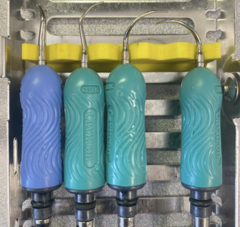
blue: heavy supra
green: supra and sub
2nd one is for anteriors
last 2 are right and left
what are each of these used for
orange: heavy supra
navy/purple: sub or supra
green and red: posterior right and left
what are each of these used for

all the same as the other blue and green ones, but they are newer and have bigger ergonomics
what are each of these for
- rinse w water and dry prior to autoclaving
- don't put in sonic cleaner
- replace o rings when needed
- watch for worn inserts and replace after 2mm loss
magneto insert care & maintenance