ARC 2701 Gothic Architecture
 Call Kai
 Learn
 Practice Test
 Spaced Repetition
 Match
 Flashcards
 Knowt Play
1/31

There's no tags or description
Looks like no tags are added yet.
32 Terms
Gothic architecture is an architectural style that was popular in Europe from the
late 12th to the 15th century, during the Late Middle Ages. It is noted for its
___,___,and___.
lightness, intricacy, verticality
Gothic architecture was known during the period as ___ ("French work")
opus francigenum

Paris, France (1137 – 1231 CE)
Basilica of Saint-Denis
The Abbot rebuilt portions of the abbey church(Basilica of Saint-Denis) using innovative structural and decorative
features. In doing so, he is said to have created
the ___ truly Gothic building.
first
Key Characteristics of Gothic architecture:
1. V___
2. F___
3. P___
4. S___ and P___
5. R___
6. T___
7. R___
8. S___
Verticality, Flying Buttresses, Pointed Arches, Spires and Pinnacles, Rib Vaults, Tracery, Rose Windows, Stained Glass Windows
____ – Having a strong or exaggerated sense
of rising upward to the sky. In Gothic architecture,
this is done through the building height and its
proportions (achieved with flying buttresses), as
well as through the upward thrust of the other
elements: spires, towers, pinnacles, pointed
arches, vertical buttresses, etc.
Verticality
___ – is a specific form of buttress
composed of an arch that extends from the
upper portion of a wall to a pier of great mass, in
order to convey to the ground the lateral forces
that push a wall outwards.
The defining, functional characteristic of it is that it is not in contact with the wall at ground level
Flying Buttress

Flying Buttress
___ allows for thinner, more
skeletal, inner wall
Flying Buttresses
___ – is an arch with a pointed
crown, whose two curving sides meet at a
relatively sharp angle at the top of the arch
Pointed Arch
___ = a tall, slender, pointed
structure on top of a roof or tower,
especially at the summit of church
steeples.
Spire
____= is an architectural
ornament originally forming the
cap or crown of a buttress or small
turret, later also used on parapets,
at the corners of towers, and in
many other situations. Looks like a small spire.
Pinnacle

Spire, Pinnacle
____ – A
variation on a groin vault, where a
framework of crossed or diagonal
arched ribs conceal the groins, the
intersections of the panels. These ribs
are all the structure, with thin stone
panels filling the spaces between the
ribs, thus greatly reducing the weight
and thus the outward thrust of the
vault.
Rib Vault
___ – is an architectural device by
which windows (or screens, panels, and
vaults) are divided into sections of various
proportions by stone bars or ribs of molding.
Most commonly, it refers to the stonework
elements that support the glass in a window.
Tracery
____ – A decorated circular window, with radial
stone tracery, usually glazed with stained glass.
Rose Window
____ – windows infilled with
portions of colored glass, used to form decorative
or pictorial designs, both by painting and
especially by setting contrasting pieces in a
framework.
Stained Glass Windows
___ is an architectural style that was popular in Europe from the late 12th to the 15th
century, during the Late Middle Ages. It is noted for its lightness, intricacy, and verticality
Gothic
The ___ rebuilt portions of the abbey
church using innovative structural and
decorative features. In doing so, he is said to
have created the first truly Gothic building.
Abbot

Basilica of ____
Saint-Denis

Paris, France (begun 1163 CE)
Notre-Dame de Paris

What is this a floor plan of?
Notre-Dame de Paris
___ = a spout in the form of
a grotesque human or animal figure
projecting from a roof gutter to throw
rainwater clear of a building.
Gargoyle

France (1194 – 1220 CE)
Chartres Cathedral
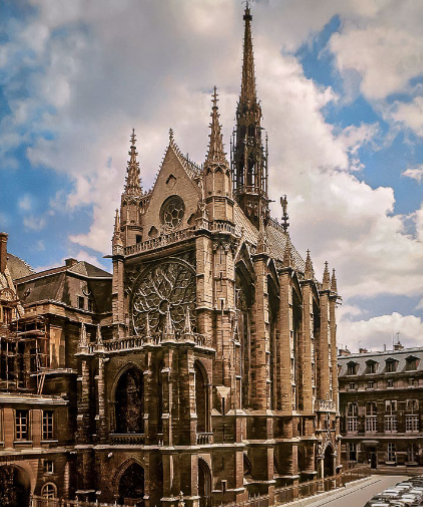
Paris, France (1238-48 CE)
Sainte Chapelle
___: the loads normally carried by load
bearing masonry walls were
transferred to the buttresses thereby
enabling a greater use of glass and
opening the space to light and the sky
above. The walls became thinner,
more transparent, and as a result
appeared to dematerialize
Dematerialization

London, England (1245-1376 CE)
Westminster Abbey

____:
• Flamelike curving tracery
• Addition of decorative ribs to interior
vaults (fan vaults, tracery ribs)
• Spires increase in visual detail,
becoming skeletal and/or spikey
Flamboyant Gothic
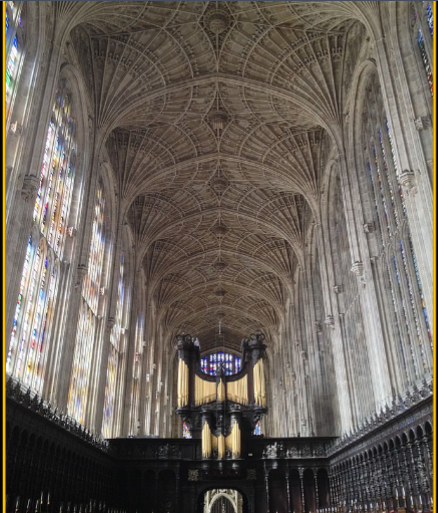
World’s largest fan vault (1515 CE)
King’s College Chapel
___ Architecture didn’t use much for religious structures, more for important secular buildings like palaces. So we see
primarily the pointed arch and tracery as attributes.
Venetian Gothic

Venice, Italy (1340 CE)
Doge’s Palace