Protein Structure and Function III
 Call Kai
 Learn
 Practice Test
 Spaced Repetition
 Match
 Flashcards
 Knowt Play
1/29

There's no tags or description
Looks like no tags are added yet.
30 Terms
Proteins interact with: proteins, __, ions, __, lipids, and water
nucleic acids : metabolites
Protein Binding Specificity: Regardless of the interacting partners, each protein only binds to a __ range of possible molecules and amongst the millions of possible partners each protein must find the right __ to function correctly
narrow : partner
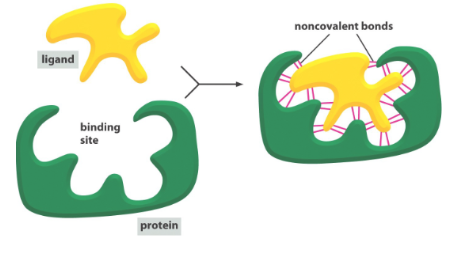
Proteins have great __ towards their binding partners. Any ion/molecule/protein that binds to a protein is called a __ (latin for “to bind”). __ or __ are regions of the protein that accept ligands
specificity : ligand : Binding sites : receptors
Weak non-covalent bonds (e.g. hydrogen bonds, van der Waals) often help a ligand bind to a proteins. Ligands often “fit” into defined areas of proteins, like a hand in a glove. Non-covalent bonds depend on: __ of the protein & __ of the protein
Sequence : Topology
__, or immunoglobulins, are produced by the immune system to recognize foreign molecules. The target ligand of antibodies is called an __, which they recognize with amazing specificity
Antibodies : antigen
Antibodies are typically composed of light chains and heavy chains, that each have a __ that binds to the antigens. The amino acid sequence of the variable domain can easily be changed, thus allowing the __ of antibodies
variable domain : diversity
Antibodies are composed of four subunits (two __ chains, and two __ chains. These subunits are linked together by __ bonds
heavy : light : disulfide
An __ is a type of protein that catalyzes a chemical reaction (e.g. invertase catalyzes the hydrolysis of sucrose to glucose and fructose)
enzyme
Enzymes are __ specific - often recognizing one isomer of a molecule ad not another (D-glucose vs. L-glucose)
extremely
Enzyme binding sites are called __ sites. Combinations of enzymes working in tandem create __ pathways (e.g. glycolysis)
active : metabolic
Enzymes are Catalysts: Facilitate __, lower the __, and are not __ during the reaction. Enzymes lower the __ energy of a reaction, thereby making the reaction more favorable
reactions : activation energy : consumed : activation
Enzymes : 2 models
The Lock-and-Key Model and The Induced Fit Model
Co-factors: __ molecules needed for enzymatic functions. E.g. Fe2+ and Mg2+
Inorganic
Co-enzymes: Loosely bound __ molecules. E.g. NAD+
organic
__:The complete __that is fully functional is called the holoenzyme
Holoenzyme : complex
__: The protein part that is __ the co-enzyme and/or co-factor is called the apoenzyme
Apoenzyme : missing
Enzymatic Activity: Activity levels of enzymes can be influenced by several factors:
pH, temperature, Allosteric regulation, Covalent modification (phosphorylation), Concentrations of reactants , Metal Ions
Enzymes must be regulated for two main reasons:
-__with other enzymes in various pathways
-prevent unnecessary waste of __
coordinate : energy/resources
__ is a common method of regulating enzyme activity, where a product from a later reaction in a pathway inhibits the activity of an enzyme involved earlier in the pathway
Negative feedback
__ is similar except the product stimulates the activity of an enzyme involved earlier in the pathway
Positive feedback
Allosteric __: Physical contact with another molecule alters conformation of a protein
changes
Allosteric __: Change in conformation activates or deactivates enzyme
activation/inhibition
Protein __ is the process of adding a phosphate group (-PO4) to an amino acid side chains. Phosphorylation can change the configuration of the protein, which can lead to changes to activity or function
phosphorylation
Phosphorylation is reversible: Protein __ add phosphate groups, Protein __ remove phosphate groups, There are hundreds of these types of enzymes in cells
kinases : phosphatases
Presence or absence of a __ group is a commonly used method to alter the activity of some enzymes. Notice the phosphorylation (P) can turn a protein either __
phosphate : on OR off
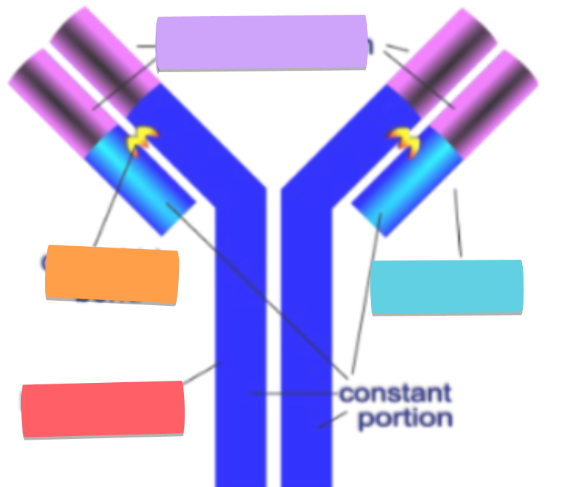


Lock and Key Model
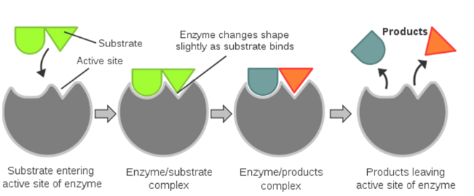
Induced Fit model
the unfolding of a protein (usually by heat) to its primary sequence (always making a nonfunctional protein)
denaturation
Explain chaperone vs. spontaneous protein folding
Spontaneous vs chaperone-induced protein folding- The former suggest that a protein naturally takes on its three-dimensional shape due to thermodynamics; the latter uses a another protein to help a protein fold into its proper shape.