BIOL1951 #4 - DNA Replication

0.0(0)
Studied by 0 people
call kaiCall Kai
learnLearn
examPractice Test
spaced repetitionSpaced Repetition
heart puzzleMatch
flashcardsFlashcards
GameKnowt Play
Card Sorting

1/36

encourage image

There's no tags or description

Looks like no tags are added yet.

Last updated 12:11 AM on 10/5/26
Name
Mastery
Learn
Test
Matching
Spaced
Call with Kai
Chat

No analytics yet

Send a link to your students to track their progress

37 Terms

1
New cards

Nucleotide

A five-carbon sugar (pentose), nitrogenous ring (base), and phosphate group

<p>A five-carbon sugar (pentose), nitrogenous ring (base), and phosphate group</p>
2
New cards

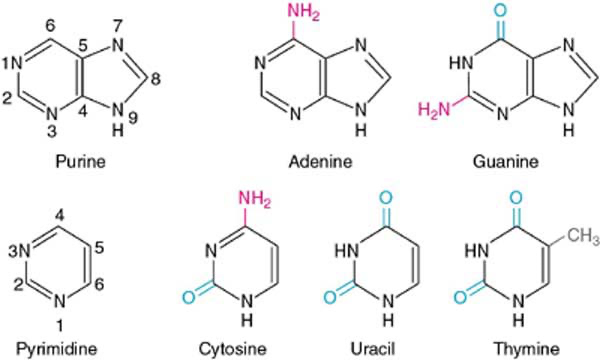
Purines

nitrogenous double rings (A & G)

<p>nitrogenous double rings (A &amp; G)</p>
3
New cards

Pyrimidines

nitrogenous single rings (T, U, & C)
<p>nitrogenous single rings (T, U, &amp; C)</p>
4
New cards

Equation for DNA Base Composition

%A + %G = %T + %C

5
New cards

Nucleic Acids

Polymer of nucleotides linked by phosphodiester bonds

6
New cards

What are the Major/Minor Grooves determined by?

The double helix places the backbone chains at unequal distances across from each other

<p>The double helix places the backbone chains at unequal distances across from each other</p>
7
New cards

Major Groove

Provides a wide, accessible location of binding

<p>Provides a wide, accessible location of binding</p>
8
New cards

Antiparallel

The DNA double helix runs side-by-side, but in opposite chemical directions

9
New cards

Components of a Chromosome

  1. Nucleotides

  2. Single strand

  3. Double helix

  4. DNA + Histones = Nucleosomes

  5. Chromosome


<ol><li><p>Nucleotides</p></li><li><p>Single strand</p></li><li><p>Double helix</p></li><li><p>DNA + Histones = Nucleosomes</p></li><li><p>Chromosome</p></li></ol><p></p>
10
New cards

DNA Replication Theories

  1. Semiconservative Mechanism

  2. Conservative Mechanism

  3. Dispersive Mechanism


11
New cards

Semi-conservative Mechanism

two parental strands separate ➡ each new DNA double helix contains one parent strand and one daughter strand

<p><span style="font-family: &quot;Times New Roman&quot;;">two parental strands separate </span><span data-name="arrow_right" data-type="emoji">➡</span><span style="font-family: &quot;Times New Roman&quot;;"> each new DNA double helix contains one parent strand and one daughter strand</span></p>
12
New cards

Conservative Mechanism

two parental strands stay intact ➡ totally new (daughter) double helix

<p><span style="font-family: &quot;Times New Roman&quot;;">two parental strands stay intact </span><span data-name="arrow_right" data-type="emoji">➡</span><span style="font-family: &quot;Times New Roman&quot;;"> totally new (daughter) double helix</span></p>
13
New cards

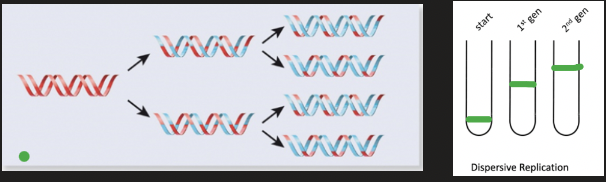
Dispersive Mechanism

 two parental strands break into fragments ➡ each new DNA double helix contains alternating patchwork of parental and daughter segments
<p><span style="font-family: &quot;Times New Roman&quot;;">&nbsp;two parental strands break into fragments </span><span data-name="arrow_right" data-type="emoji">➡</span><span style="font-family: &quot;Times New Roman&quot;;"> each new DNA double helix contains alternating patchwork of parental and daughter segments</span></p>
14
New cards

What did the Meselson & Stahl Experiment prove?

DNA replicated using the semi-conservative method

<p>DNA replicated using the semi-conservative method</p>
15
New cards

Polymerase Chain Reaction (PCR)

In-vitro form of DNA Replication

16
New cards

Origin of Replication

  • Site within a chromosome that serves as a starting point for DNA replication

    • Prokaryotes: 1 origin of replication

    • Eukaryotes: multiple origins of replication


<ul><li><p>Site within a chromosome that serves as a starting point for DNA replication</p><ul><li><p>Prokaryotes: 1 origin of replication</p></li><li><p>Eukaryotes: multiple origins of replication</p></li></ul></li></ul><p></p>
17
New cards

Replication Bubble

Open, unwound region of DNA replication

<p>Open, unwound region of DNA replication</p>
18
New cards

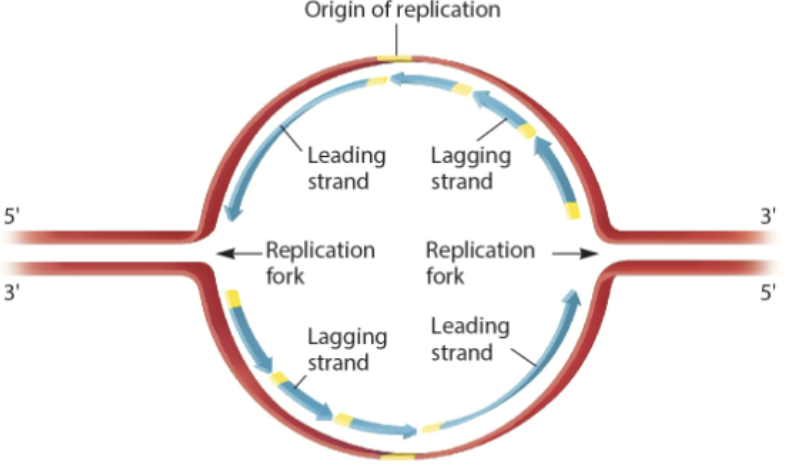
Replication Fork

Y-shaped region where the DNA double helix unwinds
<p>Y-shaped region where the DNA double helix unwinds</p>
19
New cards

Topoisomerase

Enzyme that prevents supercoiling ('“knotting”) in DNA

<p>Enzyme that prevents supercoiling ('“knotting”) in DNA</p>
20
New cards

Helicase

  • Enzyme that “unzips” the DNA, breaking hydrogen bonds

    • Lagging strand


<ul><li><p>Enzyme that “unzips” the DNA, breaking hydrogen bonds</p><ul><li><p>Lagging strand</p></li></ul></li></ul><p></p>
21
New cards

Primase

  • Enzyme that synthesizes the needed primer

    • Lagging strand


<ul><li><p>Enzyme that synthesizes the needed primer</p><ul><li><p>Lagging strand</p></li></ul></li></ul><p></p>
22
New cards

Primers

Small nucleic acids that bind to DNA, providing a 3’ (-OH) that DNA Polymerase can bind to

<p>Small nucleic acids that bind to DNA, providing a 3’ (-OH) that DNA Polymerase can bind to</p>
23
New cards

Single-strand Binding Proteins

Coat the DNA strands, preventing the reformation of the double helix during replication

<p>Coat the DNA strands, preventing the reformation of the double helix during replication</p>
24
New cards

DNA Polymerase needs _ replicate DNA…

  1. A template

  2. A primer (3’ hydroxyl)


25
New cards

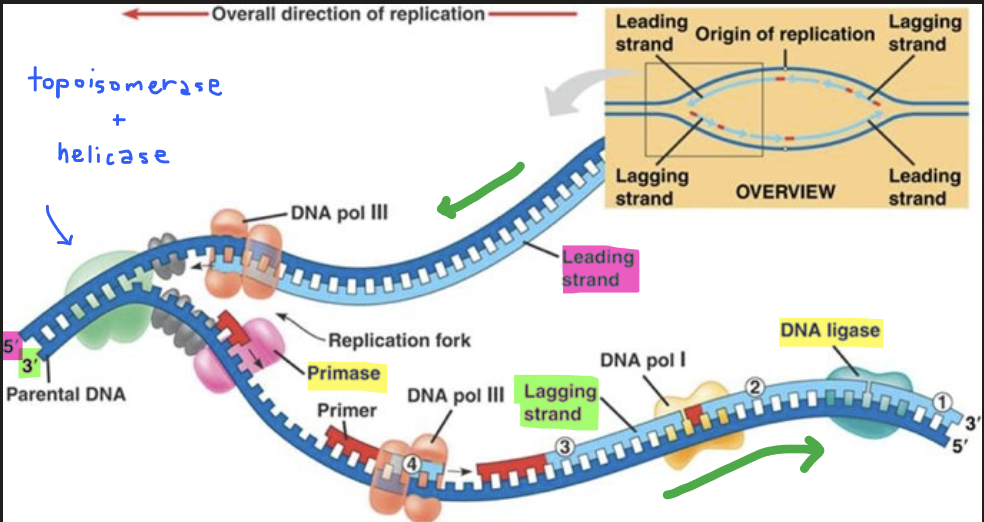
DNA Ligase

Forms a covalent bond between the first and second Okazaki fragments, forming a third Okazaki fragment
<p>Forms a covalent bond between the first and second Okazaki fragments, forming a third Okazaki fragment</p>
26
New cards

Leading Strand

synthesized as one continuous molecule, ALWAYS synthesized towards the replication fork

<p>synthesized as one continuous molecule, ALWAYS synthesized towards the replication fork</p>
27
New cards

Lagging Strand

synthesized as a series of small fragments, ALWAYS synthesized away from the replication fork

<p>synthesized as a series of small fragments, ALWAYS synthesized away from the replication fork</p>
28
New cards

Telomerase

Enzyme that synthesizes a repeating sequence to the ends of a strand, preventing chromosome shortening  ➡ Polymerase with a BUILT-IN template

<p><span style="font-family: &quot;Times New Roman&quot;;">Enzyme that synthesizes a repeating sequence to the ends of a strand, preventing chromosome shortening&nbsp; </span><span data-name="arrow_right" data-type="emoji">➡</span><span style="font-family: &quot;Times New Roman&quot;;"> Polymerase with a BUILT-IN template</span></p>
29
New cards

Telomerase Process

  1. Binds to a DNA repeat sequence

  2. Synthesizes a 6-nucleotide repeat sequence

  3. Repeats another sequence

  4. Primase makes an RNA primer (matching the 3' end)

  5. DNA Polymerase synthesizes the complementary strand

  6. Primer is eventually removed


<ol type="1"><li><p><span style="font-family: &quot;Times New Roman&quot;;">Binds to a DNA repeat sequence</span></p></li><li><p><span style="font-family: &quot;Times New Roman&quot;;">Synthesizes a 6-nucleotide repeat sequence</span></p></li><li><p><span style="font-family: &quot;Times New Roman&quot;;">Repeats another sequence</span></p></li><li><p><span style="font-family: &quot;Times New Roman&quot;;">Primase makes an RNA primer (matching the 3' end)</span></p></li><li><p><span style="font-family: &quot;Times New Roman&quot;;">DNA Polymerase synthesizes the complementary strand</span></p></li><li><p><span style="font-family: &quot;Times New Roman&quot;;">Primer is eventually removed</span></p></li></ol><p></p>
30
New cards

DNA Mutation

A mutation that alters the DNA sequence of a genome, which can affect traits

31
New cards

Point Mutation Types

  1. Silent

  2. Missense

  3. Nonsense

  4. Frameshift


32
New cards

Silent Mutation

Does NOT alter the amino acid sequence, even though the nucleotide sequence has changed

<p>Does NOT alter the amino acid sequence, even though the nucleotide sequence has changed</p>
33
New cards

Missense Mutation

Changes a single amino acid in a polypeptide sequence

<p>Changes a single amino acid in a polypeptide sequence</p>
34
New cards

Nonsense Mutation

Changes a codon into a termination codon

<p>Changes a codon into a termination codon</p>
35
New cards

Frameshift

Involves the addition/deletion of nucleotides NOT a multiple of three

<p>Involves the addition/deletion of nucleotides NOT a multiple of three</p>
36
New cards

Germ-Line Mutation

Reproductive cell mutation that affects the entire organism

37
New cards

Somatic Mutation

Body cell mutation that affects a specific patch of cells



