Section 1: Parasites
 Call Kai
 Learn
 Practice Test
 Spaced Repetition
 Match
 Flashcards
 Knowt Play
1/71

Earn XP
Description and Tags
Learning Outcomes: Compare the direct and indirect lifestyles of a parasite. Describe the role of vectors in the transmission of parasites. Describe the methods for the diagnosis and control of parasites in a clinical setting. Discuss the impact globally of parasites in healthcare.
72 Terms
oocyte def.
Oocyte : a cell in an ovary that may undergo meiotic division to form an ovum
Trophozoite
Trophozoite : a growing stage in the life cycle of some protozoan parasites, when they are absorbing nutrients from the host
Cyst
Cyst : a stage in the life of certain parasites, during which they are involved in a protective wall
Intermediate host
Intermediate host : an organism that supports the immature or nonreproductive forms of a parasite
Definitive host
Definitive host : an organism that supports the adult or sezual reproductive form of a parasite
Tachyzoite
Tachyzoite : a cellular protozoan stage where organisms are motile, quickly multiplying, spreading through the blood, and responsible for population expansion
Bradyzoite
Bradyzoite (s) : the slowly dividing stage of the parasite that make up tissue cysts
what is a parasite
Parasites are organisms that live on or in another organism, the host, and derive a benefit and/or nutrients at the expense of the host.
T or F : parasites are not considered part of the normal flora
T
what are the four ways parasites can be acquired
Bites (tick, mosquito (malaria) )
Water (ex Giardia lambilia)
Environment (ex strongyliodes stercoralis, contaminated soil)
Food (ex diphylobothrium latum contaminated fish)
Based on location, how are parasites divided
Endoparasites
Ectoparasites
what classification of parasite is this?
Live within the host and cause infections
Anaerobic respiration
Usually permanent unless medical intervention (completed lifecycle in the host)
Undergo specialization to maximize their nutrient absorption Ex : loss of anus in flatworms and integument in helminths
Endoparasites
what type of respirtation do Endoparasites use
Anaerobic respiration (no o2)
T or F: Endoparasites are no permanent even without medical intervention
Usually permanent unless medical intervention (completed lifecycle in the host)
what classification of parasite is this :
live on the host and cause an infestation.
aerobic respiration and can be temporary, intermittent, or permanent.
they do not have a readily available source of nutrients → acquired adaptations, such as penetrating the skin, to acquire their nutrients.
Ectoparasites, also known as exoparasites
example of Ectoparasites, also known as exoparasites
Examples of ectoparasites include fleas or lice.
what type of respiration do ectoparasites use
aerobic respiration and can be temporary, intermittent, or permanent
T or F: There is generally less adaptation in ectoparasites when compared to endoparasites, but specialization does occur.
T: ectoparasites do not have a readily available source of nutrients → acquired adaptations, such as penetrating the skin, to acquire their nutrients.
give the pros and cons of endoparasites
Endoparasites :are protected from the external environment because they are inside their host and can more easily access nutrients
BUT These organisms do have to deal with the host immune system and have troubles dispersing throughout their host.
give the pros and cons of ectoparasites
ectoparasites are protected against the host immune system and can be easily dispersed.
BUT vulnerable to the external environment and have difficulty feeding
what are the 2 divison of endoparasites
Endoparasites: Protozoa (single celled) and Helminths (multicellular)
are protozoa single or multicellualr
single celled
are helminths single celled or multicellular
multicellular
T or F: protozoa are single cells eukaryotic organisms
T: Usually microscopic
Protozoa examples (3)
Plasmodium spp.
Giardia spp
Toxoplasma spp.
what is Plasmodium spp.
protozoa endoparasite Causes malaria via a vector mosquito
what is Giardia spp
protozoa endoparasite
Causes giardiasis (abdominal pain and diarrhea)
Colonizing small intestine
what is toxoplasma spp
protozoa endoparasite
causes toxoplasmosis
T or F: Helminths are large, multicellular organisms
T: visible to the naked eye in their adult stages
T or F: helminths proliferate within their host
F: do not proliferate within their hosts. Worms develop slowly, so any resultant diseases are slow-onset and chronic.
Examples of helminths (3)
Cestodes
trematodes
nematodes
what helminths is this :
Flatworm parasites most tape worms
Flat segmented worms
Live in intestines
Transmission by eating undercooked meat
asymptomatic can have diarrhea, vomiting, weight loss, abdominal discomfort
Cestodes
what helminths is this?
AKA flukes
Infect blood vessels, lungs, GI tract, liver
Ex : schistosoma spp → infects blood → schistosomiasis
Trematodes
what helminthis is this?
Round worm
Contaminated food and water
Ex Stronglyoides spp
Ex Enterobius vermicularis
Nematodes
What is a further classification of ectoparasites?
Arthropods
what are Arthropods characterists
Exoskeleton
Segmented body
Paired jointed limbs
2 types
what are the 2 types of arthopods
Two types
1) 6 legged insects : fleas, flies, lice which actively feed on host tissues and fluids
2) 8 legged arachnids: ticks and mites (which bite into tissues and feed off of host fluids)
fleas, flies, lice are examples of what type of arthropods?
1) 6 legged insects : fleas, flies, lice which actively feed on host tissues and fluids
ticks and mites are examples of what types of arthropods
8 legged arachnids: (which bite into tissues and feed off of host fluids)
what kind of tissue do arthropods bite on too? what does that cause?
Bite dermal tissues = inflammation and hypersensitivity reactions
T or F arthropods are either: Are either histophagus (tissue feeding ) or hematophagus blood sucking
T:
T or F: arthropods are usally involved either pathogen or vector
T
what are 2 examples of arthropods
Scaroptes scapiei :
Pediclus humanus
what arthropod is this?
an arthropod responsible for scabies, a contagious skin infestation that is also known as the seven-year itch.
severe itchiness and a rash. Occasionally, tiny burrows may be seen in the skin.
Scaroptes scapiei :
T or F: lice feed on human blood
T: ediclus humanus
Human lice
Body or head
Pediculus humanus corporis, which causes body lice
Pediculus humanus capitis, which causes head lice
Feed on human blood
T or F: Pediculus humanus corporis causes head lice
T: Pediculus humanus corporis, which causes body lice
Pediculus humanus capitis, which causes head lice
breifly review the classifications of parasites

what is the difference btw a Facultative Parasites and an Obligate Parasites
Facultative Parasites
Free living state or as a non parasite (commensal even)
May be parasitic only during certain part of life cycle and free living other times
Obligate Parasites
Can not survive as a free living
Needs host to survive
T or F: oligate parasite will often kill host quickly
F: Need to preserve the health of the host
Do not often result in death of host (bc need them for food and replication)
however not the case when death of the host is need to be transmitted
what are the 3 roles that host can take on in relation to the parasite
Primary host / definitive host
Secondary host
Reservoir host
what type of host?
Host serves a source of infection
Host has the infective stages of the parasite development but the parasite does not develop or cause disease here
Reservoir host
what type of host?
Parasite reaches adult/sexual mature stage in
Can undergo sexual reproduction in the host
Primary host / definintive
what type of host?
Harbours larval/immature/asexual stages of parasite
Undergoes asexual reproduction in a secondary host
Secondary host
Direct life cycle needs how many hosts
only need one host
Indirect life cycle needs how many hosts
1+ intermediate host
what are namatode trichostronglyus
Roundworm nematode in the intestines
what type of life cycle direct or indirect
Once in the host = lay eggs (ex if in the GI → eventually passed via stool)
Eggs hatch → larva released in rhabditiform stage (early development not infective yet)(grown in feces or soil)
5-10 days larvae = filariform larvae = infective
Human host contact → larvae go through skin of feet → BV → heart → lungs → pulmonary alveoli → ascend the bronchial tree → pharynx → swallowed
Larvae reach intestines, reside and mature into adults and live in the digestive tract
Direct Life Cycle of namatode trichostronglyus
what type of life cycle direct or indirect?
Unsporulated oocytes of the parasite are shed in the cat’s feces
Oocytes takes 1-5 days to sporulate = infective, intermediate host = animal that ingest contaminated soil, water, plant material become infected
Oocytes → tachyzoites after ingestion by intermediate host and localize in neural and muscle tissue → tissue cysts bradyzoites
Cats become infected by consuming intermediate host that have tissue cysts (rats, birds, etc)
Animals that humans eat can also become infected after eating sporulating oocysts from environment
Humans get infected by:
By eating undercooked meat of animals harboring tissue cysts
By consuming food or water contaminated with cat feces or by contaminated environmental samples
By a blood transfusion or organ transplantation
Transplacentally from mother to fetus
Stages of indirect Life Cycle : Toxoplasma gondii
what is a Tachyzoites
Tachyzoites: A cellular stage where organisms are motile, quickly multiplying, spreading through the blood, and responsible for population expansion.
what is a Bradyzoites
Bradyzoites: slowly dividing stage of the parasite that make up tissue cysts
During the chronic portion of this stage, tachyzoites stage-convert to bradvoites to form tissue cysts
How do humans get infected by Toxoplasma gondii
Humans get infected by:
By eating undercooked meat of animals harboring tissue cysts
By consuming food or water contaminated with cat feces or by contaminated environmental samples
By a blood transfusion or organ transplantation
Transplacentally from mother to fetus
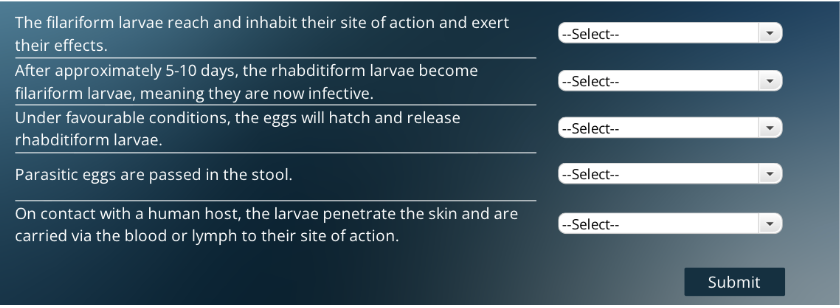
order the life cycle of a direct life cycle

is the rhabditiform stage is non infective
The rhabditiform larva (first-stage or L₁ larva) of Strongyloides stercoralis is non-infective to humans, grown in feces or soil, eggs are hatched —> rhabditiform larva
filariform larvae form from what? are they infective?
egg —> rhabditiform larva —> filariform larvae ( they are infective)
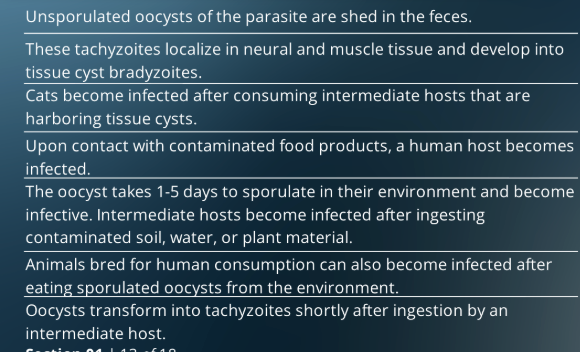
order the life cycle of a indirect life cycle

what are tachyzoites formed from? fast or slow replication? are they infective? direct or indirect life cycle?
indirect life cycle (ex toxomplasma)
They are infective and transform from oocysts shortly after ingestion by an intermediate host
represent the rapidly dividing, mobile form of Toxoplasma gondii responsible for the acute phase of infection and systemic spread
tachyzoites —> bradyzoites
T or F: indirect life cycle parasites are easier to control
F: direct life cycle completes life cycle in 1 host.
easier to control with antiparasitic agents or interventions.
indirect life cycle, need multiple hosts to complete their life cycle.
tend to be more complex and more virulent as they have multiple hosts to continue propagation of infection.
They don't have to worry about killing off their only host.
indirect life cycle sexual reproduction occurs exclusively inside the host.
(a lifecycle requiring two or more host species to complete),
definitive host
T or F: vectors are only biological
F: A vector transmits the parasite from host to host and can be either biological or mechanical
T or F: Bio vectors are not needed for parasite to complete the life cycle
F: Biological
Bio vectors are need for parasite to complete the life cycle
Mosquitoes
Ticks
Cats
Fish
Crabs
what is a mechinical vector?
Any unessential vectors to the parasites life
EX:
Water
Watercress
A dark leafy green grown in natural spring water
Question: Give two examples of how an individual can become infected with a parasite, describing the mode of transmission and how the parasite replicates and matures. Include one example of a parasite with a direct life cycle and one example of a parasite with an indirect life cycle.