Doctor-patient communications in consultations
 Call Kai
 Learn
Learn Practice Test
 Spaced Repetition
 Match
Match Flashcards
 Knowt Play
1/32

There's no tags or description
Looks like no tags are added yet.
Name | Mastery | Learn | Test | Matching | Spaced | Call with Kai | Chat |
|---|
No analytics yet
Send a link to your students to track their progress
33 Terms
What is doctor-patient communication?
The verbal & non-verbal interactions that occur between a healthcare provider & a patient, with the aim of exchanging information, understanding medical concerns & fostering a therapeutic relationship
Communication is not only about transmitting facts. What else does it include?
Building trust & mutual understanding
Empowering patients by involving them in decisions about their care
Emotional support (often includes discussions about sensitive topics (e.g. illness, prognosis & quality of life)
What is the importance of communication in relation to foundations for future clinical practice?
As medical students shift from theory to patient interaction, effective communication becomes as vital as medical knowledge
Skills (e.g. history-taking, explaining diagnoses, discussing treatments and educating patients) are foundational to medical students’ practice
What is the importance of communication in relation to building trust & rapport with patients?
Crucial for gathering information & making patients feel comfortable
Patients are more likely to follow treatment plans & return for care when they feel understood
What is the importance of communication in relation to improving diagnostic & treatment accuracy?
Medical students must practice active listening to gather key information, as missed details can lead to errors
Asking the right questions, clarifying concerns and providing clear explanations improve understanding of the patient’s condition
What is the importance of communication in relation to patient-centered care?
Medical students should consider individual preferences, values and needs in treatment decisions
Effective communication helps medical students understand the holistic aspects of care, including social, psychological and cultural factors
What is the importance of communication in relation to managing difficult conversations?
Medical students will face challenging situations (e.g. delivering bad news or discussing end-of-life care)
Therefore, they must develop emotional intelligence & communication skills to navigate these situations with empathy
What is the importance of communication in relation to collaboration with healthcare teams?
Effective communication ensures team alignment & coordinated, high-quality care
Medical students must learn to communicate clearly & work well in multidisciplinary teams (e.g. with nurses, specialists & pharmacists)
What is the importance of communication in relation to enhancing professionalism & confidence?
Explaining complex medical concepts with empathy builds respect
Effective communication also reduces anxiety & boosts students’ confidence, preparing them for future careers
What is the importance of communication in relation to improving patient satisfaction?
Patient satisfaction depends on feeling heard, understood and involved in their care
Satisfied patients are more likely to follow treatments, leading to better outcomes & a more rewarding practice for doctors
What is the definition of empathy in relation to communication?
The ability of doctors to understand & share the feelings, experiences and perspectives of a patient
What is the definition of verbal empathy?
Using words to acknowledge & validate the patient’s emotions, concerns or experiences
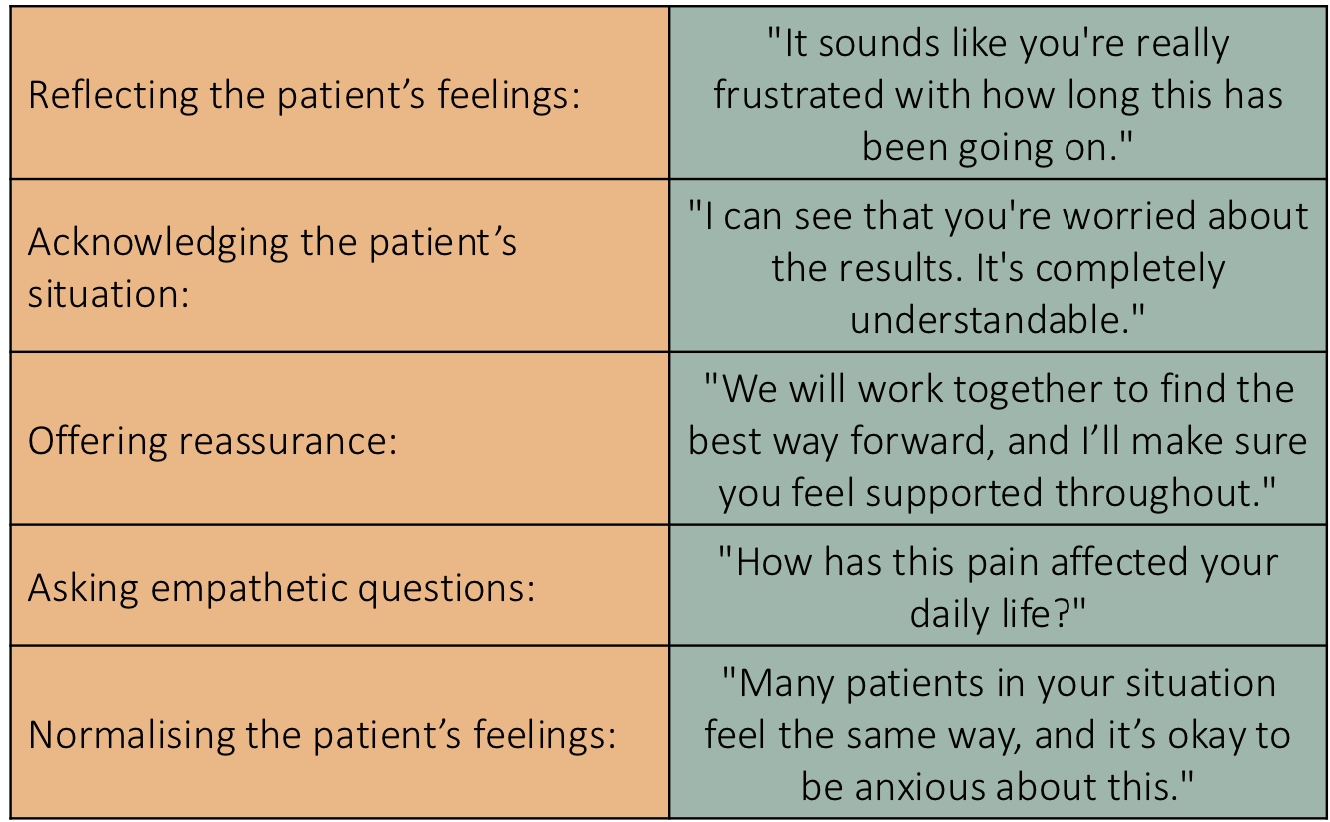
What is the definition of non-verbal empathy?
Empathy that is conveyed through body language, facial expressions & other physical cues that reflect understanding & care

What are some benefits of empathy?
Patients are more likely to trust a doctor who demonstrates understanding & care for their feelings & concerns
Empathy fosters a positive experience, leading to higher satisfaction with the healthcare provider
When patients feel understood, they’re more likely to engage actively in discussions about their health & treatment
What is the definition of active listening?
The practice of giving your full attention to the patient, ensuring you understand their concerns & responding in a thoughtful, meaningful way

What are some techniques for active listening?
Allow patients to speak without interruption:
give patients time & space to express their concerns & thoughts without cutting them off
interruption can make the patient feel unheard or rushed, which may limit the information they share & hinder trust
Paraphrasing & summarising:
restating what the patient has said to ensure understanding & confirm their concerns shows that you’re actively engaged in the conversation & prevents miscommunication
Pay attention to tone & body language:
non-verbal cues (e.g. facial expressions, gestures & posture) provide additional context to what the patient is saying
patients may sometimes minimise or avoid discussing their emotional states verbally, but non-verbal cues can reveal underlying anxieties or distress
What are some benefits of active listening?
Patients feel more understood & respected, which enhances their trust in the healthcare provider
Encourages patients to share more accurate information, leading to better diagnosis & treatment
Empathetic, attentive communication creates a stronger bond, which improves adherence to treatment plans
What is the definition of clear information exchange in doctor-patient communication?
The effective & unambiguous sharing of relevant health-related information between a doctor & a patient
It encompasses the accurate delivery, reception & understanding of messages regarding a patient’s condition, diagnosis, treatment options & overall care plan

How can clarity & simplicity help in clear information exchange?
Avoid medical jargon (patients often find medical terminology confusing) & explain complex information in plain language that’s easy for the patient to understand
e.g. instead of saying “hypertension”, say “high blood pressure”
Overwhelming patients with jargon can create confusion, reduce adherence to treatment & increase anxiety
Break down instructions into small, digestible parts → e.g. “First, take this pill every morning with food. Next, try to walk for at least 30 minutes a day. Finally, if you feel any dizziness, call the clinic immediately.”
How can the teach-back method help in clear information exchange?
Involves asking patients to repeat back the information or instructions you have provided to ensure they have understood correctly
This helps identify gaps in the patient’s understanding & allows the doctor to clarify or correct any misunderstandings
e.g. after explaining how to take a new medication, ask “Can you tell me how you’re going to take this medication each day?”
What are some benefits of clear information exchange?
Patients are more likely to adhere to medical advice, which leads to better health outcomes, as they clearly understand their diagnosis & treatment plan
Clear, empathetic communication helps patients feel more comfortable, reducing anxiety & increasing satisfaction with their care
By ensuring the patient understands & participates in their care, the doctor-patient relationship is strengthened, leading to a more collaborative partnership in managing health
What are 3 examples of barriers in doctor-patient communication?
Language barriers: the doctor & patient do not share a common language or when medical jargon is used, leading to misunderstandings or incomplete information exchange
Cultural differences: variations in beliefs, values & health practices between doctors & patients can create misunderstandings about symptoms, treatments or medical advice
Emotional barriers: fear, anxiety or stress from the patient can prevent them from fully listening, asking questions or expressing their concerns clearly
also, a doctor’s detachment or hurriedness can impeded effective communication
How can language barriers in doctor-patient communication be overcome?
Use of professional interpreters:
employ certified medical interpreters (in-person or via phone/video) to facilitate accurate & confidential communication
this ensures that patients with limited English proficiency (LEP) understand critical health information
Simplified language:
use short, clear sentences & avoid complex medical jargon
use easily understood language & confirm understanding by asking patients to paraphrase the information provided
Multilingual resources:
provide written materials (e.g. forms, prescriptions & discharge instructions) in the patient’s preferred language
this allows patients to review & absorb the information in their own time
Cultural competence training:
train healthcare providers to be aware of & sensitive to language & cultural differences
this makes patients feel more comfortable asking questions or expressing concerns
How can understanding of illness be a cultural difference in communication?
Cultural beliefs:
patients from different cultural backgrounds may have unique beliefs about the origins & treatment of illness (e.g. some may believe in spiritual causes of illness or embrace alternative medicine, such as herbal remedies)
Impact on treatment acceptance:
patients from cultures that emphasise holistic approaches might prioritise treatments that align with their cultural practices & may resist or question conventional medical treatments
Health-seeking behaviour:
certain cultures may delay seeking medical help due to traditional beliefs or reliance on home remedies, which can impact diagnosis & treatment outcomes
How can communication styles be a cultural difference in communication?
Indirect vs direct communication:
some cultures value indirect communication, where patients may avoid openly expressing concerns, asking questions or disagreeing with the doctor
however, other cultures may embrace direct, open dialogue where patients feel comfortable voicing opinions & asking detailed questions
Respect & deference:
in certain cultures, patients may show great respect for medical authority & refrain from questioning the doctor’s expertise, even if they’re confused or unsure about the treatment
How can views of medical authority be a cultural difference in communication?
Doctor-directed decision-making:
in some cultures, patient expect doctors to take a paternalistic role, making decisions on their behalf without much input
they may view the doctor as the primary authority figure whose decisions should be followed without question
Shared decision-making:
other cultural groups may prefer a collaborative approach, where patients expect to be actively involved in the decision-making process, contributing their opinions & preferences when choosing treatment options
What are 3 examples of how cultural barriers can be overcome?
Cultural awareness & sensitivity:
healthcare providers should be aware of cultural differences in beliefs, communication & decision-making preferences
tailoring communication to accommodate these differences can help build trust & ensure that patients feel respected & understood
Adapt communication style:
adjust your approach by recognising whether the patient prefers a more direct or collaborative role in their care
use open-ended questions to learn about the patient’s cultural preferences
Patient education:
educate patients in a culturally sensitive way by addressing their beliefs about illness & treatment
explain medical concepts in a manner that aligns with their understanding & values
What is the definition of psychosocial & emotional barriers in doctor-patient communication?
A patient’s mental & emotional state (e.g. fear, anxiety or stress) impairs their ability to understand & engage in effective communication with their healthcare provider
What impact can psychosocial & emotional barriers have on communication?
Patients may find it difficult to fully process or retain information about their condition or treatment
This can led to misunderstandings of critical health details & potential cause patients to withdraw from discussions or avoid asking important questions
What impact can psychosocial & emotional barriers have on decision-making?
Anxiety or fear can cloud a patient’s judgement, making it hard for the to make informed decisions or follow through on treatment recommendations
They may focus on worst-case scenarios or become overwhelmed by the volume of medical information presented
What are some examples of how psychosocial & emotional barriers can be overcome?
Acknowledge & validate emotions:
recognise & address the patient’s emotions directly (e.g. “I can see you’re feeling worried about this. Let’s talk through your concerns.”)
this helps patients feel heard, respected & understood
Provide empathetic & reassuring responses:
use empathy to build trust by responding to patient concerns with care & reassurance
offer encouragement & create an open, supportive environment where patients feel comfortable expressing their fears
Simplify information:
avoid using medical jargon & focus on delivering clear, simple explanations of the patient’s condition & treatment options
break information into manageable chunks to prevent overwhelming the patient
Offer emotional support resources:
recommend counselling or support groups when appropriate, as these can help patients manage their emotional responses & improve their ability to engage in their care plan
What is the definition of patient confidentiality?
The obligation to protect all personal health information, whether shared verbally, in writing or electronically (this is both an ethical & legal duty). For example:
discuss patient information only in private setting where unauthorised individuals cannot overhear
follow institutional protocols & guidelines when sharing patient information with colleagues or for referrals, ensuring it is need-to-know
What is the definition of patient autonomy?
The right of patients to make informed decisions about their own medical care.This requires that they understand the relevant information & make decision free of coercion