(ADBS) PRELIM
 Call Kai
 Learn
Learn Practice Test
 Spaced Repetition
 Match
Match Flashcards
 Knowt Play
1/116

There's no tags or description
Looks like no tags are added yet.
Name | Mastery | Learn | Test | Matching | Spaced | Call with Kai | Chat |
|---|
No analytics yet
Send a link to your students to track their progress
117 Terms
Database
Database Management System (DBMS)
Database Application
Users
What are the components of database system?
Database
What is an organized collection of structured information, or data, typically stored electronically in a computer system?
Database Management System (DBMS)
What serves as an interface between the database and its end-users or programs?
Database Management System (DBMS)
What allows users to retrieve, update, and manage how the information is organized and optimized?
Performance monitoring
Tuning
Backup and recovery
A DBMS also facilitates oversight and control of databases, enabling a variety of administrative operations such as?
Database Application
What is a set of one or more computer programs that serves as an intermediary between the user and the DBMS?
Application programs
by sending DB query language to the DBMS
What does read or modify database data? And how?
Naive Users
Application Programmers
Sophisticated Users
What are the types of users?
Naive Users
Who are the unsophisticated users who interact with the system by using predefined user interfaces; such as web or mobile apps?
Application Programmers
Who are the computer professional who write application programs?
Sophisticated Users
Who interact with the system without writing programs? Instead they form their requests either using a DB query language.
Database System Architecture
What involves database design and construction on how the database will operate and function within existing structures and location?
Centralized Database System
Distributed Database System
What are the two main types of database system architecture?
Centralized Database System
What is the database that supports data located at a single site?
Distributed Database System
Which refers to a collection of multiple interconnected databases, and spread physically across various locations?
Structured Data
Unstructured Data
Semi-structured Data
What are the structures of data in DBMS?
Structured Data
Which refers to data that are stored in relational databases?
Structured Data
Which type of data uses a predefined and expected format or schema?
Unstructured Data
Which refers to data that exist in its original or raw state the can come in all shapes and sizes?
Semi-structured Data
Which refers to individual items of the same type may have different sets of attributes?
Semi-structured Data
Which contains semantic tags and there is no predefined schema?
Structured Data
What data structure does the example represent?

Unstructured Data
What data structure does the example represent?

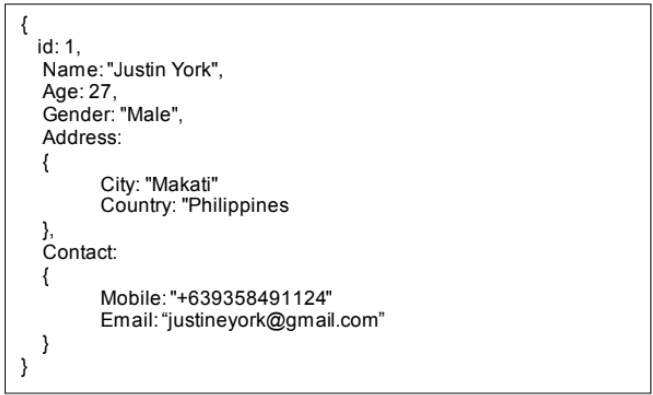
Semi-structured Data
What data structure does the example represent?
SQL (Structured Query Language)
NoSQL
NewSQL
Object-Oriented DB
XML (Extensible Markup Language)
What are the types of database management system?
SQL (Structured Query Language)
What refers to a computer language for storing, manipulating, and retrieving data stored in a relational database?
NoSQL
What is generally used to describe a new generation of DBMS that is not based on the traditional relational database model?
Not only SQL
What does NoSQL stands for?
Big Data
NoSQL has been developed to address the challenges represented by what?
NoSQL
Which features a dynamic schema for unstructured data and the data can be stored in different ways?
NoSQL
What allows you to create documents without first having to carefully plan and define their structure?
NewSQL
Which incorporates and builds on the concepts and principles of SQL and NoSQL systems?
NewSQL
Which provides improved functionality and services, by combining the reliability of SQL with the speed and performance of NoSQL?
Object-Oriented Database
Which refers to a database that stores object rather than data as individual relations?
C++, Java and C#
Object-Oriented Database makes use of object-oriented languages such as?
Object-Oriented Database
Choose this when you have a business need for high performance on complex data.
XML (Extensible Markup Language)
Which is designed to facilitate the exchange of structured documents?
XML (Extensible Markup Language)
Which simplifies data sharing between various systems because of its
platform-independent nature?
XML (Extensible Markup Language)
Choose this as long as your datasets stay relatively small.
PL-SQL
T-SQL
PostgreSQL
MySQL
SQLite
What are the examples of SQL Extensions?
PL-SQL
What is the combination of SQL along with the procedural features of programming languages?
PL-SQL
What was developed by Oracle Corporation and stands for Procedural Language?
Transact-SQL
T-SQL stands for?
T-SQL
What is the Microsoft’s and Sybase’s extension of SQL that adds and declare variables, support transaction control, error and exception handling, and row processing to SQLs existing functions?
PostgreSQL
What is the open-source object-relational database system that uses and extends the SQL language?
MySQL
What is the open-source SQL relational database management system that was developed and supported by Oracle?
SQLite
What is the relational database management system contained in a C programming library?
BEGIN/END
DECLARE
SET or SELECT
CAST
PRINT
TRY-CATCH
What are examples of T-SQL Statement Blocks?
BEGIN/END
What is used to define a set of SQL statements that execute together?
DECLARE
What is used to declare a variable in SQL server?
@ symbol
If we want to use a variable in SQL server, what do we need to declare first and start variable names with?
SET or SELECT
What is used to assign a value(s) to a variable?
CAST
What converts an expression of one data type to another?
What allows users to return a pre-defined message or value?
TRY-CATCH
What consists of a try block followed by one or more catch clauses, which specify handlers for different exceptions?
TRY-CATCH
What feature helps to deal with any unexpected or exceptional situations that occur when a program/query is running?
IF-ELSE
ELSE
ELSE-IF
WHILE
CASE
What are some examples of T-SQL Conditional Statements?
IF-ELSE
This conditional statement specify a block of code to be executed, if the returning condition is true.
ELSE
This conditional statement specify a block of code to be executed, if the returning condition is false.
ELSE-IF
This conditional statement specify a new condition to test, if the previous returning condition is false.
WHILE
This conditional statement loops through a block of code as long as a specified condition is true.
CASE
This conditional statement is the extension of IF-ELSE statement.
CASE
This conditional statement allows the user to apply multiple conditions to perform different sets of actions.
Common Table Expression (CTE)
What does specify a temporary named result set?
WITH
What operator can be used to define a CTE?
Common Table Expression (CTE)
What allows users to define tables that can be used in a particular query?
SELECT
INSERT
UPDATE
DELETE
What are the other statements CTE can be referenced within?
ORDER BY
INTO
OPTION
What are the clauses that cannot be used in CTE queries?
Non-Recursive CTE
Recursive CTE
What are the types of CTE?
Non-Recursive CTE
Which doesn’t use repeated procedural loops or recursion?
Non-Recursive CTE
Which type of CTE is easier to understand?
Recursive CTE
Which type of CTE uses recursion?
Recursive CTE
Which is useful when working with hierarchical data?
Recursive CTE
Which type of CTE continues to execute until the query returns the entire hierarchy?
Subqueries
What is a query (SELECT statement) inside another query?
parantheses
Subqueries are expressed inside what?
Outer Query
What refers to the first query in the SQL statement?
Inner Query
What refers to the query inside the SQL statement?
Inner Query
Which query is executed first?
output of an inner query
What is used as the input for the outer query?
In WHERE clause
In FROM clause
In SELECT clause
In IN operator
In ALL and ANY operator
Correlated Subqueries
In EXISTS operator
What are examples of subqueries?
WHERE clause
Which subquery work as part of the row selection process?
WHERE clause
Which subquery is often found in the WHERE clause?
Nested Subqueries
WHERE clause is also called as?
FROM clause
Which subquery returns a temporary or virtual table?
FROM clause
Which subquery is useful in data warehousing application?
Inline View or Derived Table
FROM clause is also called as?
SELECT clause
Which subquery is nested in the list of another SELECT statement?
IN operator
Which subquery allows users to match one item from any of those in the list?
ANY operator
Which subquery returns true if any of the subquery values satisfy the condition?
ALL operator
Which subquery returns true if all the subquery values meet the condition?
Correlated Subqueries
Which subquery is used to select data from a table referenced in the outer query?
Correlated Subqueries
Which is executed repeatedly, once for each row evaluated by the outer query?
Simple Subquery
Correlated subqueries cannot be executed independently as?
Repeating Subquery
Correlated subqueries are also known as?
EXISTS operator
Which subquery is used to check whether a subquery produces any rows of query results?
Correlated Subqueries
EXISTS operator is commonly used with what?
Views
What refers to a virtual table that is constructed from other tables or views and saved as an object in the database?
Views
Which has no data of its own, but obtains data from tables or other views?
ORDER BY clause
A reference to a temporary table or a table variable
What cannot be included in VIEWS?