Bio Unit 1 Short Answer
 Call Kai
 Learn
Learn Practice Test
 Spaced Repetition
 Match
Match Flashcards
 Knowt Play
1/23

There's no tags or description
Looks like no tags are added yet.
Name | Mastery | Learn | Test | Matching | Spaced | Call with Kai | Chat |
|---|
No analytics yet
Send a link to your students to track their progress
24 Terms
Draw the Molecule
Explanation:
The parts where the circles connect, or where there is a lone pair, represent the covalent bonds that occur between the Hydrogen and Oxygen atoms.
Each hydrogen has only one valence electron, while Oxygen has six valence electrons, meaning oxygen is readily available to share the charge of two more electrons. That is why it forms covalent bonds with hydrogens in order to gain two more electrons to complete its full octet.
The exact bond type in this molecule is polar covalent bond, because the atoms are sharing electrons unequally. This means that, because oxygen has a higher electronegativity, it receives a partial negative charge. The two hydrogen atoms have a partial positive charge. These partial charges and unequal sharing of electrons makes the water molecule polar.
Oxygen and Hydrogen have a large electronegativity difference. This means oxygen is “electro-needy” and has a stronger pull of the electrons from the hydrogens. Polarity is characterized by one type of atom in a molecule being more electronegative than the other, because it creates partial charges and unequal sharing of electrons.
DRAW a water molecule with its 3 atoms in its correct shape using Bohr models. Indicate all 4 poles, both positive (+) and negative (-). Show:
all three atoms within an individual water molecule
all valence electrons including:
the shared electrons (covalent bonds)
lone pairs
Briefly explain your drawing using complete sentences. In your explanation, describe:
polarity
type of bond(s) connecting each atom

Draw the Molecule
Explanation:
The three atoms within an individual water molecule include two hydrogen atoms and one oxygen atom. The oxygen has a high electronegativity compared to the hydrogen atoms. Because of this difference in electronegativity, the oxygen atom has a partial negative charge. The hydrogen atoms have partial positive charges, because the atoms with lower electronegativities have the partial positive charges.
Oxygen is the “electro-needy” atom in this molecule, so it has a stronger pull on the shared electrons. This means that the electrons are being shared unequally, causing the polarity. Polarity is characterized by one type of atom in a molecule being more electronegative than the other, because it creates partial charges and unequal sharing of electrons.
Each hydrogen has only one valence electron, while Oxygen has six valence electrons, meaning oxygen is readily available to share the charge of two more electrons. That is why it forms covalent bonds with hydrogens in order to gain two more electrons to complete its full octet.
The specific type of bond is a polar covalent bond, due to the unequal sharing of electrons and partial charges on the atoms.
Explain the causes of the bonding between THE THREE ATOMS WITHIN AN INDIVIDUAL WATER MOLECULE. . You must discuss:
all three atoms within an individual water molecule.
polarity.
valence electrons.
type of bond(s).
You MUST use both a diagram and a description using complete sentences to complete your answer.
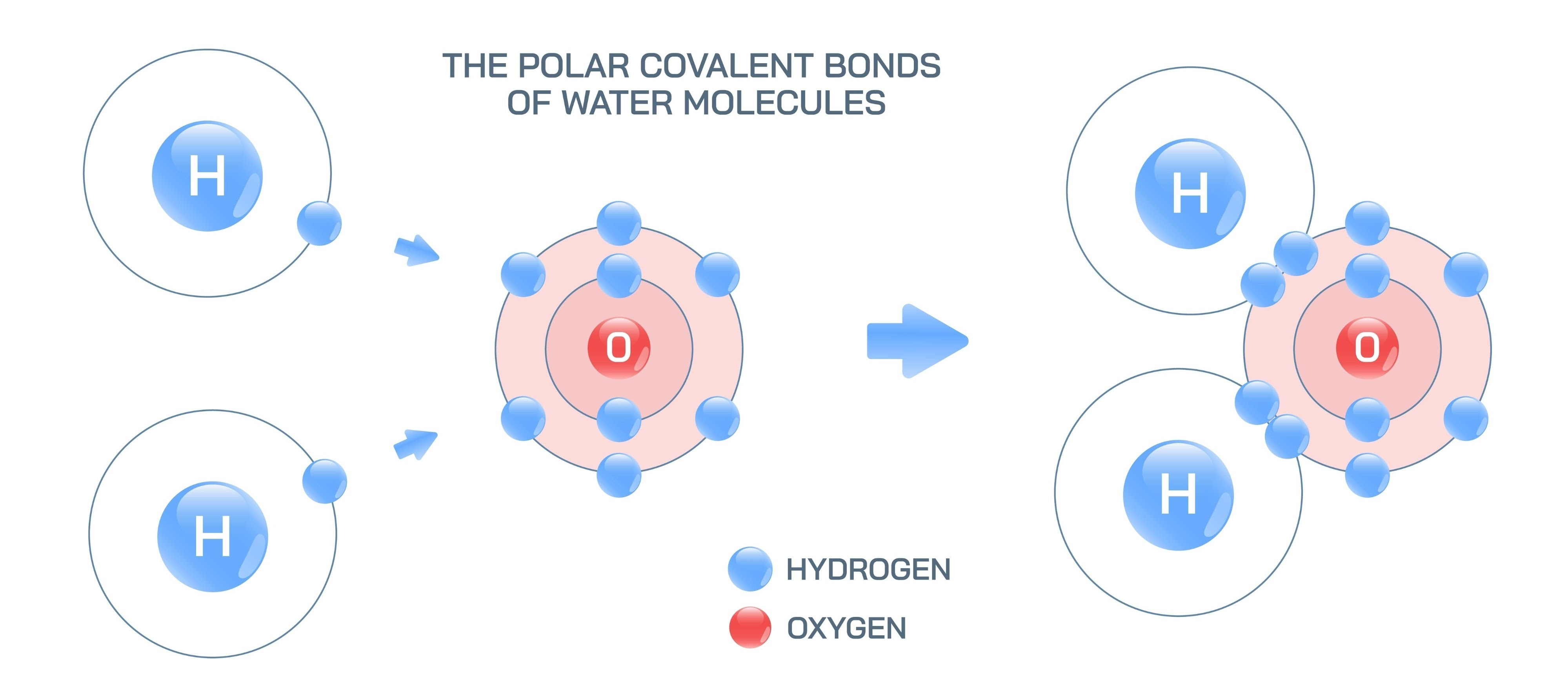
Draw the Diagram
Explanation:
The three atoms within an individual water molecule include two hydrogen atoms and one oxygen atom. The oxygen has a high electronegativity compared to the hydrogen atoms. Because of this difference in electronegativity, the oxygen atom has a partial negative charge. The hydrogen atoms have partial positive charges, because the atoms with lower electronegativities have the partial positive charges.
Each hydrogen has only one valence electron, while Oxygen has six valence electrons, meaning oxygen is readily available to share the charge of two more electrons. That is why it forms covalent bonds with hydrogens in order to gain two more electrons to complete its full octet.
Oxygen is the “electro-needy” atom in this molecule, so it has a stronger pull on the shared electrons. This means that the electrons are being shared unequally, causing the polarity. Polarity is characterized by one type of atom in a molecule being more electronegative than the other, because it creates partial charges and unequal sharing of electrons.
The type of bonds between the atoms in the water molecule is polar covalent bonds. The type of bond between several molecules of water is hydrogen bonds.
The hydrogen bonds form between water molecules, because the molecules are polar. They are polar, because they have partial charges on the ends of the molecule (partial positive for the hydrogen atoms and partial negative for the oxygen). The partially positive end of one hydrogen atom is attracted to the partially negative end of another water molecule. These attractions cause weak bonds between the molecules called hydrogen bonds, which constantly break and reform the hexagonal lattice network.
Explain the causes of the BONDING BETWEEN SEVERAL MOLECULES OF WATER. You must discuss:
all three atoms within an individual water molecule.
polarity.
valence electrons.
type of bond(s).
You MUST use both a diagram and a description using complete sentences to complete your answer.

A single water molecule is incapable of forming a hydrogen bond, because a hydrogen bond is a bond that forms between separate molecules, not within one. Hydrogen bonds are intermolecular forces, which means it is a weak electrostatic attraction between the positive hydrogen of one molecule and the negative oxygen of a separate water molecule. One water molecule needs another neighboring molecule in order to form a hydrogen bond with.
Why is a single, isolated water molecule incapable of forming a hydrogen bond? Respond using complete sentences.
It is cooler by the lake, because water has a high specific heat capacity, meaning it takes a lot more time and energy to raise or lower by 1 degree Celcius. When the sun shines on a lake, the energy can’t speed up the molecules right away. The energy is first directed at breaking the hydrogen bonds between the water molecules. While a single hydrogen bond is not very strong, the hexagonal lattice structure that forms from water molecules’ hydrogen bonds is strong. The energy is mainly used to break these bonds rather than speed up molecules, so it cannot increase the molecular motion quickly. Cooler substances, like the water molecules, have slow molecular motion. Because water has a high specific heat capacity, it takes a large amount of energy to heat up the water in a lake. The cool air rushes over the land as the hot air on the land rises.
Why is it “cooler by the lake” in the summer? Consider specific heat, molecular motion, and hydrogen bonds in your response. Respond using complete sentences. Use Lake Michigan as example?
Through evaporation, liquid (or sweat) transitions into a gas. Heat from your skin transfers the energy into sweat, which makes the molecules move faster (increased Kinetic Energy). Water has a high heat of vaporization, because it takes a large amount of energy to turn liquid water into gas. As the sweat absorbs the heat from your body in the form of energy to change phase into gas, your skin loses the heat energy (it cools down).
How does evaporative cooling (sweating) reduce your body temperature? Consider the heat of vaporization, molecular motion, and hydrogen bonds in your response. Respond using complete sentences.
Ice floats, because it has a lower density as a solid than a liquid. Hydrogen bonds lock water into a rigid hexagonal lattice structure when frozen, and gaps between the molecules are created, which lowers the density. In liquid form, the hydrogen bonds constantly break and reform, causing the constant movement. As it cools, the molecules slow (lose kinetic energy) until they become in a fixed position in the lattice structure.
Why does ice float? Discuss hydrogen bonds and molecular motion in your response. Respond using complete sentences. B
Cohesion is an attraction of water molecules to each other due to hydrogen bonding, while adhesion is an attraction of water molecules to other molecules, such as charges surfaces.
In cohesion, the attraction of water molecules to other water molecules, which creates a strong surface tension. While in adhesion, the water molecules stick to non-water substances.
A similarity is that in both cohesion and adhesion is that the attractions form hydrogen bonds. In adhesion, water molecules are able to form hydrogen bonds with other molecules or charged surfaces like plant cell walls. In cohesion, water molecules are able to bond with other water molecules due to hydrogen bonds. This is because the positive end of one water molecule is attracted to the negative end of another.
What is a difference AND a similarity between water adhesion and cohesion? Discuss hydrogen bonds in your response. Respond using complete sentences.
Because water is polar, it can dissolve other polar substances, or substances that also have partial charges. In other words, “Like dissolves like". The partially charged ends of water molecules attracted to the oppositely charged ends of other polar molecules. Ionic compounds have charged ends also, which allows for the charged ends of the ionic compounds to attract to the oppositely charged ends of the water molecules. The water molecules easily form hydrogen bonds with molecules that also have partially charged ends, so it is able to create a pulling force that breaks the bonds (dissolves).
Why is water capable of dissolving ionic compounds and polar molecules but is incapable of dissolving nonpolar molecules? Respond using complete sentences.
Water has a high boiling boiling, because it has a high specific heat capacity. Meaning it takes a larger amount of energy to raise 1 gram of water 1 degree Celcius compared to most other liquids. Most of the thermal energy applied to water is used in the breaking of the hydrogen bonds, so there is less amount of energy that can go into increasing molecular motion (speeding up the molecules). The hydrogen bonds hold the water molecules tightly together. The partial positive end of a hydrogen bonds with the partial negative oxygen of another, creating a strong intermolecular force (hydrogen bond). At 100 degrees Celcius the water molecules move fast enough that the energy is able to break the hydrogen bonds.
Why is water’s boiling point higher than most other liquids? Discuss molecular motion and hydrogen bonds in your response. Respond using complete sentences.

Draw model
Atomic number: 6
Protons: 6
Neutrons: 6
Electrons: 6
Explanation:
The first energy level holds two electrons and the second energy level holds four valence electrons. It needs four more electrons to share to complete its octet. These four valence electrons allows carbon to form four covalent bonds. This means carbon atoms can form long chains, which helps build the structure for proteins and DNA.
Draw a Bohr model for carbon-12 (atomic number 6). Identify the number of protons, neutrons, and electrons (including details about electron energy levels). Describe how this atomic structure allows carbon to form the central “backbone” element of macromolecules. Respond using complete sentences.
The blood glucose level of the lactase persistent individual will be significantly higher than the blood glucose level of the lactase non-persistent individual. The lactase persistent individual is able to produce the lactase enzyme. So, they are able to break down the milk sugars (lactose) into glucose and galactose. In return, they will have a high concentration of glucose in the blood. While a lactase non-persistent individual is not able to produce the lactase enzyme, so they are not able to effectively break down the lactose into glucose. This results in a low level of glucose in the blood. That is why the lactase non-persistent individual’s blood glucose levels are low.
The blood glucose data of the lactase persistent individual will show an upward rise, while the data of the lactase non-persistent individual will show minimal change.
Prepare to analyze blood sugar (glucose) data from a lactase persistent individual vs. a lactase non-persistent individual after both consume milk (which contains lactose).
The blood glucose level of the lactase persistent individual will be significantly higher than the blood glucose level of the lactase non-persistent individual. The lactase persistent individual is able to produce the lactase enzyme. So, they are able to break down the milk sugars (lactose) into glucose and galactose. In return, they will have a high concentration of glucose in the blood. While a lactase non-persistent individual is not able to produce the lactase enzyme, so they are not able to effectively break down the lactose into glucose. This results in a low level of glucose in the blood. That is why the lactase non-persistent individual’s blood glucose levels are low.
A lactose intolerant individual lacks the enzyme lactase to break apart milk sugar. A lactose tolerant individual produces this enzyme. If both of these individuals consume milk, predict the differences you would expect in their blood sugar (glucose) levels over time. Explain the reasoning behind your prediction. Use complete sentences in your response.
Starch is a polysaccharide that is made of glucose monomers. It naturally twists into a tight linear shape due to alpha-1,4 glycosidic bonds. So, the reactive groups like ketone, aldehyde, and carbonyl are pointed inward and hidden within the chemical bonds inside the chain, leaving few to react with the Benedict’s reagent. Starch lacks free groups o the outside of the chain to react with the reagent, so it results in a negative result for presence of sugar.
However, digestive enzymes like amylase and maltase are able to break the glycosidic bonds in starch. This process of hydrolysis splits the molecule into smaller glucose molecules. This results in a rise in blood sugar levels.
If a starch solution was tested for the presence of sugar using Benedict’s reagent, it would yield a negative result (no sugar present). However, if starch is consumed and digested, it can eventually cause a rise in blood sugar (glucose) levels. Explain why this can occur. Use complete sentences in your response.
Joining monosaccharides together to form a disaccharide is a dehydration synthesis reaction. Water is released in the process, because an OH- or hydroxyl group is removed from one monosaccharide and an H+ is removed from the other one, forming a water molecule. Energy is required for this reaction. The functional groups involved include hydroxyl groups. The two monosaccharides are joined by a glycosidic bond. The atoms bonded together in the glycosidic bond are carbon and oxygen. The oxygen atom connects a carbon of one monosaccharide to a carbon of the other.
Describe the process of joining monosaccharides together to form a disaccharide. Using complete sentences, identify:
reaction type (dehydration synthesis or hydrolysis)
water (required or released)
energy (required or released)
functional groups involved
bond/linkage type
atoms bonded together
Digesting starch into glucose is a hydrolysis reaction. Water is required in the process in order to break the chemical bonds of the polysaccharide. Energy is released. The functional group involved is hydroxyl, because they help break the glycosidic linkages. The bond type that is broken in this process are glycosidic bonds. The atoms bonded together are carbon and oxygen atoms, which form the glycosidic b
Describe the process of digesting starch (a polysaccharide) into glucose (a monosaccharide). Using complete sentences, identify:
reaction type (dehydration synthesis or hydrolysis)
water (required or released)
energy (required or released)
functional groups involved
bond/linkage type
atoms bonded together
The reaction type is dehydration synthesis. Water is released and energy is required. The functional groups involved are amino and carboxyl groups. The bond type is a peptide bond. The carbonyl carbon atom bonds to the nitrogen atom of the amino group.
Describe the process of joining two amino acids together to begin to form a polypeptide. Using complete sentences, identify:
reaction type (dehydration synthesis or hydrolysis)
water (required or released)
energy (required or released)
functional groups involved
bond/linkage type
atoms bonded together
Forming a triglyceride is a dehydration synthesis reaction. Water is released, because the glycerol molecule and fatty acids are joined by removing the OH and H groups, thus forming three water molecules. Energy is required. The functional groups involved include hydroxyl groups (which is found in the glycerol) and carboxyl groups(found at the ends of the fatty acid chains). The linkage type is ester bonds. The ester bond is formed between carbon and oxygen atoms. And for each fatty acid that is attached, an OH (hydroxyl) from the glycerol bonds with an H atom from the fatty acid.
Describe the process of joining fatty acid chains to a glycerol molecule to form a triglyceride. Using complete sentences, identify:
reaction type (dehydration synthesis or hydrolysis)
water (required or released)
energy (required or released)
functional groups involved
bond/linkage type
atoms bonded together
The biuret test requires peptide bonds to be able to form the purple molecules.
Water yields a negative result, because it lacks peptide bonds to interact with the copper (II) ions. So, the solution remains the original blue color.
A solution of water and lysine amino acid monomers yields a negative result, because it also does not contain peptide bonds. The amino acid does not interact with the copper (II) ions in order to produce the purple molecules.
A solution of water and lysine amino acid monomers, and arginine amino acid monomers will yield a negative result because it does not contain the required peptide bonds. Free amino acids do not contain the peptide bonds to interact with the copper (II) ions and form purple molecules.
The solution of water and a water -soluble polypeptide yields a positive result, because it contains a chain of peptide bonds which will interact with the copper (II) ions. The nitrogen in the peptide bonds interacts with the copper ions by sharing electrons.
A biuret test is a chemical test used for detecting the presence of proteins. In the presence of peptide bonds, copper (II) ions in the biuret reagent form pale purple molecules (indicating a positive result for proteins). Explain the following results using complete sentences.
A solution of water yields a negative result.
A solution of water and lysine amino acid monomers yields a negative result.
A solution of water, lysine amino acid monomers, and arginine amino acid monomers yields a negative result.
A solution of water and a water-soluble polypeptide yields a positive result.
Digestive enzymes break starch down into smaller glucose molecules that get absorbed into the blood and raise blood glucose level. The enzymes break the chemical bonds in the starch, thus breaking down the starch into digestible molecules. A diabetic person does not produce sufficient insulin to clear the glucose into the cells, and so the sugar will accumulate in the blood. So, diabetics must be careful how much starch they eat so that too much glucose doesn’t enter their bloodstream and accumulate. A hydrolysis reaction is involved when starch is eaten and digested, because water is used to break the glycosidic bonds in the starch. Energy is released in this process in the form of glucose from the starch.
Diabetes is a disease in which your blood sugar (glucose) levels are often too high. Glucose comes from the foods we eat. Insulin is a hormone that helps the glucose get into your cells to give them energy. The body of a person with type 1 diabetes does not make insulin. Diabetics have to be mindful about how much glucose they consume. However, diabetes must also be mindful about how much starch (and other carbohydrates) they consume as well. Describe why consuming starch can cause a rise in blood sugar (glucose) levels. Discuss whether a dehydration synthesis reaction or hydrolysis reaction would be involved if starch is eaten and digested. Respond using complete sentences.
Being dehydrated would be problematic, because your body requires water molecules to break the chemical bonds within polymers. The water molecule has to split and donate an OH and H in order to effectively break the monomers apart. The lack of water molecules inhibits this process, since it is required.
Explain why being dehydrated would be problematic for your body’s ability to break apart polymers. Use complete sentences in your response.
Water is formed in the process of dehydration synthesis. When two monomers join together, the hydroxyl group (OH) of one is removed and bonds with the removed H atom of the other monomer. Thus forming an H2O molecule as a byproduct. At this time, the two monomers bond at the site to form the polymer.
Describe how water can be formed when building polymers. Use complete sentences in your response.
Similarities
both are built on a central glycerol molecule
both have three fatty acid chains connected to the glycerol
both are non polar
both function as energy storage for the cell
Saturated Side
only have single carbon-carbon bonds
solid at room temperature
have a straight, linear structure and thus are tightly packed
Unsaturated Side
have one or more double bonds, rather than just single bonds
liquid at room temperature
have bends and kinks in structure and thus are loosely packed
Produce a Venn Diagram table of similarities and differences between saturated triglycerides and unsaturated triglycerides. Identify at least three similarities and at least two differences. In other words, the “Saturated Triglycerides” section should have at least two entries, the “Unsaturated Triglycerides” section should have at least two entries, and the “BOTH Types of Triglycerides” section in the middle should have at least three entries. Identify similarities and/or differences in elemental composition, formation, structure and/or function.
Similarities
both contain adenine, guanine, and cytosine
both are built from monomers of nucleotides
found inside the nucleus of eukaryotes
role of storing or transferring genetic information
both work together to express genes and build proteins
DNA Side
contain the pentose sugar deoxyribose
contain thymine
double helix structure
RNA Side
contain the pentose sugar ribose
contain uracil
single stranded
Produce a Venn Diagram table of similarities and differences between DNA and RNA. Identify at least three similarities and at least two differences. In other words, the “DNA only” section should have at least two entries, the “RNA only” section should have at least two entries, and the “Both DNA and RNA” section in the middle should have at least three entries. Identify similarities and/or differences in structure, function, and/or location.