Growth/Bones and Burns/Wounds
 Call Kai
 Learn
 Practice Test
 Spaced Repetition
 Match
 Flashcards
 Knowt Play
1/28

There's no tags or description
Looks like no tags are added yet.
29 Terms
What is growth hormone (GH)?
Secreted by anterior pituitary and controlled by hormones from the hypothalamus (GHRH or GHIH), has both metabolic and growth effects
What are the metabolic effects of GH?
Lipid metabolism (breaks down trigylcerides and releases into blood)
Fuel for muscles
Increases blood glucose
How does GH promote bone growth?
Through increasing bone thickness and length.
Long bones grow in length at the epiphyseal plate, stopping in late adolescence. Cartilage at epiphyseal plate grows then is replaced by bone.
What happens if not enough GH?
Dwarfism can be pituitary defect, or abnormal GH receptors (Laron dwarfism)
Delayed growth
What happens if too much GH?
In children: gigantism - excessive growth of long bones
Adults: acromegaly - thickening of bones, growth of soft tissue
Functions of bones?
Mechanical: structural support, muscle attachment, protection, movement
Metabolic: mineral storage, calcium homeostasis, haematopoiesis
What types of bones?
Cortical or spongy
What is the chemical composition of bones?
Mineral salts: 65-70% (inorganic component) - more hard
Osteiod, collagenous fibres, non-collagenous proteins: 30-35% (organic component) - more flexible
What are the main cells of bone tissue?
Osetoblasts: bone building cells secreting osteoid (organic component)
Osteoclasts: Bone resorbing cells, releasing calcium into the blood
Osteocytes: mechanical sensors in bone - detect changes in mechanical environment, these are mature osteoblasts
Why do we remodel bone?
Calcium homeostasis
‘Mechanostat’ adapting shape for biomechanical force
Maintaining structural integrity (making small repairs)
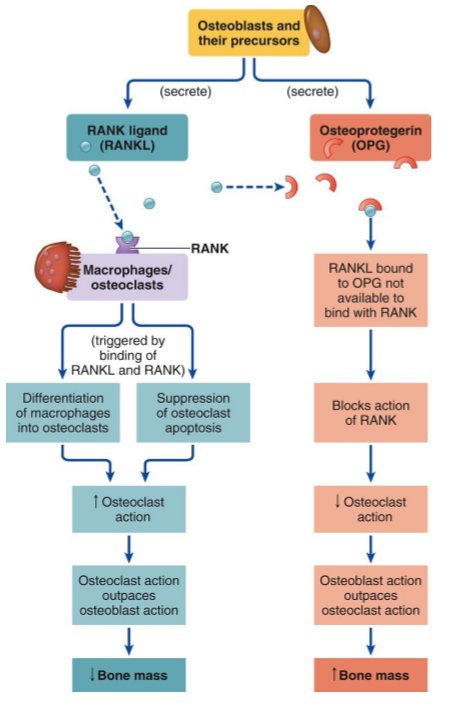
How is bone remodelling controlled?
Binding of RANKL to macrophages/osteoclasts increases osteoclast action overpowering osteoblasts and decreasing bone mass.
RANKL binding to osteoprotegerin (OPG) blocks RANK, reducing osteoclast action, osteoblasts overpower osteoclasts and increase bone mass.
What is the function of parathyroid hormone (PTH)?
Secreted when calcium blood levels drop. Increases blood calcium by taking it out of bone storage.
Fast exchange: immediate Ca2+ regulation
Slow exchange: response to hypocalcaemia. Breaks down bone.
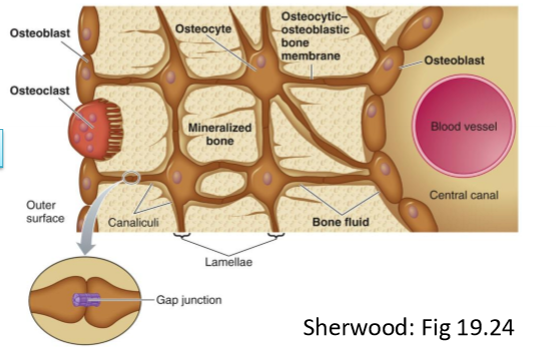
How does fast exchange occur?
Earliest effect of PTH, activates Ca2+ transport carriers in plasma membrane of osteocytes and osteoblasts. Transports Ca2+ from blone fluid into cells then into blood (central canal).
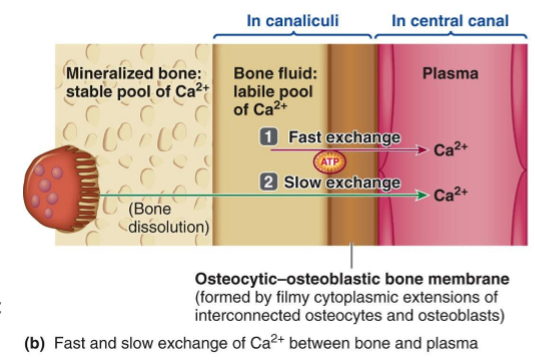
How does slow exchange occur?
From prolonged decrease in blood Ca2+, PTH inhibits osteoblasts and causes them to release RANKL which stimulates osteoclasts. Increases bone resorption, releasing calcium and phosphate into blood.
Effect of PTH on kidneys and then intestines?
Stimulates Ca2+ reabsorption, stimulates vitamin D activation.
Vitamin D then increase absorption of Ca2+ in the intestines.
How does bone mineral density increase?
Mechanical load above the normal range, causes increased bone mass.
What is osteoperosis?
Adolescent disease with geriatric onset. Decreased oestrogen and testoserone increases osteoclast activity and bone resportion.
Risk factors include: female, sendentary lifestyle, smoking, poor nutrition.
Can be prevented by increasing bone mass prior to age 30. maintaining calcium and vitamin D levels, and exercise.
What is thick and thin skin?
Thick skin is hairless on the soles of feet or palms. Increased epidermis. Thin skin is everywhere else.
What are the layers of the epidermis?
Stratum basale: deepest, single layer containing stem cells for regeneration of epidermis.
Stratum spinosum: prickly layer, daughter cells from basale.
Stratum granulosum: Contains granules with keratin and water resistance
Stratum lucidum: in thick skin only, clear layer
Stratum corneum: outermost, cells lack nucleus or organelles, filled with keratin layers
How do epidermis cells mature?
Stem cells divid in basale, daughter cells are pushed up and dead keratinized cells are lost on surface
What are the other cells of the epidermis?
Langerhan’s cells: immune cells, immune response to pathogens
Melanocytes: located in stratum basale, produce melanin to protect DNA
Merkel’s: located in basale, sensory receptor cells

What is the dermis?
Beneath the epidermis contains hair follicles and glands, blood vessels and sensory receptors, consists of:
Papillary dermis: top layer
Reticular demis: bottom layer
What is the hypodermis?
Beneath the dermis, location of subcutaneous fat, holds skin to tissue and permits movement.
What are the exocrine glands of the skin?
Subaceous glands: produce sebum (oily secretion) lubcriating hair and skin
Merocrine sweat glands: temperature regulation
Apocrine sweat glands: found in axilla, nipples, pubic and anal regions
What are the two healing processes?
Regeneration: proliferation of uninjured cells, returning to normal state
Scar formation: damaged tissue replaced by connective tissue
What are the stages of wound healing?
Inflammatory: 4-6 days, blood clotting and inflammation occurs
Proliferative: 1-14 days, cell divison, keratinocytes proliferate along wound edge, form scab layer, and proliferation in dermis layer. Granulation tissue also forms.
Maturation phase: 8 days - 1 year, granulation replaced by scar tissue, connective tissue is remodelled.

What are the different degrees of burn?
1st: superficial layer, sunburn - epidermis, skin and receptors functioning
2nd: superficial partial thickness & deep partial thickness - epidermis + upper or most dermis, skin function absent, receptors can be functional or diminished
3rd: full thickness, epidermis dermis and hypodermis, absent function and receptors

What are the zones of burn injury?
zone of coagulation: middle, irreversible nerve damage, coagulative necrosis
zone of stasis: tissue is compromised and ischaemic (reduced blood flow), outcome is variable
zone of hyperaemia: dilated blood vessels but no structural damage, will heal
What is burn shock?
Can cause death, it is systemic can involve all of the body, fluid shift results in hypovalaemia and decreased CO