BIOL 324 Midterm L1-5
 Call Kai
 Learn
 Practice Test
 Spaced Repetition
 Match
 Flashcards
 Knowt Play
1/119

There's no tags or description
Looks like no tags are added yet.
120 Terms
Name the 4 whorls of a flower from outward to inward
1st whorl: Sepals (collectively = calyx) (outermost)
2nd whorl: Petals (collectively = corolla)
3rd whorl: Stamens
4th whorl: Pistil (innermost)
corolla + calyx = ?
perianth
corolla = petals collectively
calyx = sepals collectively
anther + filament = ?
stamen


What is taxonomy?
Trying to organize organismal chaos (aka evolution)
It is people who observe, document, and publish what they have observed and tested
It is how we sort everything in our lives and the thought process to decide what goes with what
What would happen without taxonomy and taxonomists?
There would be no biodiversity
Types of taxonomy
Grouping
“Biology bit” taxa are grouped traditionally by morphology and more recently by evolutionary descent (i.e. “Clades”) reconstructed using phylogenetics
Ranking
Plants organized into different taxa (e.g. species, genera, families, orders)
Taxon
Rank
Naming
Naming new taxa and ensuring integrity of nomenclature by applying the ICBN
Taxon
a taxonomic group of any rank/level
Rank
Arbitrarily decided levels of taxonomic organization
Rank free nomenclature proposed (“phylocode”)
Examples of ranking
species, genera, families, orders
Example of grouping
Traditionally grouped by morphology
Recently by CLADES (by evolutionary descent)
What is applied when naming new taxa and why?
The International Code of Botanical Nomenclature (ICBN)
To provide meaningful and accurate names
What does grouping, ranking, and naming result in? Explain what each are.
Checklist - usually the beginning, building a list of what we see in the area being documents
Flora - a book of the plant diversity for a particular region (describes interactions)
Key - a dichotomous key of the flora (e.g. does it have hairs, red flowers, etc.)
What is grouping, ranking, and naming based on in taxonomy?
Based on diverse evidence of similarities and differences found in a plant’s morphology, ecology, biosystematics, and phylogenetic relationships
Why is taxonomy important in your life?
Biodiversity - Would be no way to understand biodiversity fully without it
Bio-compounds - Many plant groups have similar chemicals and properties that save or kill us
Economy - we eat 100 million bananas a year and trades at 25 billion/year
We wouldn’t know what we are eating without all these names (e.g. If you ask for a banana, they are not all the same around the world!)
Why is taxonomy important for science? (5)
Species discovery
what types of organism and how many, share the planet with us
Identification
basis of ecology, conservation, weed science, medicine, all types of organismal biology
Defines the units
for reporting on taxa and their populations (i.e. COSWIC reports)
Accurate grouping
provides powerful tool for hypothesis testing in comparative bio (i.e. within a phylogeny, can we predict a plant’s phenological response to global climate change?)
Informatics
provides “stable names” for ordering and retrieval of biological data (i.e. mapping)
Map / order of how to do taxonomy
Herbarium (all taxonomy starts here; basic classification, naming and data storage)
Field (plants must be examined in populations)
Laboratory (test hypotheses in lab)
Repeat (back to the herbarium)
Can genetics replace the science of taxonomy?
No; DNA alone cannot tell us the way an organism looks, behaves, or interacts with the environment without using taxonomy!!
what is the problem with grouping based on fruit colour instead of by morphology, ecology, shared chemistry, and evolutionary descent?
Many dark red fruits have antioxidants but that’s because they turn red since birds like red, so they’ll be more attractive for the birds to take the seeds - not really to do with the fruit itself
If you are a scientists and see 2 plants in an herbarium, how will use the steps / map of taxonomy to identify and determine if they are unique species?
I would begin in the herbarium where I would start with basic classification, naming, and data storage of the 2 plants —> this would also remove bias of pre-identification without knowing the name beforehand
I would then go to the field and observe the 2 plant species in populations and collect data
I would then go to the lab and test my hypotheses if they are unique species
After, I would repeat and go back to the herbarium
Structure where seeds are housed in a flower
Ovary
Unique feature(s) of tracheophytes
Have trachea (vascular tissue) which fights gravity
Unique feature(s) of embryophytes
retention of embryo
Seed plant diversity (distinguish the difference between the groups)
Gymnosperms - naked seeds
Angiosperms - enclosed seeds, have flowers, double fertilization
Gymnosperms
Morphologically diverse
Naked seeds (e.g. cones) —> seeds are NOT enclosed in pistils
Reproductive structures are found in cones
Cycads, conifers, Gingko, gnetoyphytes
only c. 950 species (mostly conifers)
Angiosperms
Enclosed seed
differ from gymnosperms in having flowers and double fertilization (c. 300,000 species)
Polytomy
When relationships between groups are unresolved

what was the 1st evolutionary land mark for seed plants? explain what it is and its types
Axillary lateral branching
arrangement/pattern of stem and branch growth on a plant
different types
unbranched
dichotomous
lateral

what type of branching?
lateral

what type of branching is this and a disadvantage?
Dichotomous
con: becomes weighted down

what type of branching
unbranched
Main axis of shoot vs. lateral branch
Main axis of shoot - growth at an apical meristem
Lateral branch - growth at a new apical meristem (each lateral branch starts off as an axillary bud)

what is this pic showing
shoot apical meristem
Shoots vs. buds
Shoots
above ground bits include stem, leaves, buds
Buds
have the potential to become a branch, leaf, or flower
What type of branching do all seed plants have
Axillary lateral branching
2nd evolutionary land mark of seed plants
Ovule/seed; pollen (gymnosperms have)
Pine pollen cone vs. Pine seed cone
Pine pollen cone
Pollen from leaf-like structures on main axis
Pine seed cone
Naked seeds on woody lateral branches on a main axis

Ginkgo biloba (family Ginkgoaceae) characteristics - gymnosperm
One family, one genus, one species (monotypic species)
Dioecious (has EITHER male (staminate) or female (ovulate, bearing seed called a peduncle))
Leaves are bilobed, with dichotomous venation
Ginkgo is a tree

Cycads (characteristics)
Have 3 families
In Cycadaceae, there is one genus (Cycas) and 105 species
East Africa, Madagascar, SE Asia, Tonga
Usually dioecious
Are trees/shrubs
Often unbranched

Conifers characteristics

Which 2 groups of gymnosperms have mobile sperm?
Ginkgo biloba & Cycads
For monoecious plants, why can’t you just take the one plant?
Because monoecious means there’s 2 types of reproductive (both male and female) cones on one plant
If you just take one plant, it will result in inbreeding - they’ll both have similar genetics
mitosis = ? = ?
mitosis = cell division = primary growth
where does cell division occur?

apical meristems connection to primary growth
apical meristems give primary growth as they keep doing mitosis and generating cells

what is this entire image showing and what does the red circle show
Entire: Root apical meristem
Red circle: Where cell division is occurring

what is this entire image showing and what does the red / pink circle show
Entire: Shoot apical meristem (bud)
Pink: If (a) gets damaged, these axillary buds will be activated to continue cell division
Explain secondary growth (=lateral meristem)
Only “woody” things have lateral meristem
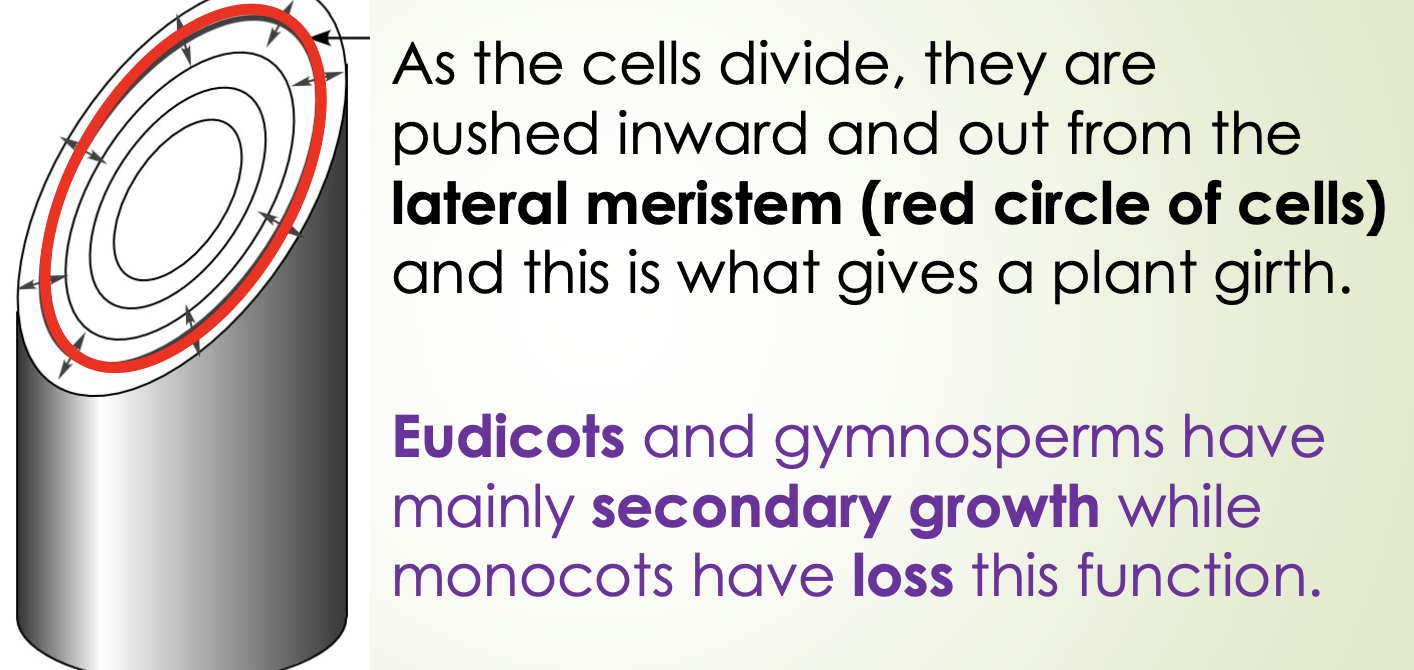
Do all eudicots, gymnosperms, and monocots have secondary growth?
Eudicots & gymnosperms have mainly secondary growth
Monocots have LOST this function
Apical bud = ?

Leaf primordial = ?

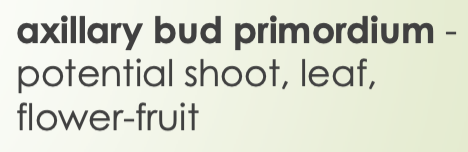
Axillary bud primordium = ?
Angiosperms evolved how long ago in what period
125 - 100 million years ago
Cretaceous Period
Angiosperms: Flowering plants characteristics (important) (5)
Closed carpels
Seeds enclosed within ovary (fruit)
Male pollen (gametophyte) highly reduced
Only 3 cells (1 pollen tube cell and 2 sperm cells - all specialized)
Penetrative pollen tube growth
Eats away at tissue of style to reach ovules for fertilization
If it’s self breeding it can choose to stop to prevent inbreeding
Double fertilization
1 sperm fertilizes egg cell and the other sperm cell fertilizes the polar nuclei to form nutritive tissue (= endosperm - found in seeds)
Reproductive structures arranged in flowers
Most flowering plant diversity is in ________
eudicots
Definition of a flower (important)
Short shoot
Bearing specialized appendages (modified leaves) for reproduction
Fertile appendages (modified leaves)
Stamens produce pollen
Pistil produce ovules with the female gametophyte and egg inside (seeds = fertilized ovules)
Sterile appendages (modified leaves)
Sepals and petals - are protective or attractive (or sometimes develop after pollination for seed dispersal)
Axis compressed and determinate
Determinate - flower determines its life; once you have a flower, the apical meristem for that branch is terminated and “used up”
seed plants = _________ & ___________
gymnosperms & angiosperms
most “basal” angiosperms are trees/shrubs, but what example is an exception?
Nymphaeales (water lilies) are aquatic herbs, usually with syncarpous carpels (i.e. a compound ovary)
Characteristics of Nymphaeales (water lilies)
Note: Tepals does NOT automatically mean primitive plant

Main groups of flowering plants?
Angiosperms:
Ambrorellales
Nymphaeales
Austrobaileyales
Magnoliids:
Piperales
Canellales
Magnoliales
Laurales
Monocots
Eudicots
Groups of basal angiosperms
Ambrorellales
Nymphaeales
Austrobaileyales
Piperales
Canellales
Magnoliales
Laurales
Last 4 are Magnoliids
List the 5 primitive flora features (important)
Elongated receptacle (where everything i.e. ovary, petals, . .is attached to)
Spirally arranged parts (not in whorls)
Floral parts numerous, seemingly indefinite
Floral parts free, not fused
Superior ovaries

what type of floral arrangement is shown
spiral arrangment
Characteristics of Amborellales (4)

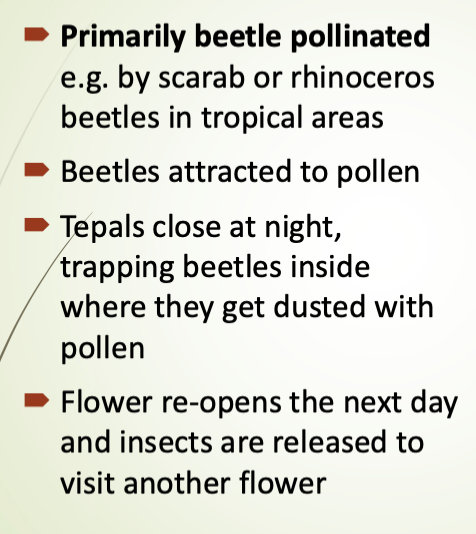
Pollination of Nymphaeales (chamber flower pollination)
Characteristics of Austrobaileyales
Flowers are often solitary, with superior ovary and spirally arranged parts (undifferentiated)
Perianth is made up of undifferentiated tepals
Carpels are loosely fused, known as apocarpous
Pollination of Austrobaileyales

3 largest groups of angiosperms in order of largest to smallest?
Eudicots
Dicots
Magnoliids
3 main morphological characters within the group Magnoliids
Grouping based on:
Trimerous flowers (comes in sets of 3)
Pollen with one pore
Mostly branching vein leaves
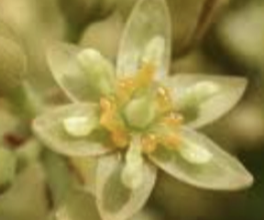
what type of flowers is this
(avocado flower) - trimerous flowers (comes in sets of 3)
Name the orders within the group Magnoliids and their edible plants
Piperales - pepper
Canellales - fragrant trees and shrubs
Magnoliales - nutmeg, mace, paw paw
Laurales - bay leaf, cinnamon, avocados
Pollination of Magnoliids: Magnolia - name the type of pollination & describe
also chamber flower pollination, similar to Nymphaeales

Pollination of Magnoliids: Piper - name pollination type and describe

What are the 7 basal angiosperm orders (end w/ “-ales”) in Angiosperms?
Amborellales
Nymphaeales
Austrobaileyales
Piperales
Canellales
Magnoliales
Laurales
Cotyledon
= “seed leaves”
food storage for seedling to germinate
some cotyledons have the ability to photosynthesize, but are different from “true leaves”
Seeds develop from what? List the 4 elements of a seed.
Seeds develop from ovules
4 elements:
Cotyledon
Endosperm (food to survive until true leaves grow)
Embryo (plant itself)
Seed coat (protection)

Common characters in monocots and eudicots?

What’s a synpomorphy
Synapomorphies = characteristic present in an ancestral species and shared exclusively by its evolutionary descendants
Name and describe four synapomorphies characters that define monocots.
(1) Monocot embryo (embryo has 1 cotyledon)
(2) Adventitious (= fibrous) root system
Seedling root (radicle) stops growing early; adventitious roots take over
(3) Parallel leaf venation
All the veins end at the same point
*some monocots evolved back to reticulate venation
(4) Herbaceous (herbs)
Lost secondary growth
Describe different ways to tell the difference between monocots and eudicots.
Monocots:
Seedling root (radicle) stops growing early; adventitious roots take over
Parallel leaf venation
Lost secondary growth
Eudicots:
Seedling root (radicle) persists and develops into main root: taproot
Reticulate leaf venation
Yes secondary growth(?)

Explain why palm tree isn’t a “tree”
Lack secondary growth (it is woody but has no wood)
Doesn’t have rings (no rings = not wood = no secondary growth)

What are some features of beetle/Chamber Flower and Brush pollination?
Beetle/Chamber Flower Pollination
Fruity fragrance attracts beetles → beetles crawl around eating pollen and old, fallen stamens (food bodies) → pick up pollen on their bodies and deposit pollen from previously visited flowers while crawling around → some species thermogenic (thermogenesis = the plant rewards the beetles by actively heating them at night)
Brush Pollination
Insects (e.g. hoverflies & beetles) attracted by pollen reward
Consume pollen but also transfer some to other flowers and plants
May also be wind pollinated (more random, unpredictable)
Basically, insects shake plant with their bodies and get pollen
Characteristics of Amborella trichopoda

What species change our understanding of the evolution of monocots and eudicots? How did it change our understanding?

Explain how floral evolution has increased in synorganization
(1) Differentiation of floral parts (e.g. undifferentiated tepals to calyx and corolla)
(2) Reduction in number or loss of floral parts
(3) Changes in symmetry from radial to bilateral to asymmetrical
(4) Compression of the receptacle and change from spiral arrangements of parts to whorled
(5) Fusion of floral parts (e.g. free to fused)
Primitive vs. Advanced Floral Charactres
Primitive vs. Advanced Organisms

Explain the five evolutionary trends in perianth evolution and with examples: Differentiation
An undifferentiated perianth of tepals is primitive (e.g. basal angiosperms)
Morphologically and anatomically differentiated sepals and petals are advanced (e.g. eudicots)
However. . .
Outer and inner perianth whorl (sepals + petals) may look alike morphologically, like Liliaceae (e.g. monocot)
Perianth of undifferentiated tepals (primitive character) occurs in some otherwise advanced families, like Cactaceae (e.g. eudicot)
Conclusion:
Group or family can or cannot have differentiated parts, yet this does not define if the group is primitive or advanced
You must look at many morphological characters from many species, to help define evolutionary relationships based on morphology

Explain the five evolutionary trends in perianth evolution and with examples: Reduction or loss of perianth parts
Primitive - indefinite number of separate, free parts
Advanced - smaller, definite number of parts (evidence for reduction can be seen in vestigial structures)
Sepals and petals - often reduced to 3 or multiples of 3 in monocots, and to 4 or 5 or multiples of 4 or 5 in dicots
Parts may be lost altogether; calyx or corolla or both may be absent (e.g. grasses)

Explain the five evolutionary trends in perianth evolution and with examples: Symmetry
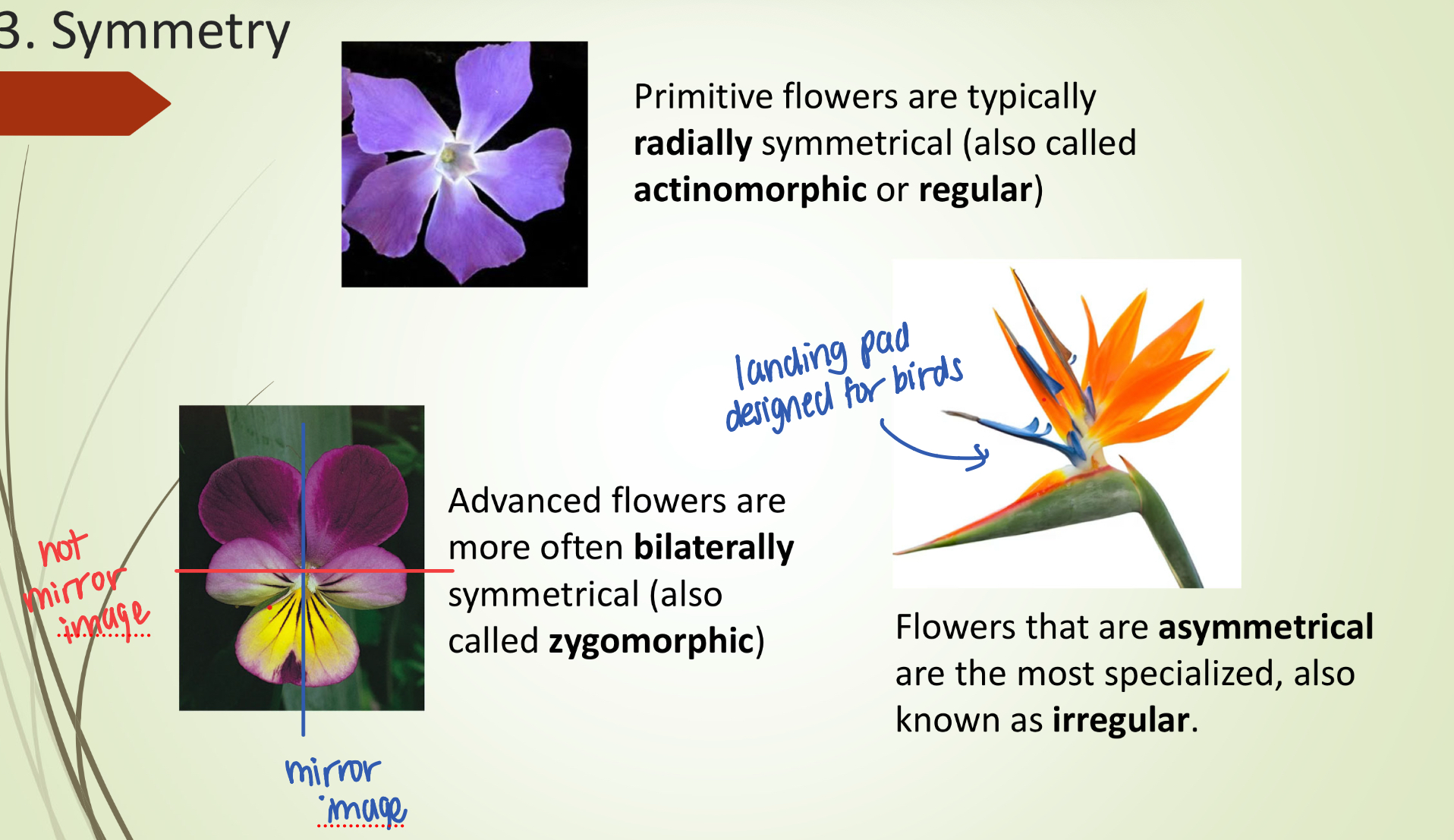
Explain the five evolutionary trends in perianth evolution and with examples: Symmetry (continued. . . changes in symmetry - the 2 types)

Zygomorphy (symmetry - 1/5 evolutionary trends in perianth evolution)
Define, common in ______ flowers, zygomorphic corollas occur in _______ taxa, typical pollinators and traits to attract pollinators, examples?
Zygomorphic & asymmetrical flowers are usually associated with a reduction in the number of floral parts
Common in sympetalous flowers (petals fused near base)
Zygomorphic corollas occur in polypetalous taxa (e.g Viola and Fabaceae), but are more characteristic of sympetalous families (e.g. Lamiaceae)
Changes in symmetry of the corolla is almost always an adaptation for pollination
Zygomorphic flowers: usually pollinated by bees (hymenoptera)
Flower colours vary (except red) usually with nectar guides or UV patterns to attract bees
Usually fragrant, broad floral tube
Reward is nectar & pollen
Bilabiate: Having 2 lips (often sympetalous) → e.g. monkey flower, sage
Explain the five evolutionary trends in perianth evolution and with examples: Compression of receptacle
Primitive receptacle is usually elongate (e.g. Mangoliaceae)
Allows floral parts develop in a spiral arrangement
Advanced receptacle - changed to a flattened receptacle and whorled parts (floral organs attached at the same level) — almost always correlated with a reduction in number of floral parts

Name a receptacle you eat (and is it fused) and a receptacle that has seeds you can eat
Receptacle you eat: Strawberries
the “dots” are seeds (ovaries) which are NOT fused
receptacle (the strawberry) makes them look fused by they’re not (trick Q)
Receptacle with seeds you can eat: Sunflower seeds
Ovule = ?
Ovary = ?
Ovule = seed
Ovary = fruit
Explain the five evolutionary trends in perianth evolution and with examples: Fusion (of floral parts)
Adenate - fusion of different floral whorls
Connate - fusion of the same whorl
Fusion of floral parts → one of the most important evolutionary trends in floral evolution
Connation (fusion of like parts) - of tepals, sepals, or petals into a tube is especially common, but also found in stamens
E.g. Tepals = perianth tube, Corolla = sympetalous, Calyx = synsepalous
Adnation (fusion of unlike parts) - of stamens to the perianth tube often accompanies fusion of petals (e.g. connate petals with adnate stamens — e.g. epipetalous)
Explain the five evolutionary trends in perianth evolution and with examples: Fusion (of stamens)
Connation
Stamen filaments fuse into a stamina tube (e.g. Hibiscus)
Anthers of stamens are connate (fused) but filaments are free (e.g. Asteraceae)
Adnation or fusion of fusion stamens and petals = epipetalous
Explain the five evolutionary trends in perianth evolution and with examples: Fusion (advanced floral fusion)
Hypanthium:
Advanced floral structured composed of fused sepal, petal, and stamen filament bases
Can form tubular, cup, bowl, or saucer-shaped structure, fused to the ovary wall

What floral fusion is shown (left and right)?
Left: Adnate
Right: Connate

What type of fusion is being shown? Describe
Adnation (fusion of unlike parts) - fusion of stamens and petals here = epipetalous

what type of fusion shown here? how do you know
Connation - anthers of stamens are connate (fused) but filaments are free
Asteraceae