cocaine & amphetamines
 Call Kai
 Learn
 Practice Test
 Spaced Repetition
 Match
 Flashcards
 Knowt Play
1/78

There's no tags or description
Looks like no tags are added yet.
79 Terms
Cocaine and Amphetamines are what type of drug?
part of a larger class of drugs known as stimulants, psychomotor stimulants, psychostimulants or uppers
Stimulate alertness and arousal
Stimulate motor activity
cocaine
psychoactive alkaloid found in coca leaves ( natural)
weak base
1800s and early 1900s used widely, doctors and scientists lauded its properties
Raw leaves
-natural
-2% concentration
-raw leaves are chewed with lime powder or ash to increase saliva ph to decrease ionization
-absorption in mouth
coca paste
-natural
-crude extract from leaves
- 80% cocaine sulfate
- can only be smoked
- "paco" or "basuco"
Cocaine HCl (hydrochloride)
-natural
-crystalline powder extracted and purified from coca paste
- very high concentration if pure
-water soluble ( coca cola)
- orally, intranasally or IV NOT SMOKED
Cocaine free base
-natural
- cocaine hcl + water + base -> extracted with ether
-vaporized dand smoked
-can be dangerous ( blow up / fire)
crack cocaine
-natural
- 75-90%
- cocaine hcl + baking soda
-smoked
-led to epidemic in 80s&90s
History of cocaine use
Coca/cocaine was widely used in many products by late 1800s
medical use for cocaine
-Cocaine has local anesthetic effects (therefore, DEA schedule II)
-Primary mechanism of cocaine: blocks monoamine transporters (like DAT).
-High doses also inhibits voltage-gated Na+ channels (involved in action potentials).
Cocaine absorption and distribution
- Extremely rapid absorption of cocaine with smoking or IV
- Peak subjective effect for crack cocaine is ~1-2 min ( over in 5-15 min)
Cocaine metabolism and elimination
- Half-life is 0.5-1.5 hrs
- Inactive major metabolite: benzolecgonine
- Active metabolite cocaethylene is formed when cocaine and ethanol are ingested simultaneously; longer half-life than cocaine
amphetamines
chemical family of synthetic and natural psychostimulants
Ephedrine
-natural
-decongestants
-ephedrine and pseudoephedrine
Cathinone
-natural
- comes from khat or qat shrub leaves
-commonly chewed
Methcathinone and mephedrone
-synthetic variants of cathinone
- 'cat' and 'meow meow'
- designer drugs disguised as bathsalt
- DEA Schedule 1
history of use amphetamines
-1920-30s: Medical use developed
-Benzedrine inhaler (for congestion) - 1932
-First use for narcolepsy - 1935
-1940s: Widespread adoption during WWII
-Early 1970s: Peak use of "speed,
Synthetic forms of amphetamines
* D-Amphetamine
* L-Amphetamine
* Amphetamine ( adderall)
Taken orally or injected
Methphetamine
-most potent of amphetamines
- oral snorted, injected IV or smoked
-synthethic
"Amphetamine-like" stimulants differ in chemical structure:
Methylphenidate
Modafinil
History of amphetamine use
- Used for nacolepsy
- Mild depression and as a diet pill
- Used widely by military during WWII (increased wakefulness)
- 10% of population were regular users in 1970
Meth epidemic
-High purity, can be smoked . As with other drugs, faster route of administration = more abuse potential.
-Easily prepared from common household ingredients.
Current medical uses for amphetamines
DEA schedule II
narcolepsy
attention deficit disorder (ADD, ADHD)
Amphetamines metabolism and excretion
Amphetamines have a slower metabolism and elimination as compared to cocaine; half-life is 7-30 hrs.
Behavioral and subjective effects of cocaine and amphetamines in humans
Autonomic effects also: increased blood pressure, hyperthermia, bronchodilation.

Cocaine vs. Amphetamines
Effects of cocaine (as compared to amphetamines)
- Shorter duration of action
- Worse cardiovascular effects (can be lethal)
- Higher convulsive/seizure properties of cocaine
Stimulants: Major effects in animals
-Animals: hyperlocomotion Locomotor activity can appear to go down with high AMPH doses because rats perform stereotypy behavior instead.
-Reinforcing/rewarding effects
withdrawal
chronic, high-dose users of stimulants (cocaine or amphetamines), withdrawal symptoms are mostly psychological (as opposed to physical) and not fatal:
tolerance
Tolerance to some effects of psychostimulants: • Autonomic • Anorexic effects effects
sensitization
sensitization • Rewarding to other effects of psychostimulants: effects • Psychotomimetic • Locomotor effects (psychosis) stimulant effects
Negative effects of chronic amphetamine use
- Psychosis
- Anorexia
- Physical damage (meth mouth, skin sores)
MDMA and Related Drugs
MDMA, MDA, MDE or MDEA
History of MDMA
- Never used clinically
- Recent evidence that MDMA can enhance communication and openness (similar to psychedelics)
MDMA Use
-club drug during 1980s-90s
-Schedule 1
-orally; long half-life (8hrs)
-pacificers or lollipop for lock jaw
MDMA: Major Effects
MDMA effects at low doses
-Behavioral : Increased energy and sociability/empathy; mild euphoria
-Autonomic : Increased heart rate and temperature
MDMA effects at high doses
-Behavioral : Mild hallucinogenic
-Autonomic : Hyperthermia & dehydration; increased H.R. and B.P. → stroke
Cocaine is an indirect agonists of monoamine systems
cocaine block reuptake of monoamines ( DA, NE, and 5-ht)
amphetamines are an indirect agonists of monoamine systems
Two actions of amphetamines lead to very high DA in synaptic cleft
-Drugs enter monoamine terminals and cause vesicles to release transmitter
- Drugs cause monoamines to be transported out of neuron via reversal of transporter
Monoamine taxonomy
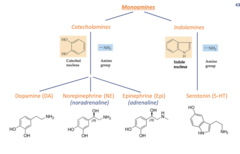
Catecholamine synthesis
-Tyrosine is an amino acid and the precursor for catecholamines.
-The enzyme tyrosine hydroxylase (TH) is the rate-limiting step in catecholamine synthesis.
- All monoamines are classical neurotransmitters (anterograde signaling).
Catecholamine Inactivation
- Reuptake (primary mechanism for inactivation, faster than metabolism) via transporters or enzymatic degradation (metabolism)
-
Catecholamine transporters
all monoamines are packaged into vesicles by the same vesicular transporter: vesicular monoamine transporter VMAT2
monoamine synaptic transporter
-DAT : dopamine transporter
-NET : Norepinephrine transpoter
-SERT : serotonin transporter
Two types of enzymes are involved in catecholamine metabolism
-MAO
-COMT
Dopamine receptors
D1, D2, D3, D4, D5
-D1-like receptors (D1, D5): coupled to Gs
-D2-like receptors (D2, D3, D4): coupled to Gi
presynaptic autoreceptors are d2
Catecholamine neurotoxin
Rats are resistant to MPTP, so another neurotoxin, 6-OHDA (6-hydroxydopamine) is used instead to create lesions of catecholamine neurons and/or axon fibers
Nigrostriatal pathway
DA neurons in substantia nigra target dorsal striatum
Mesolimbic pathway
DA neurons in ventral tegmental area (VTA) target ventral striatum (nucleus accumbens) and amygdala.
Mesocortical pathway:
DA neurons in VTA target prefrontal cortex
The majority of dopamine neurons (cell bodies) can be found in...
the midbrain
in substantia nigra ("black substance") and 2) ventral tegmental area (VTA) .
Dopamine receptors
dopamine receptors are concentrated in prefrontal cortex areas
DA neurons
*There are no DA neurons in striatum, but rather, DA neurons send axon projections to striatum. Therefore, striatum has lots of DA fibers, DA release at synapses, and DA receptors/transporters
Direct Pathway
d1
go
indirect path way
d2
no go
Parkinson's disease
death of midbrain dopamine neurons and their striatal terminals
Drug-induced Parkinson's disease
MPP+, a potent DA neurotoxin. The student developed Parkinson's symptoms within 3 days.
Adrenergic receptors
Four primary adrenergic (NE and Epi) receptors found in brain (all GPCRs):
Alpha-1 (α1) coupled to Gq
Alpha-2 (α2) coupled to Gi
Beta-1 and beta-2 (β1and β2) coupled to Gs
Norepinephrine nuclei
locus coeruleus ("blue spot") is the major source of NE in the brain. LC neurons have TH and DBH,
Dorsal noradrenergic bundle (DNAB):
originates from locus coeruleus in pons, broad forebrain innervation, major source of NE in brain; involved in cognition, arousal, and attention
Ventral noradrenergic bundle (VNAB)
originates from NE neurons in medulla, innervates limbic areas such as extended amygdala; involved in aversive aspects of stress
Norepinephrine: Role in stress/arousal
Increased norepinephrine is responsible for many stress effects on memory and cognition
Distribution of NE
NE and Epi are in brain (central nervous system)
also major components of the peripheral sympathetic nervous system "fight or flight" response
Pharmacodynamics of cocaine
- Cocaine blocks reuptake of dopamine, norepinephrine, and serotonin
- DA is important for stimulating, reinforcing, addictive properties
- In high concentrations, cocaine also blocks voltage-gated Na+ channels
Pharmacodynamics of amphetamine
also block reuptake of monoamines
But, amphetamine also causes DA release via: Entering nerve terminals (via DAT) and causing vesicles to release DA.
Reversing the transporter (DAT) so that DA is transported out of cell into synapse.
At high doses: also inhibits MAO.
cocaine in the human brain
Distribution of cocaine binding matches the distribution of DAT (densest in striatum)
Neural system in drug-induced behavioral effects
DA is critical for the reinforcing and locomotor effects of amphetamine and cocaine.
DA antagonists, but not NE antagonists
disrupt amphetamine reinforcement (self-administration)
Using 6-OHDA to lesion DA, but not NE, disrupts cocaine reinforcement Similar results with locomotor effects.
Other drugs that block DAT are also
self-administered by animals
Not readily self-administered by animals or abused by people:
-Selective blockers of NET
-Selective blockers of SERT
-Other local anesthetics (Na+ channel blockers)
core mechanism by which cocaine and amphetamine are reinforcing
DAT Blockade
Neurochemical studies
Similar time course for amphetamine effects on
- DA release in striatum
- locomotor effects
Repeated amphetamine treatment produces sensitization of locomotor and reinforcing effects, as well as sensitization of DA levels in striatum
DAT knockout
DAT knockout ← mice (DAT -/-) are spontaneously hyperactive, showing increased locomotion
DAT knock-in
DAT knock-in mice (DATki) have a mutation that makes DAT insensitive to cocaine but normal otherwise. They show loss of cocaine reinforcement (self-administration).
dopamine pathways
-Stimulant-induced DA in nucleus accumbens ( mesolimbic) = locomotion & reinforcement
-Stimulant-induced DA in dorsal striatum ( nigrostriatal) = stereotypies ( meaningless repeated movements)
MDMA neurotoxicity
-acute adverse effects of MDMA reflect dehydration and hyperthermia
-subtle cognitive deficits in regular MDMA users
-Humans: Long-lasting decrease in SERT availability after chronic MDMA
-Squirrel monkeys: Loss of serotonin axons after MDMA
-Fine 5-HT axons destroyed in cortex, hippocampus, striatum.
Methamphetamine neurotoxicity
- Rats: Long-lasting decreases in TH and DAT after meth
-Baboons: Long-lasting decrease in DAT availability after meth
-Humans: Long-lasting decrease in DAT availability
abstinent methamphetamine and methcathinone users 3 years
Neurotoxicity with amphetamines
- amphetamine, meth, MDMA
- can cause depletion of monoamines & degeneration of nerve terminals
-MDMA - 2x normal street dose
-Amphetamine/methamphetamine - high doses , high extracellular DA necessary
-Neurotoxicity affects DA and 5-HT terminals
Therapeutics for stimulant addiction
-No clinically licensed therapeutics for cocaine/amphetamine treatment.
Best treatments currently available:
• Psychosocial treatment
• Cognitive behavior therapy
• Relapse prevention therapy
Cocaine cues drive craving in animals
In rats, cocaine-associated cues also trigger drug seeking
Cocaine cues drive dopamine and craving
Cue-induced dopamine release in dorsal striatum correlates with craving
Dopamine and reward learning
- reward-associated cues (conditioned stimuli, CS) elicit dopamine release
- drive motivation for the reward