RAD 111 Unit 4 The X-ray beam
 Call Kai
 Learn
 Practice Test
 Spaced Repetition
 Match
 Flashcards
 Knowt Play
1/75

There's no tags or description
Looks like no tags are added yet.
76 Terms
Percentage of energy converted into X-rays at the anode
0.2%
Percentage of energy converted into heat at the anode
99.8%
Depth of target interactions in the anode
Approximately 0.5 mm
Speed of filament electrons from cathode to anode
Approximately half the speed of light
Two types of target interactions
Bremsstrahlung and characteristic interactions
Binding energy definition
Energy needed to remove an electron from its shell.
Tungsten K-shell binding energy
69.5 keV
Tungsten L-shell binding energy
12.1 keV
Inner vs outer shell binding energies
Inner shells have higher binding energies; outer shells have lower.
What causes heat production at the anode?
Interaction between incoming electrons and outer-shell tungsten electrons.
Heat production mechanism
Excitation of outer-shell electrons.
Bremsstrahlung alternate name
Brems or braking radiation.
Cause of Bremsstrahlung interactions
An incoming electron passes close to the positively charged tungsten nucleus.
Bremsstrahlung photon energy calculation
Entering electron energy minus exiting electron energy.
X-ray photon kEv
Difference between the energy of entering filament e- and exiting filament e-
Maximum energy limit of an X-ray photon
Cannot exceed the selected kVp.
Minimum console setting for characteristic interactions
Approximately 70 kVp or 69.5 kVp
Characteristic interaction mechanism
Incoming electron removes a K-shell electron, and an outer-shell electron fills the vacancy.
Characteristic photon energy calculation
Difference between binding energies of the two shells involved.
KvP and KeV are very rarely
equal
Kev never higher than
KvP set into console
Brems interactions happen at
all KvP ranges
At greater than 70 kVP approximately 15% of beam is made of
characteristic photons
Brems at greater then 69.5 (70) kvp percentage
85%
Brems at less then 69.5 kVp percentage
100%
Filament/incident/projectile electron
this e- is coming from the cathode filament through thermionic emission
• Energy is expressed in kEv and is affected by kVp programmed into the console
Atom electrons are held in an orbit by binding energy
Cannot be removed from orbit if filament e- does not have the same amount or higher kEv than the binding energy holding the atom e- in its shell
X-ray photon is what is created when the filament/incident/projectile e- from the cathode interacts
Brems or Characteristic with the tungsten atom
X-ray emission spectra are Polyenergetic
photons have a range of energies
X-ray emission spectrum: Basic Principles
•lowest energies are approximately 15-20 keV and the highest energy is equal to the kVp used for Brems (continuous spectrum)
• Spectrum measured in photon keV is never the same as kVp for characteristic.
• Energies are very specific values for characteristic (discrete spectrum) because can only have so many combos due to binding energy of shells
Spectra produced by Bremsstrahlung vs characteristic
Brems produces a continuous spectrum; characteristic produces a discrete spectrum.
Continuous spectrum(Brems)
-Most photons, Have a keV of 30-40% Of kVp used
-Where the graph meets the axis is kVp used

Discrete spectrum
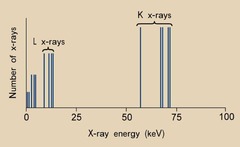
Emission spectrum

Filament electron origin
Comes from the cathode filament.
Tungsten electron location
Belongs to the tungsten target atom.
Polyenergetic X-ray beam definition
Contains photons with different energy levels.
Peak of continuous emission spectrum
Largest number of photons have 30-40% of selected kVp.
Discrete spectrum production
Produced by characteristic interactions.
Beam quality definition
Energy and penetrating ability of the X-ray beam.
Beam quantity definition
The total number of X-ray photons produced.
What factors does kVp affect?
Both beam quality and beam quantity.
kVp affect quality
Determines speed of electrons in tube current, energy of the resultant x-ray photons
Higher energy photons = higher quality and are better
able to penetrate tissue
kVp affect quantity
higher speed electrons increases efficiency
More Brems photons created
Voltage ripple definition
Amount of variation in voltage during X-ray production.
Generator type with lowest voltage ripple
High-frequency generator, at 1% voltage ripple
X-rays produced at 99% to 100% of the kVp selected
Single-phase generator voltage ripple percentage
100%
X-rays produced at 0% to 100% of the kVp selected
3 phase 6 pulse
3% voltage ripple
• X-rays produced at 87% to 100% of the kVp selected
3 phase 12 pulse
4% voltage ripple
X-rays produced at 96% to 100% of the kVp selected
What does mA control?
-Affects the # of electrons flowing between cathode and anode.
-mA chosen affects thermionic emission and # of electrons in the space charge.
-It is proportional- double mA and will double # of electrons in space charge and the # of x-ray photons created
What does mAs affect?
Beam quantity only.
Formula for mAs
mA multiplied by seconds.
Time (Quantity)
Length of time tube produces x-rays:
-The length of time the tube current flows from cathode
to anode
-Set in seconds or usually milliseconds
• (1 second = 1000 ms
-Changes in time have the same effect as changes in
mA
Technical factors affecting beam quality only
Energy of x-ray photons
Technical factors affecting beam Quantity only
Time,
mA,
mAs,
# of x-ray photons,
# of filament electrons
Technical factors affecting beam for BOTH Quality and Quantity
kVp,
Generator phase,
Energy of filament electrons
Purpose of the line focus principle
Spreads heat over a larger actual focal spot while keeping the effective focal spot small.

Actual focal spot definition
Located on anode, struck by filament electrons.
Size changes based on focal spot size selected on generator.

Effective focal spot definition
projected focal spot size measured under anode
target.
The X-ray photons. Affected by filament size and angle of anode

Anode heel effect result
When x-rays are produced, they exit the anode in all directions.
▪ X-rays directed towards the anode side have further to go.
▪ Some X-rays directed towards the anode side are absorbed
Patient positioning rule for the anode heel effect
Place the cathode side over the thicker part of the body.
Can be a 45% difference between the cathode and anode side of the tube
Purpose of X-ray filtration
Removes low-energy, non-diagnostic photons to reduce patient dose.
Standard total filtration requirement at 70 kVp
2.5 mm of aluminum (Al) using Inherent and Added Filtration
HVL Filtration
amount of filtration to reduce the beam by ½
It's original intensity
Compensating filters
-Wedge filter
-Trough filter
Effect of filtration on beam quality and quantity
Quality increases while quantity decreases.
Change in filtration (no change in technical factors)
As filtration Increases, Energy increases, But # of x-rays decrease
What is measured by Heat Units (HU)?
The amount of thermal energy produced during an exposure.
Heat unit formula for single-phase generators
mA multiplied by seconds multiplied by kVp.
Correction factor for high-frequency generators
1.4
Correction factor for 3-phase generators
1.35
three-phase Heat formula
Ma x T x Kv x (c)1.35
High frequency Heat formula
Tube warm-up requirement
Warm up the tube if unused for two hours or more.
Difference between kVp and keV
kVp is console voltage; keV is individual photon or electron energy.
Difference between excitation and ionization
Excitation raises electron energy state; ionization removes the electron entirely.