Phase diagrams
 Call Kai
 Learn
 Practice Test
 Spaced Repetition
 Match
 Flashcards
 Knowt Play
1/13

There's no tags or description
Looks like no tags are added yet.
Name | Mastery | Learn | Test | Matching | Spaced | Call with Kai | Chat |
|---|
No analytics yet
Send a link to your students to track their progress
14 Terms
How do molecules react if a change in temperature occurs
Increase in temp = increases the kinetic energy E=1/2mv² rises
How do molecules react if a change in pressure occurs
increase in pressure exerted by the surroundings forces the molecules to become closer to each other, allows intermolecular forces to operate
Variable values of ΔG
Lowest ΔG = most stable
-ΔG = energetically favourable (spontaneous)
gas to liquid - changes ΔG
Equation for changing phase and pressure
change in phase = volume of phase x change in pressure

Entropy definition
entropy is the state of disorder - the number of ways certain particles can be arranged
Increase in entropy means more moles of a compound and more ways it can be arranged
Gas entropy > liquid entropy > solid entropy
Changing phase diagram

Phase boundaries
the phase diagram is constructed by variable pressure and variable temperature
solid lines represent phase boundaries - at the boundary phases are in equilibrium
where all meet = triple point
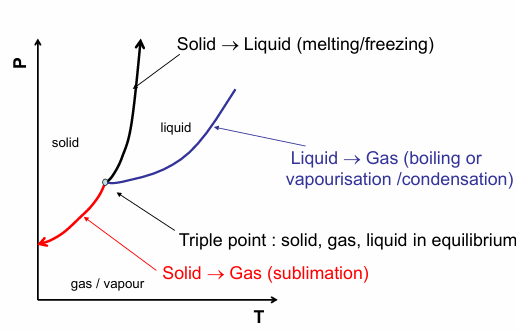
Supercritical region beyond phases
Beyond liquid there is a region called supercritical fluid, this is a compound that solvated like a liquid but has the diffusivity of a gas

Constructing a phase diagram
We get a closed container with our sample of either gas, liquid or solid, and we measure 3 points, trying to see where the liquid turns to vapour and that is the boundary

Vapour pressure definition
the pressure of the vapour when it is in equilibrium with its condensed phase
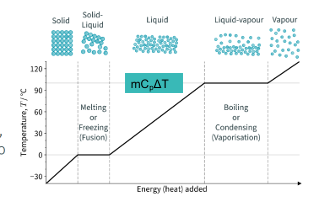
Heat capacity of phases, and the heating curve
How to measure the heating curve, is to keep the pressure constant and increase heat
Overtime the energy thermally will change to latent heat and change the phase of the sample
Heat capacity
Cp = the heat capacity of a material at constant pressure

Supercooling and Superheating
liquid water can be supercooled below its freezing point. The kinetic stabilization doesn’t happen as there are no nucleation centres for crystals to form
Phase Rule
e.g. water
components = 1
phases = 1
so the pressure and temperature can be varied independently
