ERTH303N Terms (Part 1)
 Call Kai
 Learn
 Practice Test
 Spaced Repetition
 Match
 Flashcards
 Knowt Play
1/64

Earn XP
Description and Tags
Week 1-5, ch 1, 2, 3, 13
65 Terms
Hypothesis
Proposed, testable explanation for something that occurs in the natural world
Theory
Well-tested and widely accepted view that best explains observable facts
Earth sphere
Atmosphere (air)
Hydrosphere (water)
Lithosphere (rock)
Biosphere (life forms)
System
Collection of numerous, independent interacting parts that form a collective whole. For example, earth is a system that is composed of interactions among its 4 spheres. Feedback loops can amplify (positive) or counteract (negative) these processes
Earth’s primordial atmosphere
Early, primary atmosphere retained from formation; hydrogen and helium dominated. Lighter elements escaped due to solar wind. Volcanic outgassing replaced these with CO2, N2, H2O, forming secondary atmosphere (4 bya)
Modern atmosphere
Retained by gravity; nitrogen (~78%) oxygen (~21%), argon (~0.9%) and trace gases like CO2, methane, and water vapor
Ozone
form of oxygen that contains three oxygen atoms in each molecule. Minimal presence in the atmosphere. Blocks UV rays in the stratosphere but acts as a pollutant in the troposphere (products of cars)
Pressure (millibar, Pa, psi)
Decreases w/ altitude. Weight of the air above us, caused by gravity pulling air molecules to Earth
Composition of atmosphere
Thermosphere, Mesosphere, Stratosphere Troposphere
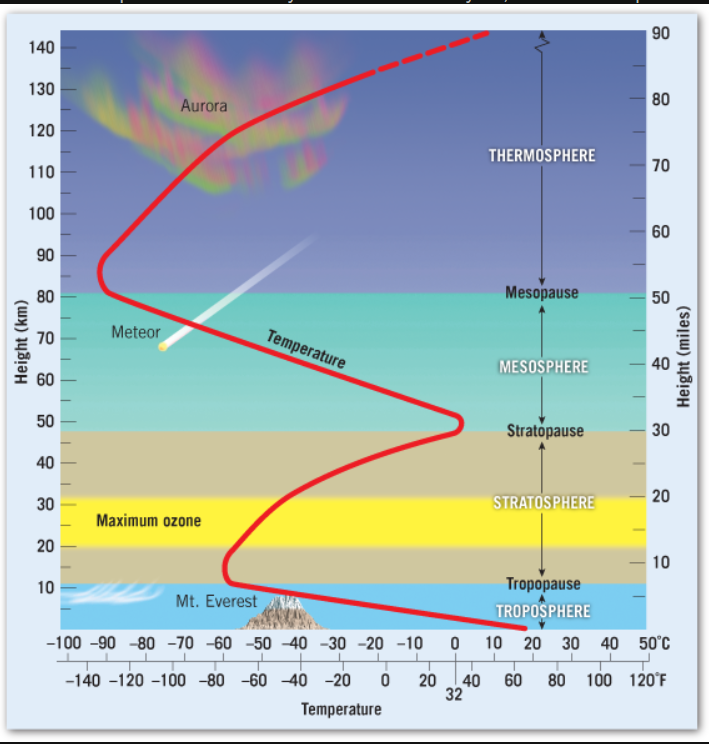
Atmospheric temperature
varies significantly by altitude, decreasing from about 15°C (59°F) at the surface in the troposphere, then increasing in the stratosphere, decreasing again in the mesosphere, and rising dramatically in the thermosphere
Temp rise caused by ozone absorbing UV light
Dalton’s Law
the total pressure of a mixture of non-reacting gases is the sum of the partial pressures each individual gas would exert if it alone occupied the total volume

Perihelion and Aphelion
The point where the earth is closest to the sun in its orbit vs where it is furthest away
Ecliptic plane
imaginary, flat surface that contains Earth's orbit around the Sun
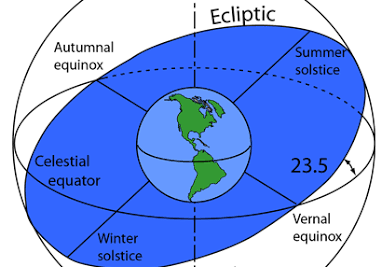
Reasons for seasons
because earth's axis is tilted at 23.5 degrees as it orbits the sun, not because of its distance from the Sun. This tilt means different hemispheres get more direct sunlight at different times of the year
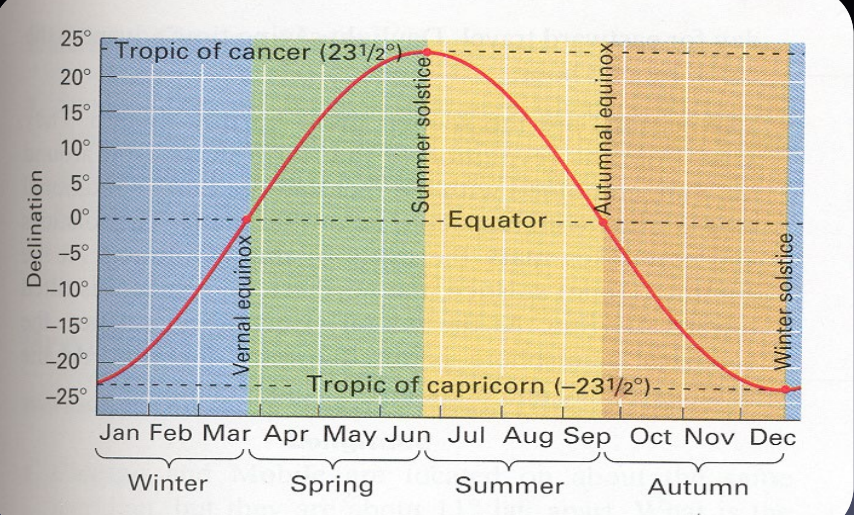
Winter solstice (Dec 21)
Point when the vertical rays of the sun are directly striking the Tropic of Capricorn (winter in the northern hemisphere) resulting in the shortest day of the year
Summer solstice (June 21)
Point when the vertical rays of the sun are directly striking the Tropic of Cancer (summer in the northern hemisphere) resulting in the longest day of the year
Equinox (around March and Sept 20)
Occurs midway between solstices. The vertical rays of the run strike the equator (0 degrees) resulting in equal amounts of day and darkness, marking the start of spring or fall
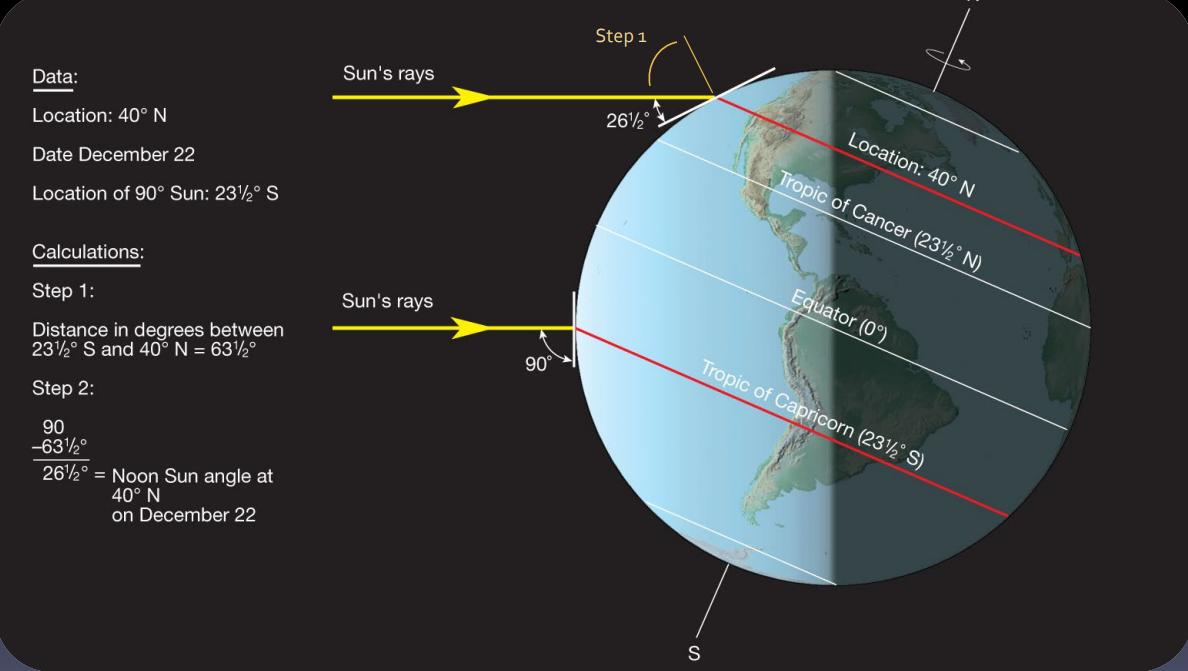
Sun angle
Solar Altitude (Elevation): angular height of the sun above the horizontal plane, ranging from at sunrise/sunset to a maximum at solar noon. It ranges from 0° (at the horizon) to 90° (directly overhead at the zenith).
Solar Azimuth: angle between directly overhead and the sun at solar noon. For example, East is 90°, South is 180°, and West is 270°.
Zenith Angle: The angle between the sun's position and the point directly overhead at noon. It is the complement of the altitude angle (90° - Altitude)
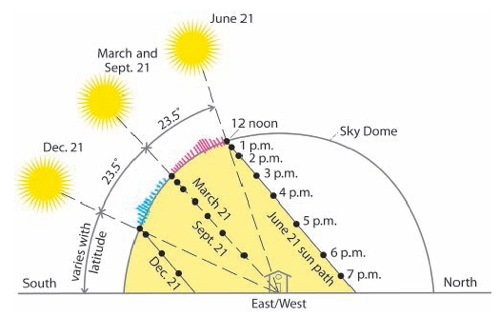
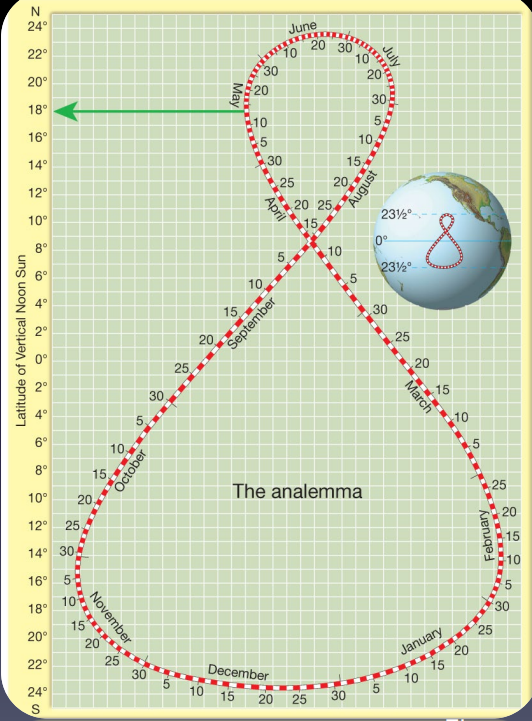
Analemma
plots solar declination through the year
Atmosphere selective absorber
It is not a black body because it selectively absorbs different radiation types. It reflects most
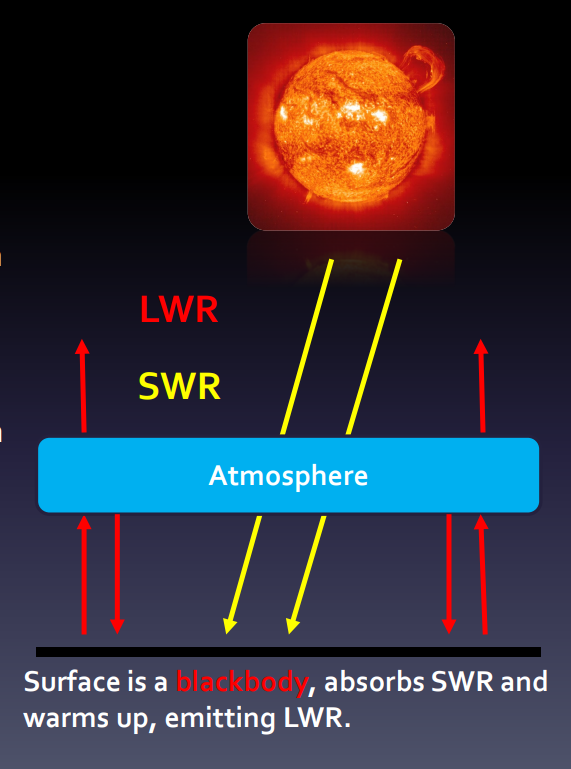
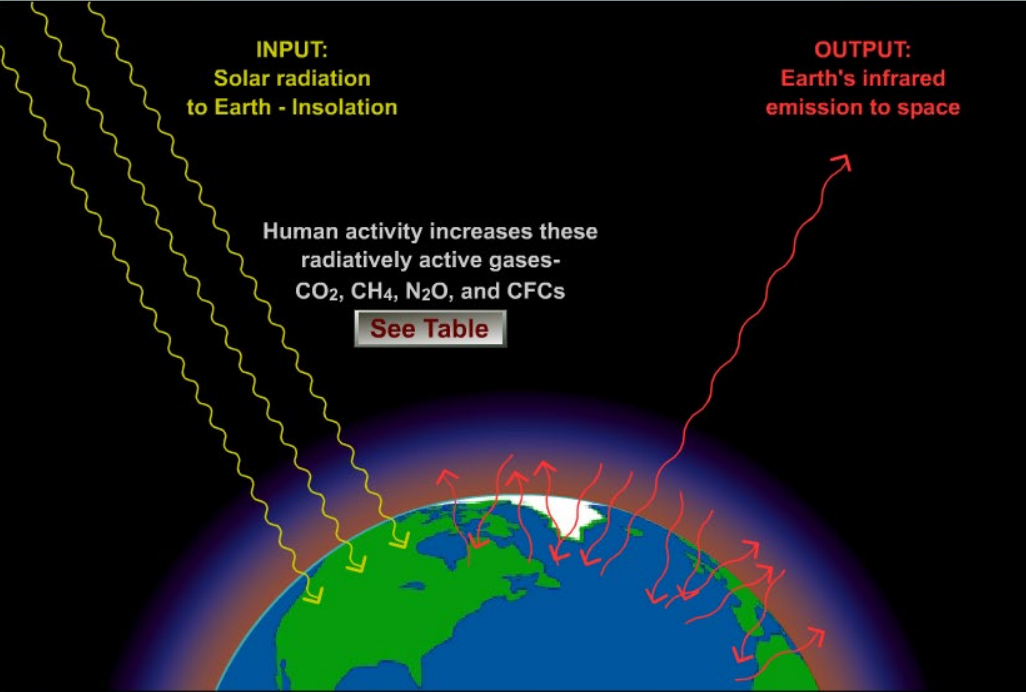
Counter radiation
LWR moving from the atmosphere to the Earth’s Surface. Causes earth to warm. The earth gives off LWR which the atmosphere absorbs, the atmosphere warms and gives off LWR
CO2 and H2O vapor are very good absorbers of LWR
clouds reflect SWR
Solar declination
Latitude at which sun is directly overhead at solar noon
Solar constant
average amount of radiation hitting the top of Earth’s atmosphere – 1367 W/m2. Earth’s surface is about 5.8 C
The sun is highest at
solar noon. It is higher in the sky in the summer than in winter
Variations in the amount of solar energy reaching a location are caused by
Seasonal changes in intensity of light (which is determined by the angle at which the sun’s rays strike earth’s surface) and by changes in the length of daylight
Insolation
Amount of solar radiation reaching a surface
Energy
capacity to do work. Described as potential (in suspension) or kinetic (motion). High temperature is associated with high kinetic energy since heat makes atoms move faster and grow hotter
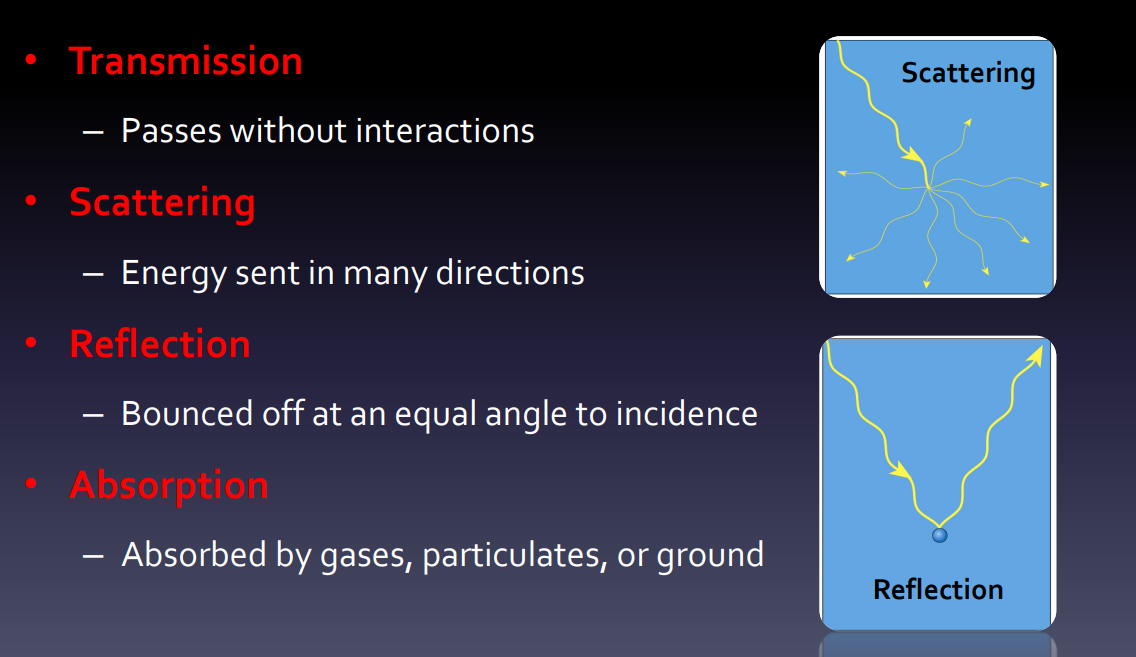
energy pathways
transmission, scattering, reflection, absorption
Why earth has weather
the atmosphere and oceans are constantly trying to even out the differences between the influx of radiation at the equator and the deficit at the poles
Albedo
Amount of light reflected from the earth’s surface. High albedo (ice) means high reflection of solar radiation. Low albedo means low reflection of solar radiation (dirt, trees, etc)
Greenhouse effect
Earth's natural warming process where atmospheric gases (like carbon dioxide, methane, water vapor) trap the Sun's heat, keeping the planet habitable. Human emissions amplify this, throwing it out of the natural rhythm
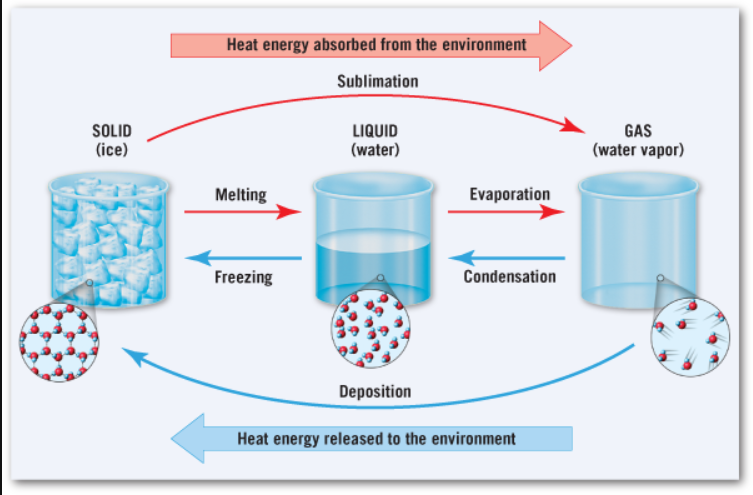
Latent heat
Energy released or absorbed by a substance during a phase change without affecting its temperature
During evaporation, the energy absorbed by escaping water molecules. During freezing, the energy released by bonded molecules
EM spectrum
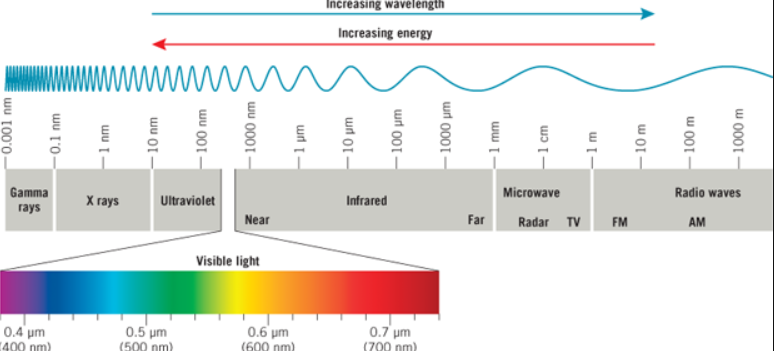
All visible and non-visible waves of radiation. Intensity increases with decreasing wavelength, and radiation becomes more harmful (gamma). The most intense of the sun’s rays are still in the visible light category
Radiation laws
All objects continually emit radiant energy over a range of wavelengths.
Hotter objects radiate more total energy per unit area than do colder objects.
Hotter objects radiate energy in the form of shorter-wavelength radiation than do cooler objects. Radiation emitted by Earth is often referred to as longwave radiation, whereas solar radiation is called shortwave radiation.
Objects that are good absorbers of radiation are also good emitters. Earth’s surface and the Sun are nearly perfect radiators because they absorb and radiate with nearly 100 percent efficiency. Bodies that absorb and radiate all wavelengths well are called blackbodies.
Mean, monthly, annual temp
The monthly mean temperature is calculated by adding together the daily means for each day of the month and dividing by the number of days in the month.
The annual mean temperature is an average of the 12 monthly means.
The annual temperature range is computed by finding the difference between the warmest and coldest monthly mean temperatures.
Annual and diurnal temp range
Annual temperature refers to yearly temperature cycles driven by Earth's tilt and orbit, while diurnal temperature describes daily swings from hot days to cool nights, caused by Earth's rotation and solar heating/cooling, with desert areas showing large ranges and humid coasts smaller ranges due to moisture
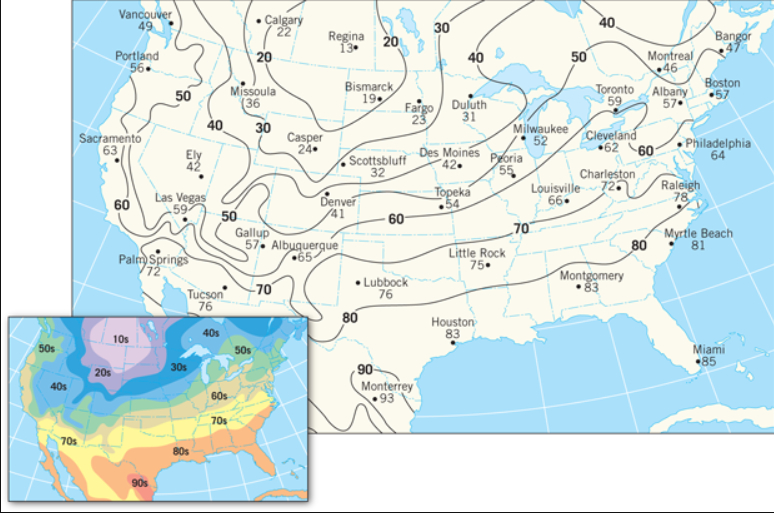
Isotherm
Heat map using warm or cool colors to depict temperatures
Lapse rate
rate at which atmospheric temperature decreases with increasing altitude, with steeper rates indicating instability and potential for thunderstorms, while a slower rate suggests stable conditions
Controls on global temp
latitude (angle of sunlight) is the strongest, atmospheric composition (greenhouse gases trapping heat), ocean currents, land/water distribution, elevation, prevailing winds, and surface reflectivity (albedo). Earth’s distance from the sun also plays a role
Seasonal temp change becomes more pronounced as
you move further away from the equator
The highest and lowest mean temps do not coincide with
the periods of maximum and minimum incoming solar radiation
Land surfaces are heated much more effectively than
water, because they are opaque. Water is able to redistribute heat through its larger mass
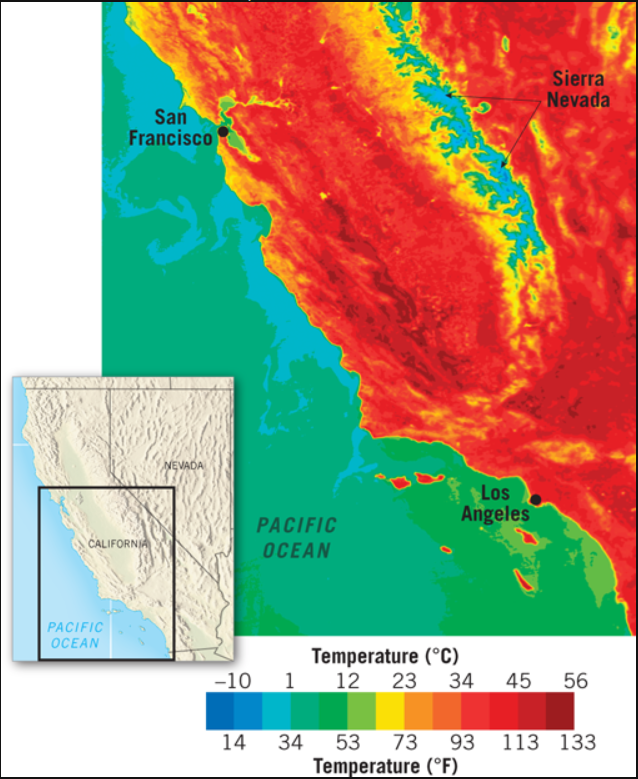
Controls on local temp
Latitude is the driving factor in temperature change, but on local scales, like how far cities are away from each other, elevation plays a larger role. Higher elevations are cooler than lower ones
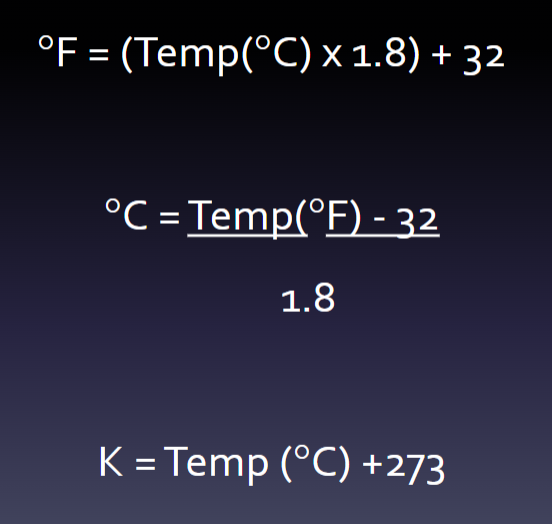
Temp scales
Fahrenheit, Celsius, Kelvin
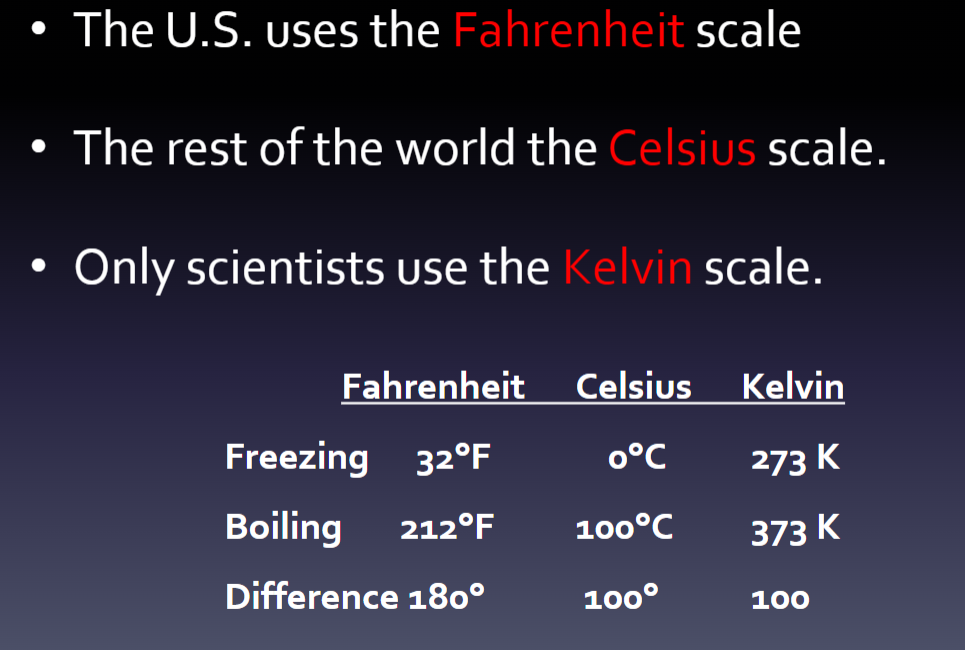
Continentality
how far inland a location is from a large body of water, with further distance resulting in a climate with greater temperature extremes (hot summers, cold winters) compared to coastal areas, because land heats and cools faster than water
Urban heat island
A city's temperature is significantly warmer than surrounding rural areas, caused by buildings, roads, and dark surfaces absorbing and re-radiating heat, reduced vegetation, and waste heat from human transport
Windchill
perceived temperature on human skin due to cold air and wind
Heat index
what the temperature feels like to the human body when relative humidity is combined with the air temperature
Growing degree days
Used to determine the day at which crops will be ready for harvest
Cooling degree days
measure the demand for air conditioning by tracking how much the average daily temperature exceeds a base of 65°F
Air pollution
Several sources, human and natural
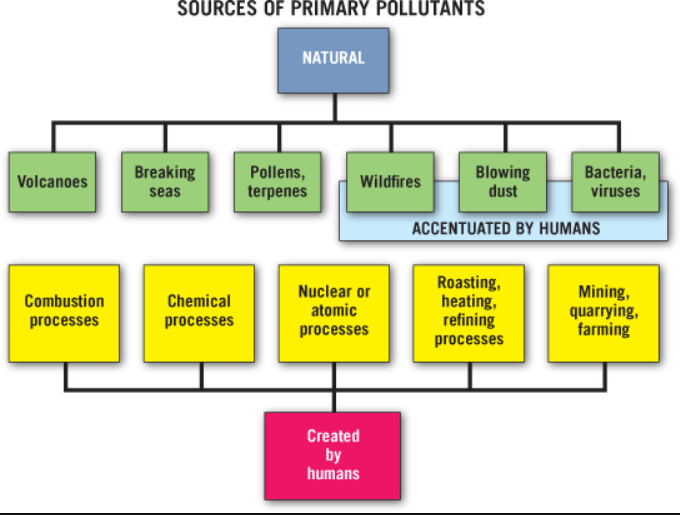
Primary pollutants
Produced directly from identifiable sources; include particulate matter, sulfur dioxides, nitrogen oxides
Secondary pollutants
produced in the atmosphere when certain chemical reactions occur that alter primary pollutants. Secondary pollutants include sulfuric acid and the chemicals that make up smog, such as ozone and nitric acid
Particulates
tiny solid or liquid particles in the air, like dust, soot, and droplets, categorized by size (PM10 and PM2.5), with smaller PM2.5 being most dangerous as they penetrate deep into lungs, causing respiratory issues, while sources include fires, vehicles, and industry, and environmental impacts involve acid rain
Nitrogen dioxide
a strongly smelling reddish-brown gas formed from burning fossil fuels, a major contributor to smog, acid rain (forming nitric acid in water), and respiratory problems
Sulfur dioxide (primary)
About 99 percent of sulfur dioxide comes from human sources—largely the combustion of sulfur-containing fuels like coal and oil. Major sources include power plants, smelters, petroleum refineries, and pulp and paper mills. Most of the remainder comes from gases emitted during volcanic eruptions
Volatile organic compounds (VOCS)
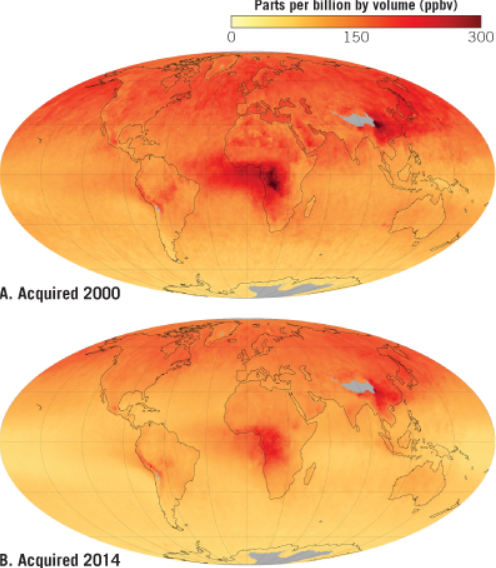
Hydrocarbons emitted from burning fossil fuels and plant/animal matter (methane, butane, propane, octane). Reacts with NOx to get photochemical smog
Carbon monoxide
Colorless, poisonous, odorless gas emitted from fires, incomplete fuel burning, generators, cars, grills, etc.
Lead
Dangerous even at low concentrations. Automotives used to be primary producer until lead was phased out of production, drastically reducing the amount in the atmosphere
Smog
Air pollution in urban and industrial areas. Wet and dry smog, usually product of burning sulfur. Damaging to plants/ag
Clean air act (1970)
federal law for controlling air pollution, empowering the EPA to set National Ambient Air Quality Standards (NAAQS) for common pollutants like ozone, lead, and particulate matter
Inversion
when a layer of warm air sits above cooler air near the ground, reversing the normal pattern where air gets colder with height. This stable layer acts like a lid, trapping cool air, fog, haze, and pollutants close to the surface
CFC (chlorofluorocarbon)
synthetic, non-toxic, non-flammable chemicals containing carbon, chlorine, and fluorine, once widely used as refrigerants, aerosol propellants, and solvents, but now largely phased out under the Montreal Protocol due to their devastating impact on the Earth's ozone layer
Montreal Protocol (1987)
a landmark UN treaty from 1987 to protect the ozone layer by phasing out ozone-depleting substances (ODS) like CFCs
Sulfur hexafluoride
synthetic, colorless, odorless, non-flammable gas known for its use in high-voltage electrical equipment like circuit breakers and transformers, but it's also the world's most potent greenhouse gas, with thousands of times the warming potential of CO2 and a very long atmospheric lifetime