Lecture 2: Evolutionary Morphology, Phylogeny, and Tools of the Trade
 Call Kai
 Learn
Learn Practice Test
 Spaced Repetition
 Match
Match Flashcards
 Knowt Play
1/42

Earn XP
Description and Tags
Vocabulary practice flashcards generated from lecture notes on vertebrate evolutionary morphology, phylogenetic dendrograms, cladistic concepts, paleontology, and geological time dating.
Name | Mastery | Learn | Test | Matching | Spaced | Call with Kai | Chat |
|---|
No analytics yet
Send a link to your students to track their progress
43 Terms
Preadaptation
A structure present in an organism by genetics that performs a function before it serves another biological role in the environment

example of preadaptation
Feathers initially functioning in thermoregulation prior to flight to escape predators and courtship to populate next generation.
5 steps led to flight in reptiles
1) leaping 2) parachuting 3) gliding 4) flailing 5) flapping “flight”
Phylogeny
The course of evolutionary change within a related group of organisms, or the overall evolutionary history of a vertebrate lineage.
Clade
A lineage of organisms that includes a common ancestor and all of its descendants.
Dendrogram types
ladders, bean stalks, bushes, bushes with balloons
Rate of change
punctuated equilibrium and phyletic gradualism
Common Ancestor
An ancestral organism determined by a shared primitive condition, such as the presence of a vertebral column for vertebrates.
Primitive condition
a characteristic that is original or ancestral, often shared by a group of organisms, and can be contrasted with derived conditions that have evolved later.
Derived Conditions
Characters that change over evolutionary time and become distinctive traits for a specific group, such as hair in mammals.
Dendrogram
use phylogenetic systematics to group organisms into clades. A branching diagram representing evolutionary history and relationships.

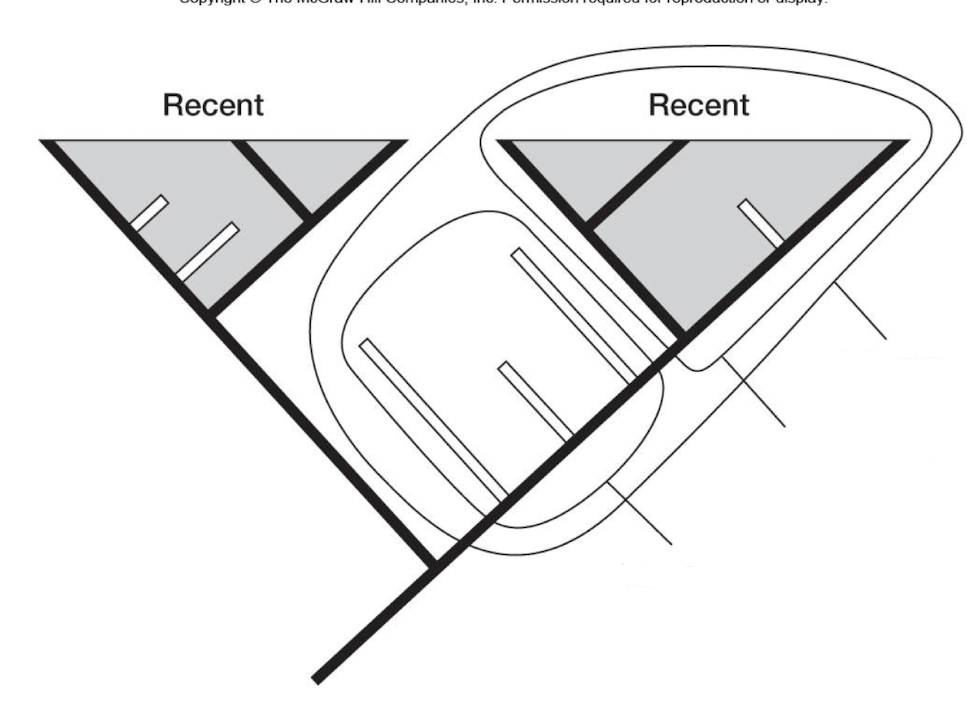
Label the image

Punctuated Equilibrium
A rate of evolutionary change characterized by long periods of little change followed by rapid change, where the common ancestor remains present alongside its descendant.
Phyletic Gradualism
A rate of evolutionary change characterized by gradual transformation over time, during which the common ancestor no longer exists.
Monophyletic Group
A cladistic taxon (clade) that includes a common ancestor and all of its descendant lineages.
Polyphyletic Group
An artificial grouping (grade) formed by uniting organisms based on non-homologous (analogous or homoplastic) traits, such as grouping birds and mammals together as "warm-blooded vertebrates."
Paraphyletic Group
A taxonomic grouping (grade) that includes a common ancestor and some, but not all, of its descendants, such as traditional reptiles excluding birds.

Ingroup
The group of closely related organisms under study that share a primitive condition, such as the presence of a horn.
Outgroup
A closely related group or taxon outside the ingroup that does not possess the shared primitive condition being analyzed.
Haekel’s Phylogeny “Evolution of Man”
A historical representation of human evolution that illustrates the perceived progression of species, often depicted as a linear sequence from primitive to advanced forms.

Why is this image misleading
not a serial progression, each arose from an ancestor that is now extinct.
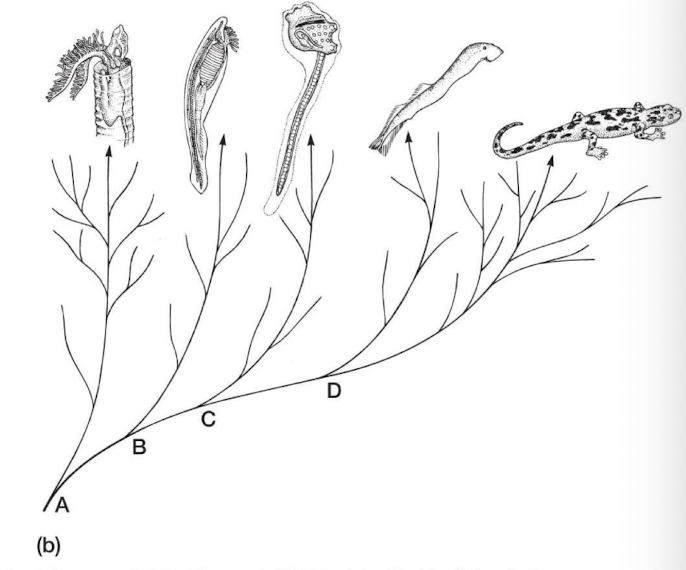
Why is this beter?
shows nodes where descendents arose from common ancestor (now extinct)
The vertebrate story: Romer
Alfred Romer explores why fossils are rare events. emphasizes how form, function, and environment interact to drive evolutionary changes over geological time
Bushes with balloons
a term used to describe the branching nature of evolutionary trees, indicating multiple lineages diverging from common ancestors rather than a linear progression.
What can be learned from fossils
bone structure, skin structure, development, diet, social behavior, motility, reconstruct animals
Why are fossils rare?
Fossils are rare because the conditions required for fossilization are specific and not often met, including rapid burial and the presence of hard parts like bones. Additionally, geological processes can destroy or overwrite fossils, making them difficult to recover.
How do paleontologists date fossils?
stratigraphy and radiometric dating
Stratigraphy
A relative time dating method based on rock layers, where deeper rock layers are recognized as older and shallower layers are recognized as newer.

Radiometric Dating
An absolute time dating method that calculates the time passed by measuring the ratio of an unstable radioactive isotope to its stable product.

Half-life
The amount of time required for an unstable radioactive isotope to decay and lose half of its original material.
Gastroliths
Fossilized stomach stones that provide direct physical evidence of digestion and dietary habits in extinct animals.

Archaeopteryx
reptile-bird intermediate. An intermediate fossil form exhibiting reptile-like dinosaur characteristics alongside true feathers.

Phanerozoic Eon
The geological eon starting approximately 0.542BYA (542MYA), marked by the diversification of vertebrate life and the breakup of Pangea into present-day continents.
Biological Role
How an anatomical structure or physiological trait is used by an organism during its behavioral interaction with its environment.
eons
Divisions of geologic time encompassing significant events in Earth's history, including the formation and development of life.
4 eons
The four divisions of geologic time are Phanerozoic (0.542BYA)==> Proterozoic (2.5 BYA) ==> Archean “Rock” (3.8 BYA)==> Hadean “fire” (>4.6 BYA). each representing distinct periods of Earth's history and biological development.
ordovician
period within the Paleozoic Era characterized by diverse marine life and the first appearance of many modern groups of organisms.
eras
The subdivisions of geological time within an eon, characterized by distinct periods in Earth's history that are marked by significant events in the development of life and geology.
periods
Subdivisions of geological time that are shorter than eras and longer than epochs, characterized by significant events in Earth's history.
epochs
Subdivisions of periods in geological time that represent notable developments in Earth's history and life forms, often defined by significant environmental changes.
scientific method
form hypothesis
design a test
carry out experiment
analyze results
corroborate or falsify hypothesis
form new hypothesis
example of how Prof Dearworth analyzes vertebrate structure to answer a question concerning its function: Do retinal ganglian cells detect approaching targets?
2) Turtle is given directional selective cells (2-D) X,Y changes, then are there cells that respond in 2 direction. 3) Use electrophys correlative responses with visual stim 4) study turtle’s behavior response.
Haekel’s Phylogeny 1896 “evolution of man”
Bean stalks tree. linear and no branching. existing animals treated like stepping stones. depicting organisms as stages in a linear progression, emphasizing the idea of a single lineage leading to modern humans.