Bird Lecture specific
 Call Kai
 Learn
 Practice Test
 Spaced Repetition
 Match
 Flashcards
 Knowt Play
1/97

There's no tags or description
Looks like no tags are added yet.
98 Terms
Synapsid skull
Single low temporal fenestra
Gives rise to mammals

Diapsid skull
Temporal fenestra and antorbital fenestra
Gives rise to reptiles and birds

Reptiles & Birds – Shared Traits skull features
antorbital fenestra
occipital condyles

Reptiles & Birds – Shared Traits middle ear
Single middle ear bone

Reptiles & Birds – Shared Traits Jaw
Lower jaw composed of several fused bones

Reptiles & Birds – Shared Traits integument
Integument: the stuff what keeps your outsides out and your insides in
“Outermost protective layer of an organism”
Reptiles & Birds – Shared Traits integument Keratin
Reptiles and birds: beta-keratin “sheets” for scales and feathers
Mammals: alpha-keratin “spirals” for hair and horns

Reptiles & Birds – Shared Traits blood cells
Mammalian RBC - enucleated
Reptile and bird RBC - nucleated
Reptiles & Birds – Shared Traits offspring
Ovipary, lays eggs
Reptiles: leathery shell
Birds: hard, mineralized shell
Reptiles & Birds – Shared Traits Overview
• Presence of antorbital fenestra
• Single occipital condyle
• Single middle ear bone
• Lower jaw composed of several fused bones
• Similarity in integument – scales and feathers
• Nucleated red blood cells
• Ovipary
Traits of birds - feather function
• Flight
• Insulation
• Social signaling
Traits of birds
Feathers
Traits of birds - mouth
No teeth, bills, weight reduction
Traits of birds - How do they walk?
Bipedalism and digitigrade feet (walks on toes)
Traits of birds - bones
fusion and reduction of bones of hands, head, pelvis
Traits of birds - bone structure
pneumatic bones
Traits of birds - breastbone
well-developed keel of breastbone
Traits of birds - wishbone
Furcula
Traits of birds - overview
• Feathers
• Lack of teeth; bills
• Bipedalism and digitigrade feet
• Fusion and reduction of bones of hands, head, pelvis
• Pneumatic bones
• Well-developed keel of breastbone
• Furcula (wishbone)
Other traits of note
• Small size (relatively speaking)
• Highly developed brains and sensory systems
• Large, energy-rich eggs
• Extensive parental care
• Highly social
Ancient wing from the lithographic stone
Archaeopteryx lithographica
Archaeopteryx lithographica - bird traits feathers
Fully feathered
Wing feathers were specialized into primaries and secondaries
Feathers were asymmetrical
Archaeopteryx lithographica - bird traits bones
Clavicles fused into furcula
Partly fused metatarsals (leg bones)
Archaeopteryx lithographica - bird traits structure
Had wings and tail
Bird-like forelimb
Archaeopteryx lithographica - reptile traits
Small braincase
Hand bones not fused; claws on wing
Pelvic bones not fused
Long bony tail
Small cartilaginous sternum (no keel)
Simple ribs (lack uncinate process)
Teeth

Thecodont hypothesis
Birds did not evolve from dinosaur ancestors, rather a separate unique bird ancestor

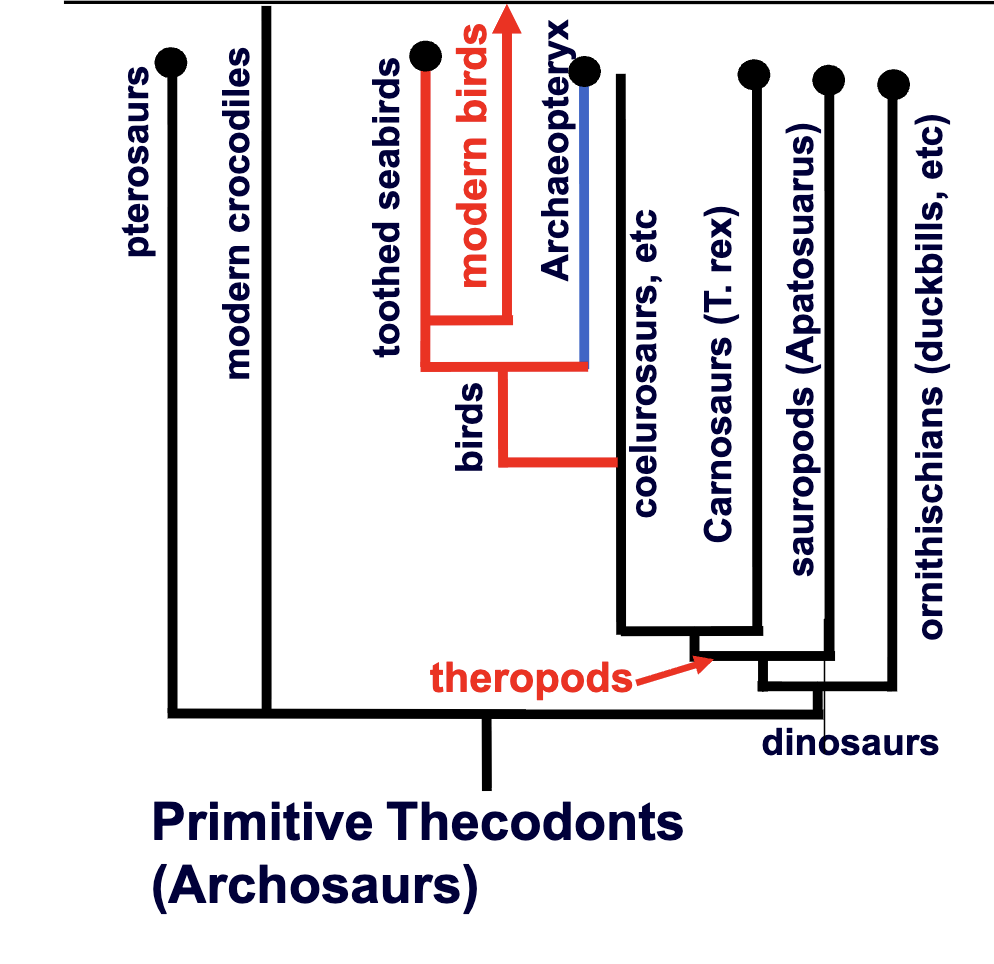
Theropod hypothesis
Birds evolved from dinosaurs and are directly related to them, overwhelming evidence supports this hypothesis
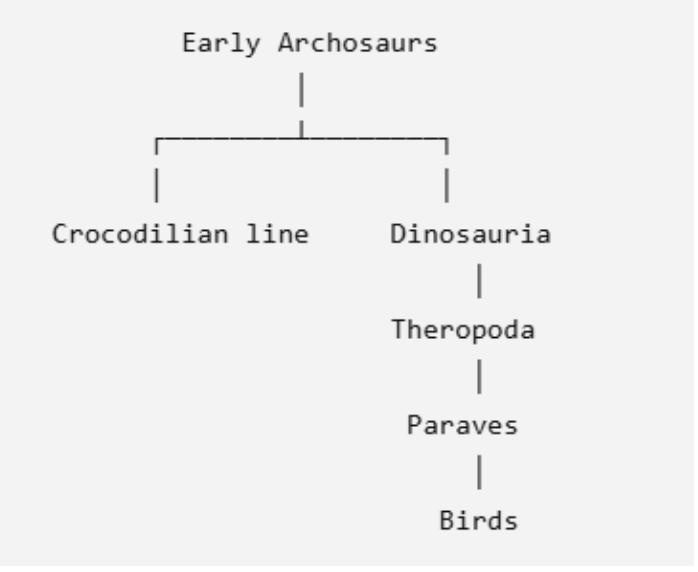
Deinonychus antirrhopus
Bipedal, terrestrial theropod dinosaur
Fused clavicles
Hollow bones
Semi-lunate carpal bone in wrist which allowed rotation
Uncinate processes
Birds (Archaeopteryx) and theropods – shared characteristics skeleton
Large orbits (eye sockets)
Flexible wrist (semi-lunar carpals)
Hollow bones
Fused clavicles
Birds (Archaeopteryx) and theropods – shared characteristics structure
Elongated arms and forelimbs
3-fingered clawed opposable grasping hands
4 toes per foot (3 main)
Bipedal digitigrade stance
Feather
Timeline
first feather discovered
Archaeopteryx discovered
Theropod hypothesis proposed
Thecodont hypothesis - Disproved
Theropod hypothesis confirmed

Sinosauropteryx
Sinosauropteryx - basic traits
Fuzzy, with colors

Protarchaeopteryx
Protarchaeopteryx - basic traits
Vaned feathers, primitive
More recent than Archae
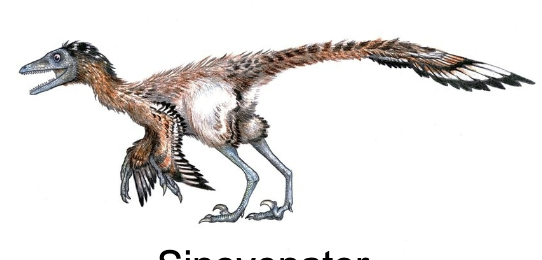
Sinovenator
Sinovenator - basic traits
Vaned feathers, primitive
More recent than Archae

Epidexipteryx
Epidexipteryx
Ribbon tail

Caudipteryx
Caudipteryx
Vaned feathers, primitive
More recent than Archae

Microraptor
Microraptor
feathers on both forelimbs and hindlimbs
Temporal paradox
Archeaoptryx a far more bird looking dinosaur developed before more under bird-developed dinosaurs like, Sinovenator, Sinornis or the Microraptor
The origin of flight - Arboreal theory
trees down
Ancestors climbed in trees
Jumping among branches and then gliding
Wings and feathers improve gliding; leads to powered flight
The origin of flight - Cursorial theory
ground up
Ancestors were ground-dwelling runners
leap to catch prey
Wing-assisted incline running
Surviving the KT extinction - 4 lineages which made it
Paleognathae, the ratites
Galliformes, the upland game birds
Anseriformes, waterfowl
Neoaves
Deep History facts
KT boundary - 65 million years ago
Birds, reptiles, and mammals last shared a common ancestor ~325 MYA

The forces of flight
Lift
Gravity
Thrust
Drag
How do birds generate lift
1) Bernoulli’s Law
2) Newton’s 3rd law of motion
Bernoulli’s Law
Static pressure + dynamic pressure = constant
Air moves faster over the top of the wing, reducing static pressure above it. Relatively higher pressure below the wing creates an upward pressure difference, producing lift.

Airfoil
Airfoil: symmetric teardrop or asymmetrically shaped surface
This shape influences how air flows around the wing.
Air on top travels faster
Faster air leads to reduced static pressure above
Higher pressure below the wing helps create lift
Lift from static pressure underneath
Angle of attack
1) The wing pushes air downward. As the bird moves forward, its angled wing redirects some of the airflow toward the ground.
2) Newton's Third Law kicks in. For every action, there is an equal and opposite reaction. The wing pushes air downward, and the air exerts an upward force on the wing.
3) The upward force produces lift! The upward force from the air helps the bird stay aloft.
Flight is a drag
Airstream flowing over the surface of a wing can become turbulent
Friction between the air and wing surface = DRAG
Profile drag
frictional resistance of wing/body passing through the air
Induced drag
caused by vortices at wing tips
Dealing with drag: Profile drag
Reduce surface area (like tucking wings)
Alula: helps to maintain laminar flow at low speed
Dealing with drag: caused by wingtip vortices
Reduce area of wing tip – narrow, pointed wings
Reduce area of wing tip – slots between feathers
Fly low enough to disrupt the vortices
Wing dimensions
Wing span – tip to tip
Wing area – total wing surface
Wing chord - width
Wing loading
he ratio of a bird's body mass to its total wing surface area
Aspect ratio
Low aspect ratio: wide, short wings for short, powerful flight
High aspect ratio: long, narrow wings for gliding, soaring fligh
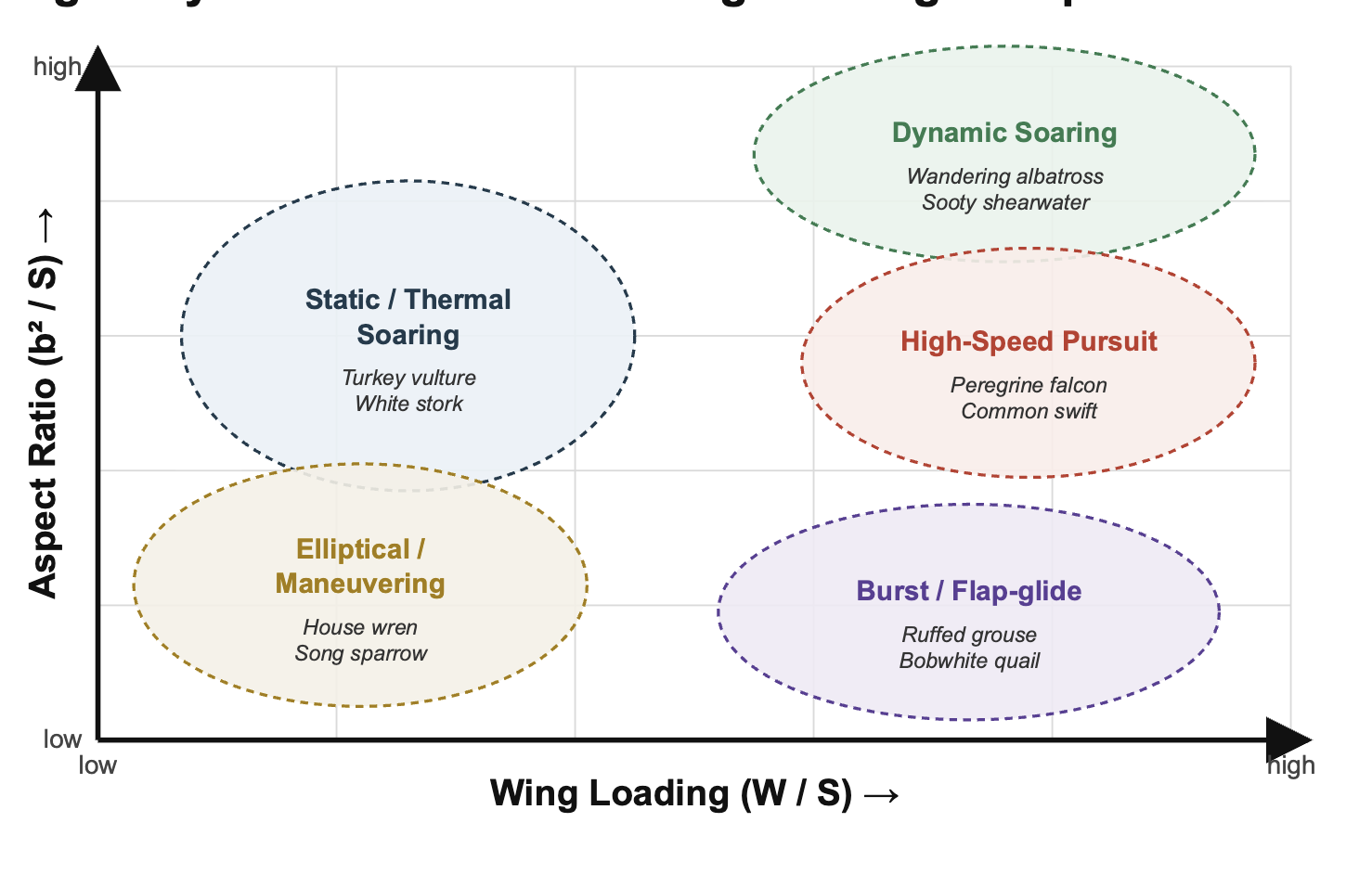
Flight Style as a Function of Wing Loading & Aspect Ratio
Low wing loading: Less weight per wing area; easier to stay aloft.
High wing loading: More weight per wing area; favors fast flight.
Low aspect ratio: Short, broad wings; maneuvering and burst flight.
High aspect ratio: Long, narrow wings; efficient soaring and gliding.
Systematics
the study of diversity and relationships among organisms and their evolutionary history
Taxonomy
naming and classifying organisms
A product of systematics
Phylogeny
depiction of evolutionary tree/hypothesis of relatedness
Monophyletic
contains a common ancestor and all of its descendants

Paraphyletic
contains a common ancestor and only some of its descendants

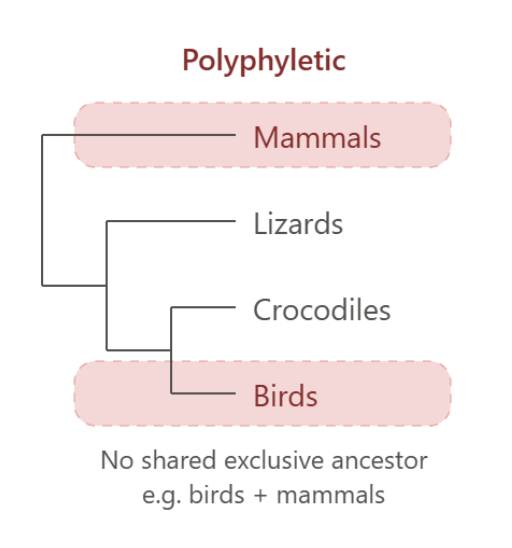
Polyphyletic
contains unrelated organisms that do not share a recent common ancestor
Node
ancestor split point

Clade
complete group of descendants

Sister group
pair of closest relatives

Outgroup
distant baseline comparison

Old birds,” Archaeopteryx and dinosaur-like things
Subclass Archaeornithes
New birds
Subclass Neornithes
Toothed jaw,” all extinct; like Hesperornis
Superorder Odontognathae
“Ancient jaw,” the 5 orders of ratites
Superorder Paleognathae