BIO 346 midterm 2
 Call Kai
 Learn
 Practice Test
 Spaced Repetition
 Match
 Flashcards
 Knowt Play
1/87

There's no tags or description
Looks like no tags are added yet.
88 Terms
Biogeochemistry
How elements move (cycle) through living organisms and the non-living environment
The movement of elements is influenced by:
– Source (atmosphere, lithosphere, biosphere)
– Chemical form(s) – determines reactivity and which organisms can use different forms
– Biological demand for that element
– Physical and chemical conditions
Source
describes a process or compartment that releases a substance into another part of the system, increasing its concentration elsewhere
Pool
refers to a reservoir or storage compartment where a particular element or compound resides
Sink
a process or compartment that removes or absorbs a substance from circulation, decreasing its concentration elsewhere
Cycle
a system consisting of two or more pools, where some of the material is transferred back and forth between the pools over time
Closed cycle, Open cycle
material cycles only within the ecosystem, e.g., within a lake
some material flows into and out of the ecosystem, e.g.
to and from the watershed and/or atmosphere
Essential elements for plant growth: Macronutrients (required in large amounts):
C, H, O, N, P, K, S, Mg, Ca, (Si)
Typically used to build large structures or to support many
physiological processes
Essential elements for plant growth: Micronutrients (required in small, or trace amounts):
Fe, Cl, Cu, Mn, Zn, Mo, Bo
Typically used for enzyme activity or a specific biological process
Redfield ratio
106:16:1
carbon:nitrogen:phosphorus
As plankton grow and die, they take up and release C, N, and P in roughly the
same proportions
Remineralization
Conversion of organic nutrients to inorganic nutrients
organic carbon → CO2
nitrogen compounds (amino acids)→ NH4, NO3
phosphorus compounds (lipids) → PO4
Processes leading to remineralization:
1. Decomposition
2. Leakage
3. Heterotrophic organisms breaking down organic matter
4. Organisms producing inorganic nutrients such as ammonium and nitrate in their waste
Why is carbon important?
• Carbon is the chemical backbone of organic molecules proteins, hydrocarbons, lipids, carbohydrates
• Currency of energy transfer
• Carbon chemistry provides a buffering system for lakes to absorb excess acid
• Exchange with the atmosphere and global climate regulation (CO2 and CH4 are green house gasses
what makes up DOC?
humic and non-humic compounds
Humic compounds – large molecular weight compounds
• By product of the breakdown of other organic compounds
• Resistant to microbial use
• Different types: humic acids, fluvic acids, humin
Non-humic compounds
sugars, carbohydrates, amino acids, urea, proteins, pigments, lipids
These fuel microbial production
Dystrophic lakes have
a lot of DOC in the water
Particulate Organic Carbon (POC)
• All living and dead organisms. Their parts, and the feces...
• Some small POC particles broken down by bacteria, some sink out from water column leading to carbon burial (e.g. diatoms, fecal pellets, cysts, etc)
• Some POC particles (e.g. plant detritus) leach DOC over time
Dissolved inorganic carbon (DIC)
• Atmosphere (CO2)
CO2 (air) + H2O ---------------> CO2 (dissolved) + H2O
• Respiration
Organic C+ H2O ---------------> 6CO2 + 6H2O
• Weathering of rocks such as calcite
CaCO3 + CO2 + H2O ---------------> Ca++ + 2HCO3-
CO2 “reacts” with water to produce different kinds of DIC
CO2 “reacts” with water to produce
different kinds of DIC
The form(s) of DIC depends on
pH
low pH: carbonic acid
high pH: carbonate
concentration and form of DIC help buffer pH change
Carbon flow in lake food webs
• All autotrophs consume CO2
• All heterotrophs respire/produce CO2
• Some organic carbon is buried in the sediments
• Lakes can therefore remove or add CO2 to the atmosphere
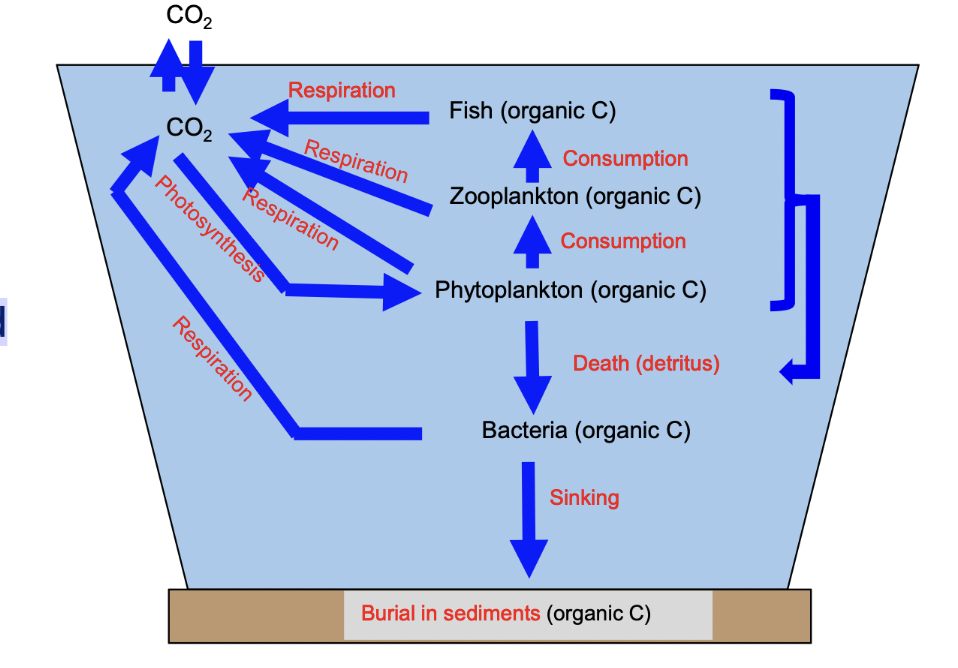
what is this representing?
Carbon flow in lake food webs
Ecosystem respiration (RE):
total CO2 produced (or O2 consumed) by living organisms
Net ecosystem production (NEP) = GPP – RE
• IF GPP> RE, lake might be a ”sink” of CO2
• IF GPP<RE, lake might be a “source” of CO2
In a typical terrestrial ecosystem (e.g., a forest):
– ecosystem respiration < photosynthesis (PS)
– because PS provides all the organic C to be respired
in many deep lakes:
– pelagic respiration > photosynthesis
Autochthonous
From within a system
• e.g. phytoplankton or other photosynthesizes in lake convert CO2 to POC
• e.g. Fish die in lake, carbon is recycled by microorganisms
Allochthonous:
From outside a system
• e.g. Streams carry terrestrial detritus (e.g. leaves) & dissolved carbon into a lake
• This is a ”subsidy” to the lake
High autochthonous contribution:
productive lakes with high algal density
High allochthonous contribution:
lots of weathered materials from watershed catchment
As DOC increases
lakes become supersaturated with CO2
• DOC ‘subsidy’ from terrestrial ecosystems (watershed) drives much of this
less C exits the lake than enters it, the remainder is
buried in sediments
Aquatic systems have ____ burial rates compared to terrestrial ecosystems
high
Reservoirs have ____ burial rates compared to natural lakes
high
Oxygen loss at depth increases activity of anaerobic bacterial producing
methane (methanogenesis)
methanogenesis
CO2 → CH4 (anoxic)
why is methanogenesis bad?
• Methane can diffuse or bubble (ebullience) to the surface
• Methane is a potent green house gas
• 1 gram of methane warms the atmosphere ~34x more than 1 gram of CO2
Methane release increases with
eutrophication
more C is buried in freshwater sediments than in
ocean sediments
• Oceans sequester ~2 Pg/yr but only 10- 15% of this is buried in sediments most is
‘sequestered’ in deep water (below ~200m) as DOC or POC
Oxygen Sinks (where it goes)
Diffusion to the atmosphere
Respiration
• Organic Carbon + O2 + H2O = CO2 + H2O + energy
Chemical oxidation (we will not discuss in this lecture)
Oxygen Sources (where it is produced)
Atmosphere
• Amount depends on diffusion, turbulence, wind
mixing
Photosynthesis
• CO2 + sun light +H2O = Organic carbon + O2
Orthograde profile
is an upright curve where oxygen is high near the surface and decreases with depth, characteristic of oligotrophic lakes where physical factors like temperature are the main influence
Clinograde profile
is a downward-sloping curve where oxygen decreases with depth, typical of eutrophic lakes where biological respiration consumes oxygen in the deeper layers

which lake shows these seasonal patterns?
oligotrophic

which lake shows these seasonal patterns?
oligotrophic
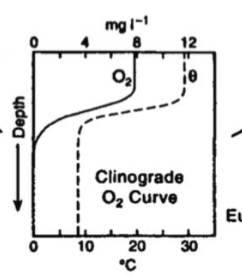
which lake shows these seasonal patterns?
eutrophic

which lake shows these seasonal patterns?
eutrophic
Biological implications of dissolved oxygen levels
• Organisms have different oxygen requirements
• Regular hypoxic/anoxic conditions have strong negative effect on community structure
• Anoxic/hypoxic conditions in hypolimnion can restrict available habitat
Chemical implication of oxygen variation
• Oxygen is a powerful “oxidizing agent”, and likes to steal electrons from other elements
• Highly oxygenated environments tend to have high redox pressure, meaning they have fewer electrons to share around
in the presence of oxygen, the forms of other elements are likely to be oxidized, electron poor versions - how does this affect lakes?
Oxidized and reduced chemical forms can behave differently
ex. Fe3 and Fe2
Fe3 can precipitate leading to Fe loss from the system
The problem with Fe3
precipitates from the system, leading to iron loss
Dissolved inorganic N can limit
primary production
Excess N supply can contribute to
eutrophication
Nitrate (NO 3 ) can be a
health hazard
• to humans if concentrations in drinking water is too high
• to other organisms at much lower concentrations
Nitrous oxide (N 2 O) is a
powerful greenhouse gas
NO X (NO, NO 2 , NO 3 ) from fossil fuels causes
acid rain
Atmospheric nitrogen (N 2 , gaseous)
Abundant in the atmosphere (78% of total gases), but only a few
prokaryotes can utilize it for nitrogen fixation
Dissolved inorganic N (DIN)
• These forms are most available to primary production and bacteria (e.g. ammonium NH 4+*, nitrate NO 3-, nitrite NO 2-)
• Oxidized forms of DIN are often abbreviated as “NO x
Nitrogen forms in freshwater
Dissolved organic N
• e.g., urea, amino acids, etc
Particulate organic N (PON)
• Organisms and detritus
Nitrogen fixation:
Certain cyanobacteria and bacteria (e.g., Anabaena, Rhizobium) convert atmospheric N₂ into ammonium (NH₄⁺), a bioavailable form
Atmospheric deposition:
Nitrate (NO₃⁻), ammonia (NH₃), and organic nitrogen can enter lakes via rainfall
Assimilation:
Phytoplankton and aquatic plants take up NH₄⁺ or NO₃⁻ to build proteins and nucleic acids
Ammonification (Mineralization):
When organisms die or excrete waste, decomposers
convert organic nitrogen back into NH₄⁺
Nitrification:
In oxygen-rich (oxic) waters and sediments, nitrifying bacteria (e.g., Nitrosomonas, Nitrobacter) oxidize:
NH₄⁺ → NO₂⁻ → NO₃⁻
This process requires oxygen and releases energy
Denitrification:
In oxygen-poor (anoxic) zones (e.g., hypolimnion or sediments), denitrifying
bacteria (e.g., Pseudomonas) convert NO₃⁻ → N₂ or N₂O gases, which return to the
atmosphere — a key nitrogen loss pathway
Anammox (anaerobic ammonium oxidation):
Specialized bacteria convert NH₄⁺ and NO₂⁻ directly into N₂ gas under anoxic conditions
Human impacts on N cycle
Humans have greatly altered N cycle
Anthropogenic N-fixation (industrial and agricultural) now exceeds all-natural N-
fixation
Atmosphere is loaded with NOx from fossil fuel combustion
• Can lead to eutrophication
• H 2O and NO3 react to form HNO3 (nitric acid), which can contribute to acid rain
• N 2O is greenhouse gas (stronger than CO 2)
Fertilizer runoff greatly increases NH 4 and NO3 concentrations in streams and lakes
Phosphorus in lakes
• Key component of ATP, DNA, RNA, bones, scales
• In non-vertebrates (plants, algae, bacteria, invertebrates) Ribosomal RNA and nucleic acids are the biggest pool of P in the body
• In vertebrates, bones and/or scales contain more P than RNA/ribosomes/DNA
Phosphorus availability is often the limiting nutrient for primary production in
lakes, rivers, oceans (and on land)
‘Soluble reactive P’ (SRP)
Approximately equal to orthophosphate (PO43-), the form of P most available to algae and plants
Total dissolved P (TDP, or TP)
All dissolved forms, including SRP
Particulate P
• All P in particulate form in the water column
• Living and nonliving matter, but this excludes fish
Total P:
all P, dissolved and particulate, captured from the water column with a typical limnological sampler, i.e., excluding fish
Because P is often limiting, there is very little available P (i.e., SRP) in the water column; most P is in
biomass
Watershed runoff:
The main source of phosphorus, often from weathering of rocks, soil erosion,
fertilizers, and wastewater
Atmospheric deposition:
Dust or aerosols can add small amounts of phosphorus to the lake surface
Groundwater and stream inflow:
Bring dissolved and particulate forms of phosphorus
Assimilation: (P)
Phytoplankton and plants take up PO₄³⁻ for growth and incorporate it into organic matter
Mineralizatioan (Regeneration): (P)
When organisms die or decompose, microbial activity converts organic P back to inorganic phosphate
Sediment binding (P)
In oxygenated (oxic) conditions, phosphate binds to iron (Fe³⁺) compounds and becomes trapped in sediments — effectively removing it from the water column
Internal loading: (P)
Under anoxic (oxygen-poor) conditions (e.g., in the hypolimnion during stratification),
Fe³⁺ is reduced to Fe²⁺, releasing PO₄³⁻ back into the water — a process called phosphorus release or internal loading
Phosphorus and Fe 3+ dynamics
• Fe3+ and water form ferric hydroxide, which binds P
• Insoluble Fe(OH) 3PO4 (complex iron phosphate), precipitates out
of water, onto sediments
• Fe2+ does not bind phosphates, and is soluble in freshwater
what drives NO3 depth profile?
O2 profile
why is phosphorus usually more limiting than nitrogen
mineralization of P and other processes take longer than nitrogen does
what are the optimal conditions for sediment binding?
Fe3+
Oxic water
Even if water overlying sediments is well-oxygenated, just a few mm deep the sediments are
anoxic
P is soluble in anoxic sediments, but when it diffuses upwards into oxic sediments, it becomes
insoluble and precipitates out (anoxic → oxic → oxic)
unless the water above the anoxic sediment is anoxic, then the ferris wheel is broken ( anoxic → anoxic → anoxic) because there no binding and burial, instead phytoplankton assimilation of soluble compounds