Better MedChem Exam 2 studying
 Call Kai
 Learn
Learn Practice Test
 Spaced Repetition
 Match
Match Flashcards
 Knowt Play
1/34

There's no tags or description
Looks like no tags are added yet.
Name | Mastery | Learn | Test | Matching | Spaced | Call with Kai | Chat |
|---|
No analytics yet
Send a link to your students to track their progress
35 Terms
aromatic hydroxylation (phase ONE)
adds an OH to a ring
cofactor = CYP

aliphatic hydroxylation (phase ONE)
adds an OH to a CH or an H (can be chain or off of a ring!)
cofactor = CYP
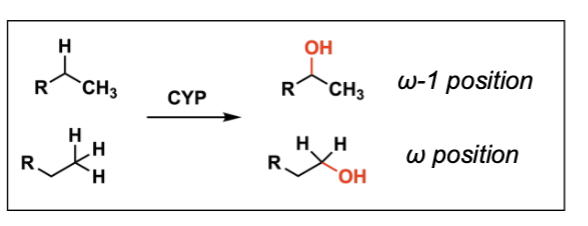
alkene epoxidation (phase ONE)
turns a double bond into a <O
cofactor = CYP

alkyne epoxidation (phase ONE)
turns a triple bond into a <|O
cofactor = CYP
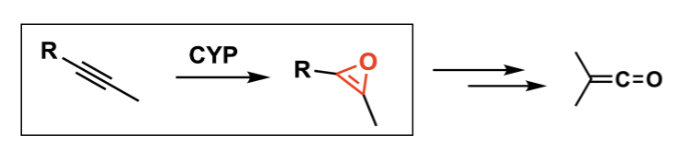
N-dealkylation (phase ONE)
takes a CH from an amide and replaces it with an H
cofactor = CYP

O-dealkylation (phase ONE)
takes a CHx and replaces it with an H
cofactor = CYP

S-oxidation (phase ONE)
turns R-S-R into S=O
cofactorS = FMO or CYP

N-oxidation (phase ONE)
takes R-N-R and adds an O- to it
oxidative deamination (phase ONE)
takes an amine (NH2) and turns it into an aldehyde
cofactor = MAO

alcohol oxidation (phase ONE)
takes an alcohol and turns it into an acteylaldehyde [h-=O]
cofactorS = alcohol dehydrogenase or CYP
![<p>takes an alcohol and turns it into an acteylaldehyde [h-=O]</p><p>cofactorS = alcohol dehydrogenase or CYP</p>](https://assets.knowt.com/user-attachments/65102044-d64f-405e-ae18-692b49dbd7cc.png)
aldehyde oxidation (phase ONE)
turns an aldehyde into a carboxylic acid
cofactor = alcohol dehydrogenase

reductive dehalogenation (phase ONE)
takes RX and turns it into RH
X = Cl and Br
cofactor = CYP
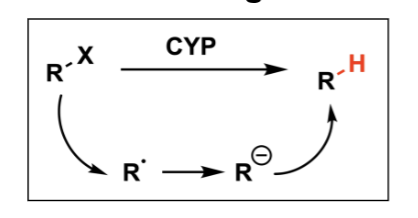
nitro reduction (phase ONE)
can lead to toxicity
takes R-N=O-O- and turns it into an amine (NH2)
cofactorS = nitroreductase or CYP

azo reduction (phase ONE)
turns N=N into an amine (NH2)
cofactorS = azoreductases or CYP
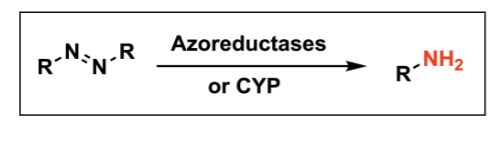
carbonyl reduction (phase ONE)
turns carbonyl into an OH
cofactorS = CRs [carbonyl reductases] or AKRs [aldo-keto reductases]
![<p>turns carbonyl into an OH</p><p>cofactorS = CRs [carbonyl reductases] or AKRs [aldo-keto reductases]</p>](https://assets.knowt.com/user-attachments/a11aba84-ab24-4754-82f2-97543dab9d74.png)
ester hydrolysis (phase ONE)
turns ester into ester and alcohol
cofactor = esterases

amide hydrolysis (phase ONE)
amide to ester + amine
cofactor = amidases

epoxide hydrolysis (phase ONE)
turns <O into OH - OH - R
cofactor = epoxide hydrolases

glucuronidation (phase TWO)
adds UDP-glucuronic acid onto an O, S, NH, COO
enzyme = UGT (udp-glucuronic acid transferase)
cofactor = UDP-glucuronic acid

acetylation (phase TWO)
adds an acetyl group
enzyme = NAT (N-acetyltransferase)
cofactor = acetyl CoA

sulfation (phase TWO)
adds SO3 group to O or NH
enzyme = SULT (sulfotranferase)
cofactor = PAPS

amino acid conjugation (phase TWO)
takes a carboxylic acid and eventually adds an amino acid on the end
enzyme = ATP-dependent acid-CoA synthetase
cofactor = acetyl CoA

methylation (phase TWO)
adds a CH3 to an O, S, or NH
enzyme = methyltransferase
cofactor = SAM (s-adenosylmethionine)

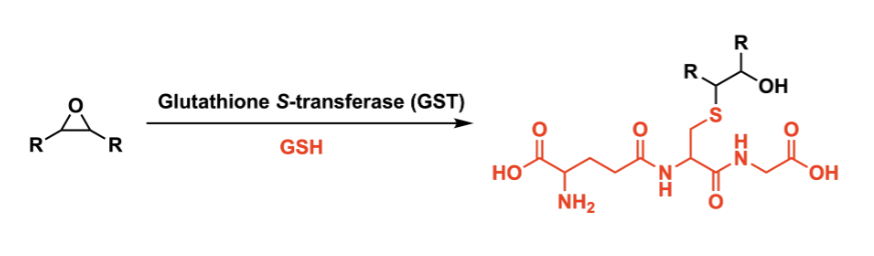
glutathione conjugation (phase TWO)
takes r-<O-r and unravels it and adds GSH to it
enzyme = GST (glutathione s tranferase)
cofactor = GSH (glutathione)
what molecules does CYP1A2 like in its active site
planar rings!
lipophilic

what molecules does CYP2D6 like in its active site
basic Nitrogen
beta blockers and CNS drugs (psych drugs)

what molecules does CYP2C9 like in its active site
weak acids

which CYPs are highly polymorhpic?
CYP2D6 —> codeine/morphine
CYP2C9 —> warfarin
what molecules does CYP3A4 like in its active site
large drugs
lipophilic [Phe groups]
can bind more than one molecule!! very versatile
![<p>large drugs</p><p>lipophilic [Phe groups]</p><p>can bind more than one molecule!! very versatile </p>](https://assets.knowt.com/user-attachments/f4c52295-7cff-4b37-abd5-386d2d553088.png)
what are the main classes of carriers involved in phase THREE metabolism?
SLCs and ABS transporters
(soluble carriers) (ATP-binding cassette)
what do SLCs do? (phase THREE)
[influx] carry drugs INTO the cell (no ATP required)
(OATP, OAT, OCT, PEPT)
what do ABC transporters do (phase THREE)
carry drugs OUT of the cell [efflux]
(MDR1, MRP, BCRP, MDR)
usually ATP DEPENDENT
what is an Augmented ADR
a toxic, unintended response to a drug at doses normally used in humans
*dose dependent
*can be solved with dose adjustments
*usu detected in animal models
what is a Bizarre ADR
an unexpected response in a drug
*often not detected until drug has been exposed to a high population of patients
*can occur at different doses in different patients
*potentially caused by bioactivation
urinary pH and drug excretion
drugs are excreted when they aren’t absorbed
when a drug is ionized, it doesn’t get absorbed —> gets excreted in the urine
weak acids get excreted more in high pHs (because high pH = more H+, which = charged acid)
weak bases get excreted in low pHs
