Wk 5 part 2+week 10+week 11
 Call Kai
 Learn
 Practice Test
 Spaced Repetition
 Match
 Flashcards
 Knowt Play
1/32

There's no tags or description
Looks like no tags are added yet.
33 Terms
What does the AD and AS model graph look like and what is AD and AS and what is it determined by
AD: describes downward sloping relationship between inflation and output
inflation leads to nominal interest rates increasing which increases real interest rates which decreases Y (ie. cuz its more expensive for firms to invest)
AD is determined by monetary policy, fiscal policy and demand shocks
AS: describes upwards sloping relationship between inflation and output
as output increases, this leads to less unemployment which leads to more inflation.
relationship between Y and u=okuns law
relationship between u and pi=phillips curve
AS is determined by inflation expectations and supply shocks.

New consumption function
C = ¯C + c(Y − ¯T ) − γC r, γc > 0
γC=interest sensitivity of consumption
as r (real interest rate) increases, savings becomes more appealing to households and they consume less.
New investment function
I = ¯I − γI r, γI > 0
γI > 0 measures interest-sensitivity of investment
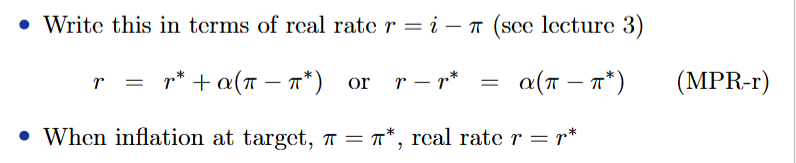
How to get real interest rate
just subtract pi from both sides since r=i-pi
what is goods market equation/AD curve
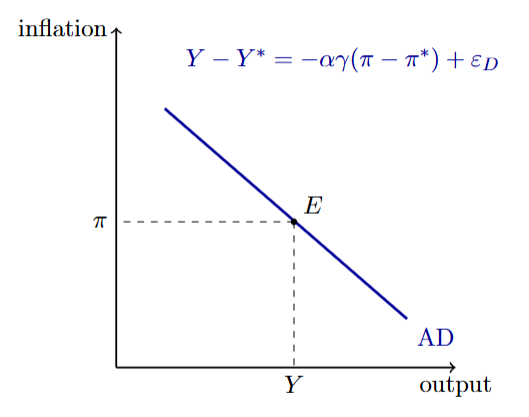
shocks to AD curve
they shift the curve either inwards or outwards
could be changes to ed=shocks to aggregate demand
increased optimism would increase ED=hence AD shifts right and vice versa


what does phillips curve represents and what are its components
phillips curve represents relationship between u and pi
πe =inflation expectations
ϕ =inflation’s sensitivity to labour market tightness
εS = supply shocks
Natural rate hypothesis
in long run inflation expectations become inflation, shocks to supply are 0 and natural rate of unemployment becomes unemployment, can’t determine inflation.
so there is a long run phillips curve at u=u*

okuns law
what we learnt ages ago
connect unemployment gap with output gap


short run AS curve
plug okuns law into phillips curve


long run AS curve
inflation=inflation expactations
Es=0

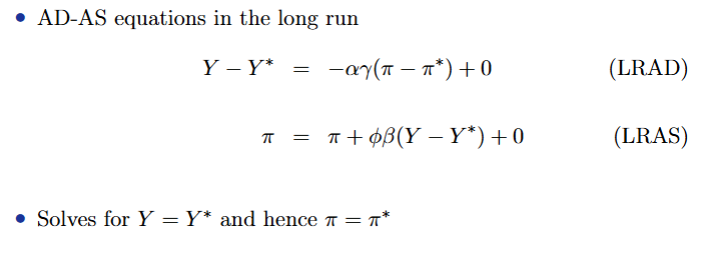
long run AD and AS curve equlibirium


short run equilbrium
example of negative ad shock.
so we started at long run equilbibrium, then negative shock moves srad curve in so we get lower output and inflation leading to a negative output gap and inflation gap

What is bilateral nominal exchange rate and what is a direct and indirect quote
bilateral nominal exchange rate= relative price of one currency relative to another.
direct quote: how many aus dollars to buy 1 avocado (how many aud to by one unit foreign currency)
indirect quote: how many foreign dollars to buy 1 aud.
how many foreign dollars does 1 aud buy
E=0.75Y/1aud= indirect exchange rate
RER
an increase in RER means the currency has appreciated THEREFORE NET EXPORTS DECREASE
an decrease in RER means the currency has appreciated THEREFORE NET EXPORTS INCREASE
RER=P/PfE=EP/Pf
gRER=GE+GP-GPf
gRER=Ge+pi-piF
What is purchasing power parity
there is the law of one price suggests that goods should sell for one price across the world once they are denominated in one currency
can have absoulte PPP=RER=1
relative PPP=RER= constant. means growth in RER=0, so growth in exchange rate just depends on inflation differental pi-pif
means dom currency appreciates when foreign currency inflation exceeds domestic currency inflation
long run vs short run implications of PPP
in long run, E just basically relects price level differences since rer is constant
in short run changes in E are mostly bc of changes to nominal exchange rate so less useful for short run

how does interest rate effect excahnge rates
domestically:
increasing r leads to foreigners investing here (so demand for dom currency increases) and supply of domestic currency reducing. demand right, supply left. so we get an appreication of currency. net exports decrease and gdp falls. and vice versa
this means MP is only more effective in open economies where exchange rates are flexible.
what does current account consist of
trade balance+net foreign income+net foreign transfers
National income accounting indentity + savinsg equation
S+ (T-G)-I=X-M
having a trade surplus means total dom savings is more than I and vice versa for deficit
what does capital account consist of
purchase and sales of assets
are current account deficits a problem
yes: becuase it means I is greater than S, so we are accumulating debt and C will have to fall in future
No: because implies KAS surplus. we are a good place to invest but there is a risk of sudden stops of we depend on foreign capital inflow
what determines net capital inflow
real return on domestic assets
real returns on foreign assets
risk premia
what does a higher domestic r do for net capital inflow (KA)
makes domestic assets more attractive to foreign investors leading to more capital inflow
foreign assets become less attractive for us leading to less capital outflow.
this increases net capital inflow
what does a higher foreign r do for net capital inflow (KA)
makes foreigners investing here less attractive so they invest less. decreasing capital inflow
makes us attractive outside more attractive so they invest more and increase capital outflow
overall decreases net capital inflow.
what does a higher international risk premia do for net capital inflow (KA)
international investing has country specific risks such as exchange rate risk and soverign irsk
risk premia is compensation for risk averse investors
increase in risk premia decreases capital inflow cuz it seems more risky
floating vs fixed excahnge rates
floating
determined by demand and supply
can have clean or dirty
fixed
determined by policy makers
fixed or pegged to a strong commodity or major currency
how to maintain a fixed exchange rate
policy makers must be willing to take the other side of the transaction
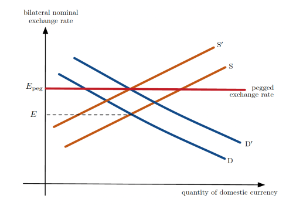
what happens if epeg>efun
it means exchange rate is overvalued
it means there is too much supply of aud relative to demand
so they will buy some of aud and sell international reserves which can be a problem
what happens if epeg<efun
exchange rate is undervalued
it means too much demand relative to supply
so policy makers will supply aud by buying international reserves
this builds up its international reserve
what are speculative attacks
mass selling and increase in supply of currency bc. people think policy makers don’t have enough international reserve.
supply curve shifts right leading to an ever lower efun
puts extra pressure on policy makers to buy even more aud and sell remaining international reserve
once we run out peg disappears and exchange rate drops to efun and devaluation has occurred.
constraints on mp
can use mp to avoid speculative attacks but means it can’t be used domestically anymore
can increase interest rate to increase investment here and shift demand right.
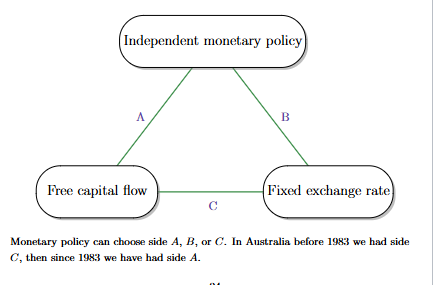
policy trilemma
can only pursue 2/3 goals
free capital flow
independent monteary policy
fixed exchange rate