MELC 10
 Call Kai
 Learn
Learn Practice Test
 Spaced Repetition
 Match
Match Flashcards
 Knowt Play
1/84

There's no tags or description
Looks like no tags are added yet.
Name | Mastery | Learn | Test | Matching | Spaced | Call with Kai | Chat |
|---|
No analytics yet
Send a link to your students to track their progress
85 Terms
Lamassu
Ancient meso deity statue, meant to protect from other gods, statues of this in front of palaces. Carved from large alabaster stones
face of a man, but a winged bull, and has a beard
carved in Zagros Mountains
Marduk
powerful Meso deity, lived around Babylon, back then was supreme ruler of Meso
Dinger
shaped like a star, cuneiform for god or goddess bc it’s believed that gods lived up in the stars
Assyrian Empire
Pharaonism
Egyptian nationalism linking back to ancient Egypt
Alexander the Great
in 330 BCE, Alexander the Great builds massive empire —> falls in 33 BCE
Integrated Egypt, Meso, and Greek culture
Large amts of cultural exchange btwn these groups, but lots of works written in Egyptian or Meso langs were translated and plagiarized by Greek scholars during this time
Hermeticism
philosophy attributed to Hermes Trismegistus
combines the Greek god of wisdom Hermes and the Egyptian god Thoth
God is viewed as creator
“authored” Hermetica, which had lots of science topics, and Greeks believed Hermetica was the secret knowledge Egyptians and Mesos used
The Hermetica was deemed fake by Isaac Casaubon (French, 1559-1614)
Written between 200-300 CE and then passed off as Ancient Egyptian
Hermetic tradition isn’t considered real science anymore
“As above, so below” (pointing up to the sky and down to the ground)
What happens in the heavens will happen down here
Hellenization
Greek practices that Greeks bring to places they conquer
Napoleon’s Campaign to Egypt
considered a failure bc last min, Napoleon decided to start a campaign in Egypt in SUMMER
succeeded in conquering Lower Egypt, but many died
French Savants
documented everything in Egypt during Napoleon’s campaign
stayed for 60 yrs and made the Description de l’ Egypte, which has useful scientific guides + technical paintings of ruins
discovered Rosetta Stone
Rosetta Stone
written in three dif scripts
this was found bc it was reused by Egyptian army who used it as a stone to build a fort
TOP: hieroglyphs
MIDDLE: demotic, formed from hieros
BOTTOM: Greek
able to use it to understand Egyptian hieros + demotic

What is this image of?
Description de L’Egypte:
It helped launch modern Egyptology and fueled European “Egyptomania,” giving scholars (including Champollion, who later deciphered hieroglyphs using the Rosetta Stone) their first comprehensive visual record of Egypt’s monuments.
It is also a product of colonial ambition
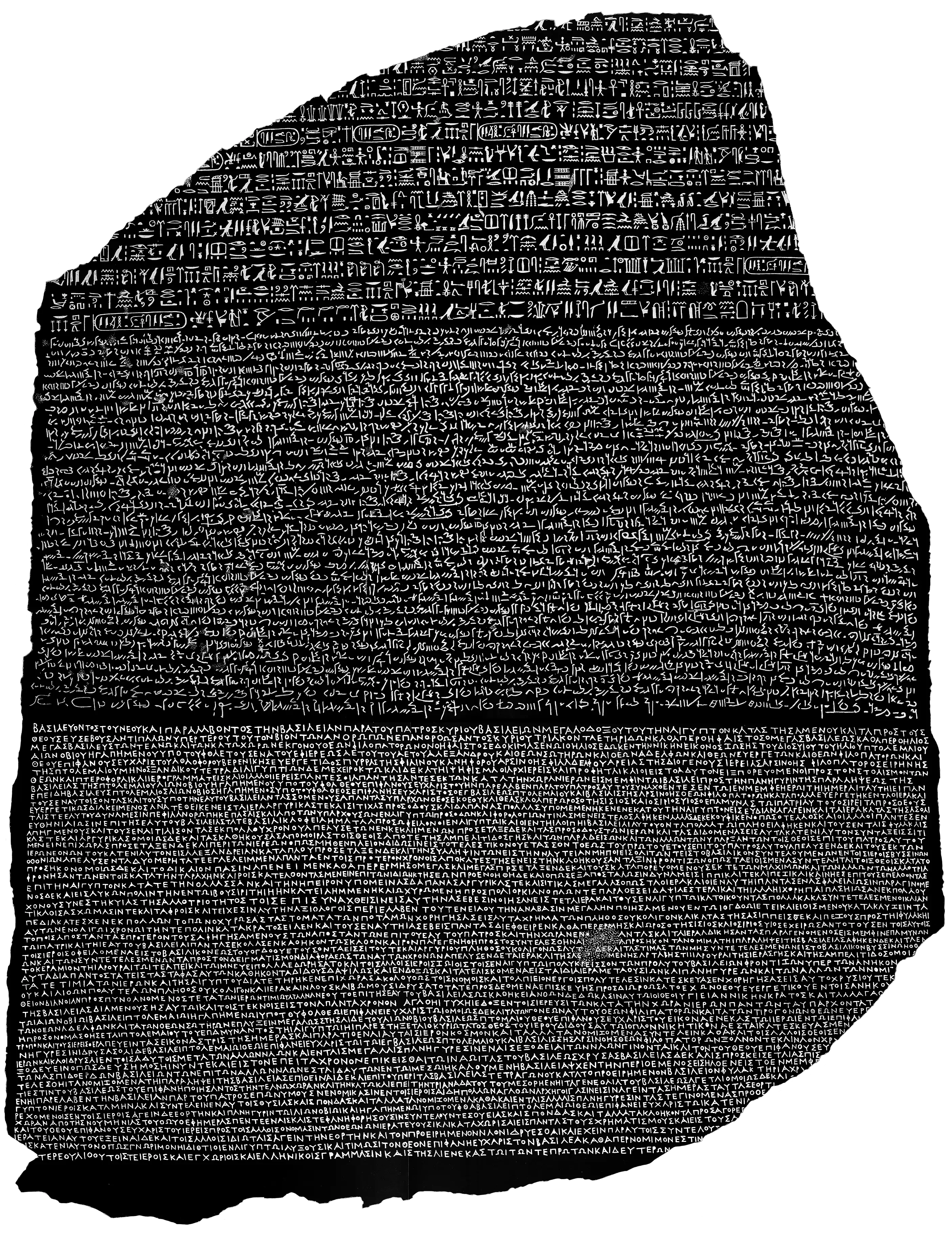
What is this image of?
Can I identify the object/text?
Can I analyze its major visual and textual elements?
Can I describe its significance?
Rosetta Stone
fragment of a dark granodiorite stele, about 112 cm tall, inscribed in 196 BCE with a decree issued at Memphis on behalf of the Ptolemaic king Ptolemy V, and it was found in 1799 by French soldiers near the town of Rashid (Rosetta) during Napoleon’s Egyptian campaign.
TOP: hieroglyphs
MIDDLE: demotic, formed from hieros
BOTTOM: Greek
Because scholars could read the Greek, the stone provided the key for comparing the three scripts
The stone was seized by British forces after the French defeat in 1801 and has been in the British Museum since 1802
Egyptomania
the deep Western fascination with the art, history, and symbols of ancient Egypt
READING WEEK 1 : REDISCOVERING ANCIENT EGYPT
scared that Western influence on Egypt is ruining it
Champollion is the one who opened ppl’s eyes to ancient Egypt (before 1800s)
before 19th cent, ppl thought OG pyramids were the ones in Rome vs the ones of Giza
disturbances in Upper Egypt kept Europeans out for half a century
Bonaparte’s savants built on a cumulative, if still severely limited, body of Western knowledge of ancient Egypt
Ottoman governor Muhammad Ali issued a landmark decree on August 15, 1835 (influenced by al-Tahtawi), banning the unauthorized export of Egyptian antiquities, halting the destruction of ancient monuments
Afrocentrism
worldview that places African history, culture, and agency at the center of analysis for people of African descent, challenging traditional Eurocentric perspectives
Fertile Crescent
The Fertile Crescent is not correct
James Henry Breasted claimed this with almost no data
Agriculture did take place in the Fertile Crescent, but it was not the only location
Egyptian Nationalism: Different Paradigms?
One is pan-Islamism; that all muslim nations could, with their cultural/religious similarities, unite into one national identity
Another is pan-arabism; the groups of people that speak Arabic should unite and form a coalition or one nation regardless of religious affiliation
Both of these extended beyond Egypt
Prehistory
Paleolithic Era; 1.5 mya - 12,000 BP
Stone tool technologies, migration in Middle East
Neolithic Era; 12000 BP - 8000 BP
Farming, sedentary life, and ceramic tech gets made
Chalcolithic era; 8000 BP - 5000 BP
Hierarchies starts to establish, copper age, first signs of organized religion
Protohistory
Bronze Age 3000 BCE-1000 bce
First cities and kings, int. trade, writing, use of bronze
need someone to bring copper from Southern Jordan (?)
Iron Age, 1000 bce-330 bce
First EMPIRES —> global trade patterns, use of iron, merchants move across large distances
much easier to get than bronze + lighter
Have to be mindful abt where you use it
Can’t be as detailed as bronze bc higher melting point
Christian Jurgensen Thomsen dev’d three age system in attempt to classify early world history (Stone Age, bronze Age, Iron Age)
Copper Age?
copper only in restricted areas
soft and malleable, used to craft detailed objects
Breeding + Domestication
domesticated certain qualities in reproducing animals
Sheep and goats domesticated first
People began adopting sedentary life
gazelle and deer die off, but sheeps suddenly become more domesticated bc easier
Pig consumption only in niche environs
Early Village of Mallaha
first evidence of architecture + stone tech + sedentary life
located near Golan Heights
Made structures in form of circles
First closet + storage bin for food!
Crops + Agriculture
humans selected plant species w larger nodes to hold onto grains + sturdier grains
Carbonized Seeds are pieces of wheat that was carbonized bc got too close to fire - kinda like fossil
Believed that agriculture encouraged pop growth, not the other way around
climate pushed humans toward argiculture
Younger Dryas —> temps plummetted around 14K yrs ago
degraded landscape bc of deforestation, soil salinization, overgrazing, hunting to extinction, and poor soil management
Paleoethnobotany
study of Ancient Plant Remains
Zooarchaeology
annalysis of ancient animal bones
no category of artifacts that we find more than animal bones
Nomadic Pastoralism/transhumance
alternative lifestyle where ppl traveled w herds seasonally
Bedouin communities — under threat bc climate change
Berossus
lived around 320 BCE, witnessed Alexander the Great’s conquests
Babylonian astronomer, came in contact w Greek histories —> wrote Meso histroy called the Bayloniaca
the OG is lost, but copied fragments in other langs survive
Manetho
3rd century BCE
Egyptian priest, authored the Aegyptiaca in Greek
compiled list of diff kings + order they ruled
Mesopotamian history
not linear march thru a single civilization
a story of the rise and fall of diff societies over 5 millenia
Northern Meso sometimes called Assyria
Northern Iraq + Eastern Syria
Southern Meso
Southern Iraq + Southern Iran
Assyrian = Northern
Babylonian - Southern
Egyptian History
Early Dynastic period (dynasty1-2)
Old Kingdom (3-6)
Middle Kingdom (11-22)
New Kingdom (23-?)
Dating
relative dating is comparing the ages to things around it, like how the top clothes in laundry are newer than ones at bottom
Absolute dating is putting actual dates
radiocarbon dating/historical records
dendrochronology - looking at tree rings
Archaeology
how to find and read ancient objects
practiced by antiquarians - wealthy precursors to archaeologists
study of humans through material remains
Four goals of analysis
Form: describe and classify archaeological evidence, being able to make observations + group them tgt
Function: reconstruct how ancient objects used
more than half of what is found, we can’t figure out what it is
Process: determine HOW and WHY societies change over time
Meaning: understand how ppl in the past thought abt the world and their place in it
Ubeidiya
located near Dead Sea, 1.2-1mya
homo erectus settled there
no skeletons though…near Jordan Valley in Israel

What is this an image of?
Can I identify the object/text?
Can I analyze its major visual and textual elements?
Can I describe its significance?
Ubeidiya
many ridges bc of tectonic movements on Jordan River
used to make many stone tools
Tell
an artificial mound w human debris, accumulated over millennia of time
Anthrosol
soil created by human interaction
Artifact
portable, discrete object created or altered by human behavior
Feature
non-portable artifact unrecoverable from excavated context
Neolithic Tower in Jericho
temples in Karnak Egypt
Assemblage
all artifacts and features associated w a particular time period or ancient society
Philology
study of ancient langs, scripts, and how both change over time
examine how words and meanings change over time
draws studies from linguistics
philologists lack direct access to ancient speech communities
Speech
context informed by culture, time, situation, and perspective
members of speech community share explicit and implicit rules abt “rules'“ of lang and meanings of words and expressions
speech changes too much over time —> living members of descedant speech comms are imperfect guides to ancient ones
Texts
ancient texts are artifacts of speech event
attempt to represent or record speech in a patterned format, uses script/scripts and follow unwritten rules of a writing system
Incantation: Against Toothache
starts off w the creatin story of a orm
dialogue btwn tooth worm and Shamash
tooth worm wants to harm humans, so God Ea is called upon to destroy worm
Wadi el-Hol
first alphabetic inscription in Egypt
\represents spoken sounds, not whole words
alphabet eventually turns into early Phoenician and spreads
How did Roman rule of Egypt work?
Rome banned Egyptian religion and culture, but hieros still preserved

What is this an image of?
Can I identify the object/text?
Can I analyze its major visual and textual elements?
Can I describe its significance?
Seated Scribe of EGYPT
it breaks away from rigid, idealized royal portraiture to offer a remarkably realistic, humanized depiction of an elite bureaucrat
rolls of belly fat, moves away from typical Egyptian portrayals of perfection
VIDEO OF THE SEATED SCRIBE SAYS…
the eyes represent alertness
relaxed, cross-legged position is rare
funerary sculpture meant for a tomb
Hieroglyphs
sourced from things that ppl would see everyday
record spoken Egyptian language
Distantly related to semitic langs like Arabic or Hebrew
after hieros forgotten, Egyptian still spoken but written in Greek alphabet
Coptic, associated with Egyptian Christianity
Grapheme
the building blocks of writing
the meaning of a grapheme is still debated
Hieratic
simplified versions of hieros
Cuneiform
script used throughout much of Middle East
written primarily on clay tablet w reed stylus
Cuneiform tablets found in Iraw and up thru Syria thru Med Sea + Turkey
4000 yrs in which cuneiform script was used
used for record-keeping
syllabic, so easy for other, new communities used it to write down a new lang
Law of Superposition
things on the bottom are generally older than those on the top; material bottom was deposited first, and top was deposited after
Uruk
huge increase of ubranization - Uruk major place of cuneiform development
administrative accounts become popular (4000-3000 BCE)
used to keep track of what workers get in exchange for labor
Lexical Lists
proto-cuneiform lists of professions, wood objects, fish, birds, cities
remain important for all of Sumerian history
served as practice for scribes, helped maintain continuity
precursor to dictionaries
no grammar - we don’t know how it was pronounced or what language it is
Logographic
type of sign in cuneiform - what it depicts as a noun - whole characters = whole words (ex. dinger= god)
Determinative
type of sign in cuneiform - combines with another sign to give more info (ex. dinger = divine)
Syllabic
A writing system where each written symbol represents an entire syllable rather than a single letter or sound
Dedicatory Objects
also had cuneiform, commemorating the project
cuneiform indicated who originally built the structure
not always necessarily meant to be read, sometimes written directly to gods to communicate w them directly so written up high
Myths and Epics
mostly written down in the Neo Sumerian period

What is this an image of?
The Royal Standard of Ur
4500 yrs old, come from Ur - early city of Mesopotamia
divided into 3 registers - shows us long distance trade that Meso culture was involved w
reminds us why society was successful was bc of agriculture
common laborers at bottom, royals at top
there’s a hierarchy of society - some members larger than others
abecedary
written list of letters of the alphabet, starts from right to left
Book of Genesis
Egyptian hieroglyphic Alphabet Video
some sounds in English and Egyptian are same, but Egyptian has some English doesn’t
no vowels in Egyptian writing
some English sounds didn’t exist in Egyptian

What is this item?
Palermo Stone
preserves yr by yr records of Egyptian kings, first thru fifth dynasties
black basalt slab
records cult ceremonies, taxation, sculpture, building, and warfare
also records the DEPTH of the Nile, lower depth = indicative that king isn’t doing a good job
Can use RTI on the backside of the Palermo Stone to identify additional text

What is this?
Inscriptions of the Battle of Djahy against the Sea Peoples depicted on Temple’s North
Ramsess III maintaining ma’at by battling these foreigners
he has a structured + clean scene
Nekhbet is the vulture, protecting the pharaoh - carries an ankh - symbol of ma’at
victims are captured under pharaoh’s feet
The Biography of Pepynakht Heqaib
represents how the welathy can and would afford their own funerary monuments
Heqaib was a seal-barer for the king
talks highly of his achievements
Introduction: Chronologies and Cultural Change in Egypt
Dynastic vs. Socio-Cultural Frameworks: Historically, Egyptian chronology relies on Manetho's system of dividing pharaonic rule into "dynasties." While convenient for tracking political sequences, Shaw argues this approach often obscures regional variations and gradual socio-economic transformations revealed by modern archaeology.
Dating Methodologies: Egyptologists combine three dating methods to build timelines:
Relative Dating: Archaeological methods like stratigraphy and seriation (e.g., tracking changes in pottery styles or wooden coffin decorations).
Absolute Chronology: Written records, king-lists, and astronomical observations (such as records of the rising of the dog-star Sirius/Sothis).
Radiometric Methods: Radiocarbon dating and thermoluminescence, which are essential for dating prehistory and verifying absolute historical timelines.
Early Commemoration and Royal Records: Early sources—such as votive palettes, ceremonial maceheads, and the Palermo Stone (a 5th-Dynasty basalt stele listing early rulers and key annual events)—blur the line between real historical events and ritualistic or magical acts. Their primary purpose was commemoration and ancestor worship rather than pure historical narration.
Royal Titles and Kingship: By the Middle Kingdom, pharaohs used a fivefold titulary system that balanced their divine identity (e.g., Horus) with their temporary human role as ruler. Features like king-lists (such as the Turin Canon) served primarily to honor legitimate royal ancestors rather than record objective history.
Chronological Challenges:
Co-regencies: Period overlaps where two pharaohs ruled simultaneously make establishing exact regnal lengths complex.
"Dark Ages" / Intermediate Periods: Times of disunity or political fragmentation are often overly simplified in political narratives, whereas material culture (like ceramics) often shows continuous, gradual evolution.
Egyptian Concept of History: For ancient Egyptians, history was an ongoing balance between preserving order (Maat) and carrying out sacred duty to the gods, making ritual and historical event inextricably intertwined.
Assyria v. Elam
war broke out bc Elamite ruler Teumman seized the throne and demanded the return of fugitives protected by Assyrian King Ashurbanipal
Battle of Til-Tuba
Assyrians have better weapons and better armor, as depicted in stone carving
Elamite king and son (Teumman is king) gets injured and caught by Assyrian soldiers - they cut both heads and take it back to camp
in the carving, images and scenes cut from place to place, so there’s captions to help understand what’s happening
Aftermath of Battle: Assyrians bring puppet king to Elamites and in the carving, he is defaced
overall, Assyria wins, and Ashurbanipal asserts dominance, saying that those who disobey him will end up like the Elamites
Battle of Kadesh
Major military conflict fought in c. 1274 BCE between the Egyptian Empire under Ramesses II and the Hittite Empire under Muwatalli II near the Orontes River
Renowned as the largest chariot battle in ancient history
Ended in a tactical stalemate, though Ramesses II widely memorialized it as a dramatic personal triumph across temple reliefs (e.g., Abu Simbel, Ramesseum, Luxor)
Culminated years later in the earliest surviving recorded international peace treaty (the Egyptian-Hittite Treaty)
Battle of Kadesh reading
2 nomads go to Ramses' II and say that king of Hittite is far north (lie)
Egyptian scouts found out they were lying and uncovered that ruler actually formed a large coalition and was waiting outside of Kadesh
Hittites surprise attack, but Ramses was like “I got this” and beats them single-handedly bc his chud army can’t do jackshart
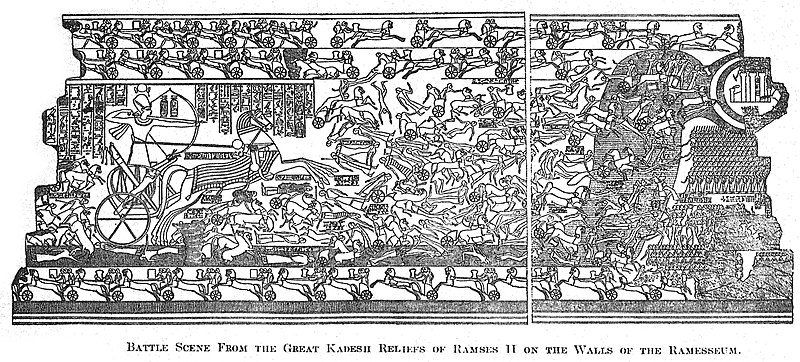
What is this?
Battle of Kadesh
first documented major battle
oversized Ramses II —> supreme power over the others
Chaos vs Order —> Egypts = order, Hittites = chaos
blocks of hieroglyphs to narrate what was happening
this is considered propoganda bc the battle was actually lowkey a stalemate, but it establishes Ramses II’s divine power and dominance rarwr
Significance of Venus
Venus was chief god Ishtar
had to check for Ishtar’s mood bc that could mean king is gonna die
When Venus disappears, Ishtar is angry
Completely whole Venus has symbolic meaning
Enuma Anu Enlil
very strong lines that separate the diary entries
Venus disappeared for three days and came back which means there’s going to be rain and peace so yay
has astronomical events + predictions
Connects celestial movements (such as the disappearance and reappearance of Venus) to earthly predictions like rain, peace, and societal well-being
Sumerian Kings List
Scholars would find copies of past tablets and write down lists of kings’ names and sometimes, the lengths of their reigns
The lists were copied and recopied over centuries because they don’t want the knowledge to decay
Sumerians thought of the past kings are more mythological and could live super duper long lives
Early Mesopotamian Kings at the beginning of the Sumerian Kings’ List were descended from Gods and considered “deified”
But later mesopotamian kings were not deified!
Cyrus Cylinder
538 BCE - talks abt the relationship w kings vs gods - to what extent are Mesos deifying themselves?
Cyrus sent gods back to their own shrines + collected ppl and brought them back to their own settlements
talked abt making Babylon a bigger, stronger city
Ma’at
Egyptian virtue that valued justice, truth, and order
personified as a woman with an ostrich feather, holds an ankh (slightly like aura..?)
Sustaining ma’at held back chaos (isfet) and sustained the balance of the universe
Ma’at was being a good person, but also meant castrating and beheading your enemies

What is this?
Mortuary Temple of Ramesses III in Luxor
text and image comes together
Inscriptions of the Battle of Djahy against the Sea Peoples depicted on Temple’s North Wall
Ramessess III maintaining ma’at by battling foreigners
Lugal
king
lu = man
gal = big
Roles of Kingship
Builder
Warrior
Governor
Priest
Scholar

Example of being a builder: Ur-Nanshe Plaque
depicts Sumerian king of Lagash
Records Ur-Nanshe’s building activities in pictures and in texts
VISUAL ANAYLSIS:
2 large figures, one is sitting and one is standing
large one is king, but he is a builder in one and a ruler in another (basket)
circle in the center meant for hanging up the plaque
chairs are expensive, so being able to sit is a privilege only king has
mu-du inscription is repeated - means to build

Warrior Role: Naram-Sin’s Victory Stele
2m high stone monument
2250 BCE
records victory of King Satuni of Lullubi tribe in Western Iran
VISUAL ANALYSIS
the lullubi lived in Zagros mtns
the stone signals that it’s the mtn
the stone’s material adds to the spectacle
Naram-sin depicts himself as Godly, but gods are still present

Governor Role: Code of Hammurabi
written w moving up and down columns
Hammurabi is trying to gain legitimacy for his law code by using an older way of writing his laws to make it seem older
created 1750 BCE, portrayed as oldest legal code, but it was more of a public monument
prologue is royal propaganda
There are 282 laws that all start with ‘shumma awilum’ or “if a man”
Describes what should happen if a man does something
Epilogue describes how to use the stele
Code presents an idealized view of Babylonian social structure:
Awilum – a free person who pays taxes to the state
Mushkenum – probably a dependent on the state–need hand outs
Wardum – slave
VISUAL ANALYSIS
Shamash proportionally much taller than Hammurabi IFFF he were standing, but bc he’s sitting, they’re the same height
Shamash handing Hammurabi the rod and ring
giving part of power to Hammurabi to rule
Shamash has the headress of horns, indicating that he has power to rule + make laws and punish ppl
Hammurabi’s gesture is pious - he’s covering his mouth

What is this?
Kadesh Relief of the Ramesseum
PRACTICE:
This image depicts the Kadesh Relief of the Ramesseum, a piece showing Pharaoh Ramesses II and his people fighting off the Hittites. The left side, where the pharaoh is, clearly highlights a more organized battle frontier. This emphasizes how Egyptians practice ma'at to fight chaos, which is represented by the Hittites. The enlarged pharaoh establishes his role as a warrior despite the fact that this battle actually ended in a stalemate. This piece is left for the public to see to further legitimize the Egyptian empire and the pharaoh's rule.
The Bulletin of Ramesses
The Bulletin provides a structured, pseudo-documentary campaign report. It details specific logistical events: setting up camp, receiving false intelligence from captured Bedouin spies, the sudden Hittite ambush, and the king holding a council of war.
Divine Kingship & Solitary Heroism: Despite its official, report-like tone, the text reinforces royal ideology. When his generals fail and his troops retreat in panic, Ramesses II is described as standing alone—empowered by Amun—to break through enemy lines and save his army from destruction.