L59 - Introduction to Disease Causation
 Call Kai
 Learn
 Practice Test
 Spaced Repetition
 Match
 Flashcards
 Knowt Play
1/58

There's no tags or description
Looks like no tags are added yet.
59 Terms
What is Disease Causation?
Understanding the factors and mechanisms that contribute to disease development

How do we Progress from Patient Observations to Causal Inference?
Identify patterns
Investigate exposures
Assess determinants
Evaluate causal evidence
What are the Three Phases of the Causal Pathway?
Etiological phase
Preclinical phase
Clinical phase

What is the Etiological Phase?
The period before biological disease onset when agent, host, environmental, risk, and protective factors operate
EX: SARS-CoV-2 Exposure

What is the Difference between Preclinical and Clinical Phases?
Preclinical disease develops before recognizable signs
EX: SARS-CoV-2 Test Postitve
Clinical disease involves symptoms, diagnosis, and treatment

What is a Direct Causal Pathway?
A pathogen directly produces disease without intermediate factors and is both necessary and sufficient for disease

Why are Direct Causal Pathways Rare in Real Life?
Individuals differ in susceptibility, immunity, exposure, and disease outcomes

What is an Indirect Causal Pathway?
A pathway in which additional factors modify the relationship between exposure and disease development

What is the Difference between Direct and Indirect Causation?
Direct: No modifying factors
Indirect: Additional factors influence disease outcomes.
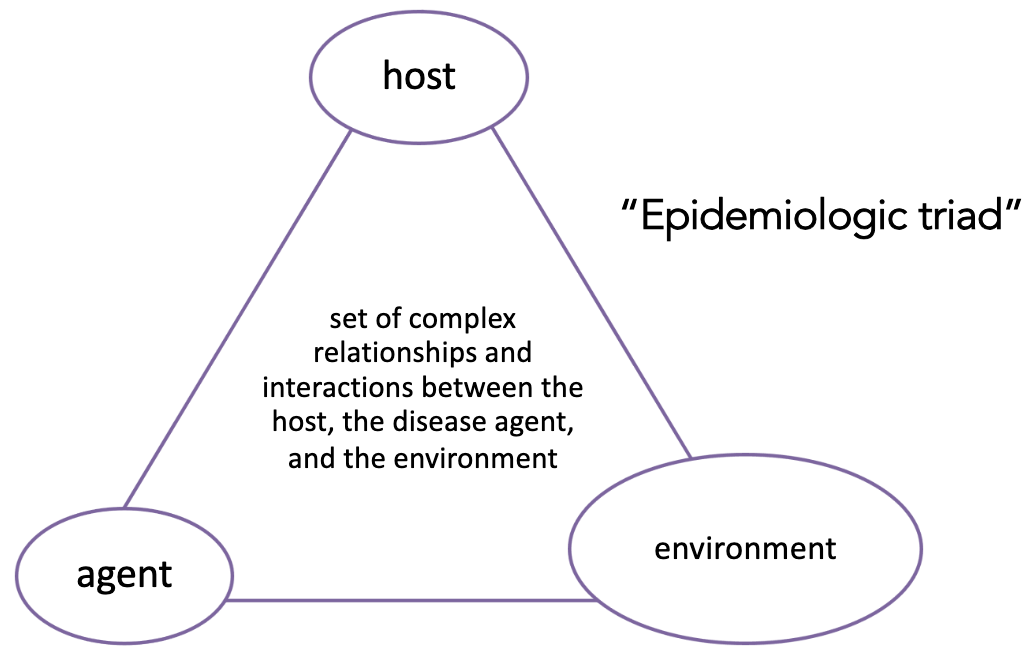
What is the Epidemiologic Triad?
A framework describing how agent, host, and environmental factors interact to influence disease occurrence
What are the Three Components of the Epidemiologic Triad?
Agent
Host
Environment
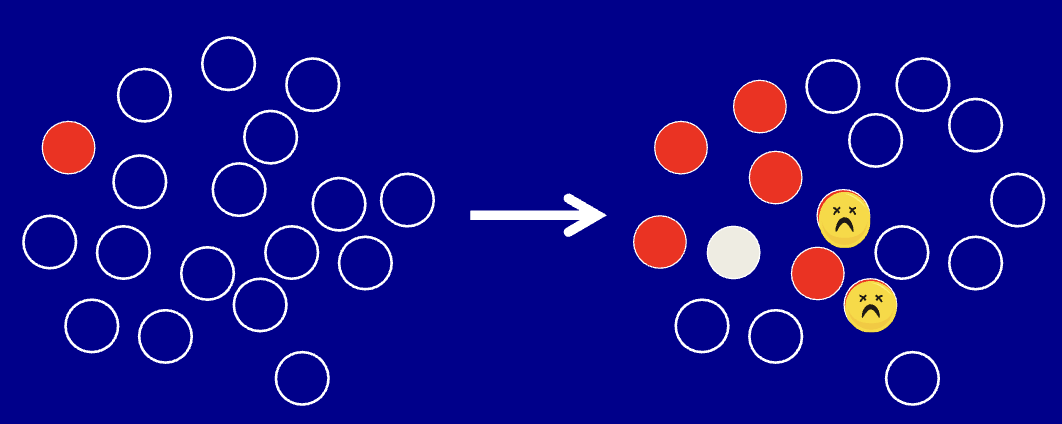
What is a Complex Web of Causation?
A network of interacting biological, environmental, and social factors that contribute to disease
What are Examples of Agent Determinants for Infectious Diseases?
Survival outside the host
Virulence
Infectiousness
Exposure dose
Duration of contact

What are Examples of Host Determinants for Infectious Diseases?
Reproductive status
Susceptibility
Behavior
Movement

What are Examples of Environmental Determinants for Infectious Diseases?
Housing
Vectors and proximity to other species
Climate
Water availability

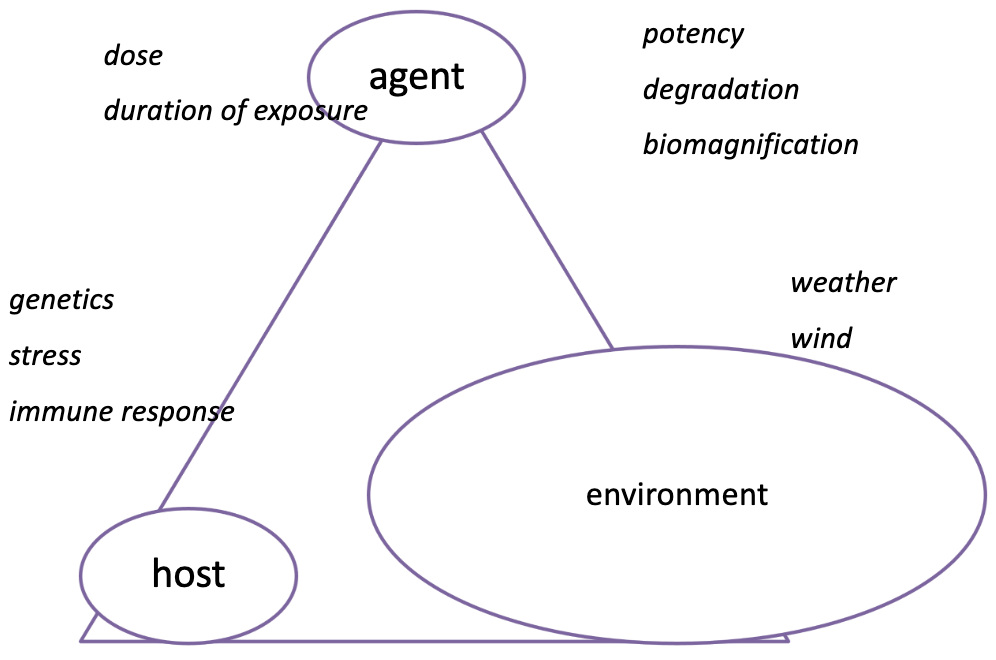
What are Examples of Determinants for Noninfectious Diseases?
AGENT
Exposure dose
Duration of exposure
Agent potency
Degradation
Biomagnification
HOST
Genetics
Stress
Immune response
ENVIRONMENT
Weather
Wind
What is a Cause in Epidemiology?
A factor, event, condition, or exposure that plays an essential role in producing disease or influencing when it occurs
Why does Correlation Not Prove Causation?
Two factors may be associated because of a shared factor, without causing each other

What is the Difference between Association and Causation?
Association → Means two factors occur together
Causation → Means one factor contributes to producing the outcome

What is a Risk Factor?
A characteristic or exposure associated with an increased likelihood of disease

What is a Protective Factor?
A factor that reduces the likelihood of disease
EX: Vaccination

Why is Establishing Disease Causation Difficult?
Disease often involves multiple interacting factors, and observed associations do not necessarily indicate causation
What is the Main Purpose of Causal Frameworks?
To systematically evaluate evidence and determine whether an observed association is likely causal
Why are Causal Frameworks Not Considered Rigid Checklists?
No
Framework provides absolute proof, and some criteria may not apply to every causal relationship
What are the Four Steps of Koch's Postulates?
Presence in disease
Isolation
Reproduction of disease
Re-isolation

What are Koch's Four Postulates?
The organism is present in diseased hosts, isolated and cultured, causes disease in a susceptible host, and is re-isolated

What are the Major Limitations of Koch's Postulates?
Difficulty culturing some agents
Asymptomatic carriers
Variable outcomes
Limitations of animal models
Noninfectious diseases
What was the Importance of the Framingham Heart Study?
It used a cohort study to investigate how factors such as smoking, cholesterol, and blood pressure relate to cardiovascular disease
What was the Importance of the Doll and Hill Study?
It used a case-control approach to demonstrate a strong association between cigarette smoking and lung cancer
What are the Nine Criteria in the 1964 Guidelines?
Temporality
Strength
Dose-response
Experiment
Consistency
Biological plausibility
Alternate explanations
Specificity
Coherence
What is the Most Essential Criterion for Causation?
Temporality: exposure must occur before disease develops
What is Temporality, and Why Is It Essential?
Exposure must occur before the biological onset of disease → A cause cannot follow its effect
Nine Criteria in the 1964 Guidelines (1/9)
What is Strength of Association?
The magnitude of the observed relationship between an exposure and disease
Stronger associations may support causality
Nine Criteria in the 1964 Guidelines (2/9)
What is a Dose-Response Relationship?
A pattern in which disease risk changes with the amount of exposure, often increasing as exposure increases
Nine Criteria in the 1964 Guidelines (3/9)
What is the Experiment Criterion for Causation?
Disease risk may decrease when exposure to the suspected causal factor is removed
Nine Criteria in the 1964 Guidelines (4/9)
What is Consistency or Replication?
Similar findings are observed across independent studies, populations, times, or circumstances
Nine Criteria in the 1964 Guidelines (5/9)
What is Biological Plausibility?
The proposed causal relationship is consistent with a reasonable biological mechanism
Nine Criteria in the 1964 Guidelines (6/9)
What are Alternate Explanations in Causal Inference?
Other possible reasons for an observed association
Including confounding factors
Nine Criteria in the 1964 Guidelines (7/9)
What is Specificity, and Why Is It Limited?
One exposure is associated with one disease
It is limited because a single exposure may cause multiple diseases
Nine Criteria in the 1964 Guidelines (8/9)
What is Coherence in Causal Inference?
Findings agree with other established scientific knowledge, while allowing for new discoveries
Nine Criteria in the 1964 Guidelines (9/9)
How does HPV demonstrate Disease Causation?
HPV infection precedes cervical cancer, shows strong and consistent associations, has biological evidence, and can be prevented through vaccination
What are the Four Criteria in the 1986 Guidelines?
Temporality
Biological plausibility
Consistency
Lack of confounding
What Is Confounding?
A distortion of an exposure–disease association caused by another factor associated with both
Why are Ecological and Social Determinants Important?
They influence exposure, susceptibility, access to prevention, and overall disease outcomes
What are Predisposing Factors?
Factors that increase an individual's susceptibility to developing disease
Distant
Social determinants
What are Enabling and Precipitating Factors?
Enabling factors → Facilitate disease development
Intermediate
Risk factors
Precipitating factors → Help trigger disease occurrence
Proximate
Direct or final cause
What is the Difference between Necessary and Sufficient Causes?
Necessary: Must be present
Sufficient: Complete cause or combination that produces disease
What is a Necessary Cause?
A factor that must be present for a particular disease to develop but may not produce disease by itself
What is a Sufficient Cause?
A complete factor or combination of factors capable of producing a disease outcome
What is a Component Cause?
An individual contributing factor that forms part of a sufficient causal mechanism

What is the Causal Pie Model?
A model illustrating how different combinations of component causes can produce the same disease

How can Causal Pies help identify prevention opportunities?
Interrupting a component cause can prevent completion of a sufficient causal pathway
How do Epidemiologists move from Observations to Understanding Disease Causation?
They identify disease patterns, investigate exposures and determinants, evaluate associations, and assess evidence using causal frameworks

Koch's Postulates vs. 1964 vs. 1986 Causal Frameworks SUMMARY
Framework | Main Criteria | Limitations |
Koch's Postulates (1880) | Presence → Isolation → Reproduction → Re-isolation | Does not explain many viruses, asymptomatic carriers, or noninfectious disease |
1964 Guidelines | 9 criteria evaluating associations | Some criteria, such as specificity, are not always applicable |
1986 Guidelines | Temporality, biological plausibility, consistency, lack of confounding | Requires evaluation of multiple lines of evidence |
Modern Multifactorial Model | Interacting component causes, risk factors, and environmental influences | Complex causal relationships can be difficult to isolate |
Remember: Temporality is essential across causal inference frameworks.
Nine Criteria of Causation (1964) SUMMARY
Criterion | Meaning |
Temporality | Exposure must occur before disease develops |
Strength | Stronger associations provide greater support for causation |
Dose-response | Disease risk changes with increasing exposure |
Experiment | Removing an exposure may reduce disease risk |
Consistency | Findings are repeated across different studies or populations |
Biological plausibility | A reasonable biological mechanism explains the relationship |
Alternate explanations | Other explanations, including confounding, must be considered |
Specificity | An exposure is associated with a particular disease |
Coherence | Evidence agrees with existing scientific knowledge |
Important: Temporality is essential. The other criteria strengthen causal evidence but are not all required in every case.
Necessary vs. Sufficient vs. Component Causes SUMMARY
Cause | Definition | Key Point |
Necessary | Must be present for disease to occur | Required but may not be enough |
Sufficient | Complete combination of factors capable of producing disease | Enough to produce disease |
Component | Individual factor contributing to a sufficient cause | One piece of the causal pie |
Remember: Multiple combinations of component causes can produce the same disease.
Epidemiologic Triad SUMMARY
Agent | Host | Environment |
Infectiousness | Age | Housing |
Virulence | Immune status | Climate |
Exposure dose | Genetics | Population density |
Survival outside host | Reproductive status | Water availability |
Exposure duration | Behavior | Vectors |
Potency (noninfectious) | Stress | Species mixing |
Degradation | Susceptibility | Environmental contamination |
Remember: Disease outcomes are influenced by interactions among agent, host, and environmental determinants.
Types of Disease Factors SUMMARY
Factor | Definition | Example |
Predisposing | Increases susceptibility to disease | Genetic susceptibility |
Enabling | Facilitates disease development | Crowded housing |
Precipitating | Helps trigger disease | Exposure to an infectious agent |
Protective | Reduces disease risk | Vaccination |
Important: A risk factor is associated with increased disease risk, but association alone does not establish causation.
How Do We Go from Patient Observations to Understanding Disease Causation? SUMMARY
Observe Disease Patterns
Identify unusual disease occurrence in patients or populations
Identify Potential Determinants
Investigate agent, host, environment, and risk factors
Evaluate Associations
Determine whether exposures are associated with disease
Apply Causal Frameworks
Evaluate temporality, plausibility, consistency, and confounding
Establish Causal Understanding
Integrate evidence and identify opportunities for disease prevention