Module 6: Genes, Neurons, and the Brain
 Call Kai
 Learn
 Practice Test
 Spaced Repetition
 Match
 Flashcards
 Knowt Play
1/67

There's no tags or description
Looks like no tags are added yet.
68 Terms
Neuroscience
An interdisciplinary field focused on how the brain produces mental processes and controls behavior.
Natural Selection
The principle that individuals best adapted to their environment are more likely to flourish and reproduce.
Sexual Selection
Occurs when well-adapted individuals are chosen as mates for overall health, physical fitness, and ability to provide.
Genotype
An organism's unique genetic makeup that makes an individual different from anyone else.
Phenotype
Outwardly observable physical characteristics, including visible and biological traits.
DNA
A tiny molecule composed of double strands of nucleotide bases arranged in a double-helix structure that encodes genetic instructions.
Genes
Individual segments of DNA in a chromosome composed of nucleotides arranged in trios called codons.

Genome
The complete set of genetic information contained within a cell.
Human Genome Project (HGP)
An international research project aimed at determining the entire sequence of chemical base pairs in humans.
Rosalind Franklin
British biophysicist and X-ray crystallographer whose diffraction images of DNA led to discovering its double-helix structure.
Chromosomes
Structures that store genes and transmit genetic information (humans have 23 pairs).

Sex Chromosomes (Pair 23)
Chromosomes (XX for female, XY for male) that determine the development and onset of sex characteristics.
Trisomy 23 (Klinefelter's Syndrome)
Chromosomal aneuploidy where an individual possesses three sex chromosomes (XXY).

Trisomy 21
Chromosomal aneuploidy where an individual has three copies of chromosome 21.
Nature and Nurture
Individual development is a combination of biology (nature) and environment (nurture).
Central Nervous System (CNS)
Comprises the brain and spinal cord.
Peripheral Nervous System (PNS)
Sensory and motor neurons connecting the CNS to the rest of the body.
Neurons
Specialized nerve cells that receive and transmit information.
Glial Cells (Glia)
Support cells of the nervous system that provide structural cohesion and support.
Cell Body (Soma)
The neuron's life-support center containing vital structures like the nucleus.
Dendrites
Branching extensions of a neuron that receive incoming messages from neighboring neurons.
Axon
A long, thin fiber that passes electrical messages away from the cell body toward other neurons, muscles, or glands.
Myelin Sheath
A fatty protein layer that insulates the axon to speed up neural impulses.
Nodes of Ranvier
Small unmyelinated gaps between myelin segments that allow action potentials to hop.
Terminal Branches (Axon Terminals)
Branched endings of an axon that form junctions with other cells and release neurotransmitters.
Sensory (Afferent) Neurons
Carry incoming sensory information from sense receptors to the CNS.
Motor (Efferent) Neurons
Carry outgoing action signals from the CNS to muscles and glands.
Interneurons
Messenger neurons that connect two of any type of neuron within the CNS.
Action Potential
A brief electrical charge generated by depolarization of the cell that travels down the axon.
Threshold for Firing
The minimum intensity of aggregate excitatory and inhibitory signals required for a neuron to fire.
All-or-None Response
An action potential's intensity and speed remain constant regardless of stimulus strength.
Neural Synapse
The junction between the axon terminal of a sending neuron and the dendrite of a receiving neuron.
Synaptic Gap (Cleft)
The 20-40 nanometer space between communicating neurons.
Neural Transduction
The transformation of physical stimulus energy into electrochemical neural impulses.

Reuptake
Process by which excess neurotransmitters in the synapse are reabsorbed back into the sending neuron.
Agonist
An excitatory molecule that binds to receptor sites and mimics a neurotransmitter's effects.
Antagonist
An inhibitory molecule that occupies a receptor site to block a neurotransmitter's action.
Dopamine
Neurotransmitter involved in pleasure, reward, voluntary movement, learning, attention, and emotion.
Serotonin
Neurotransmitter regulating mood, sleep, pain, aggression, appetite, and sexual behavior.

Norepinephrine
Neurotransmitter controlling heart rate, alertness, arousal, stress, and vigilance.

Acetylcholine (ACh)
Primary neurotransmitter used by efferent neurons to enable muscle action, learning, and memory.
GABA
The most prevalent inhibitory neurotransmitter in CNS neurons.
Glutamate
Primary excitatory neurotransmitter in the CNS involved in learning and memory.
Endorphins
Neurotransmitters responsible for pleasurable sensations and the control of pain.
Somatic Nervous System
Controls the body's sensorimotor system and voluntary skeletal muscle movements.
Autonomic Nervous System
Regulates internal organs, glands, and involuntary muscles through sympathetic and parasympathetic divisions.
Sympathetic Nervous System
Arouses the body and mobilizes energy during frightening or stressful situations (fight-or-flight).
Parasympathetic Nervous System
Calms the body and conserves energy (rest-and-digest).
Endocrine System
The body's slower chemical messenger system consisting of glands that secrete hormones into the bloodstream.

Pituitary Gland
The 'master gland' located at the base of the brain that regulates other endocrine glands. Controlled by hypothalamus.
Brainstem
The oldest part of the brain responsible for automatic survival functions.
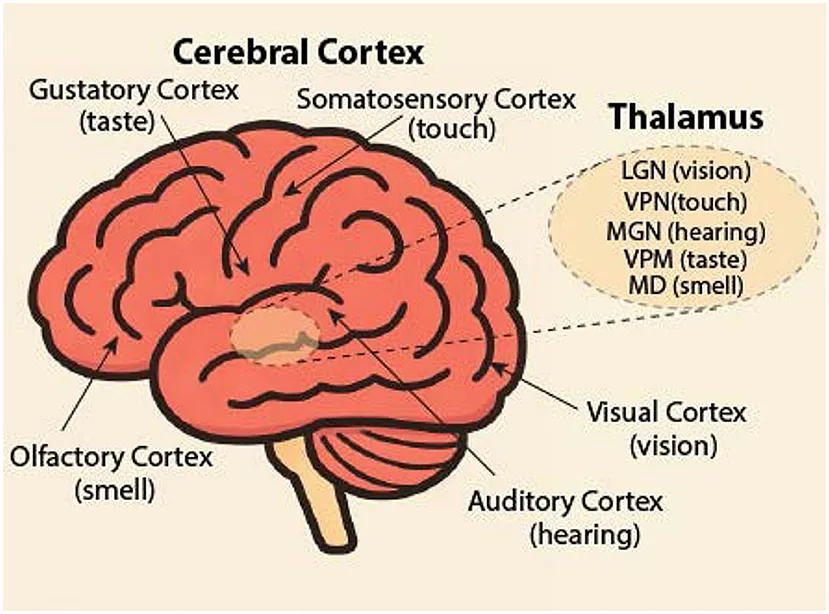
Thalamus
The brain's sensory relay station routing messages to the sensory areas of the cerebral cortex.
Medulla
Structure at the base of the brainstem that controls automatic heartbeat and breathing.

Cerebellum
Helps coordinate voluntary movements, gait, and balance.
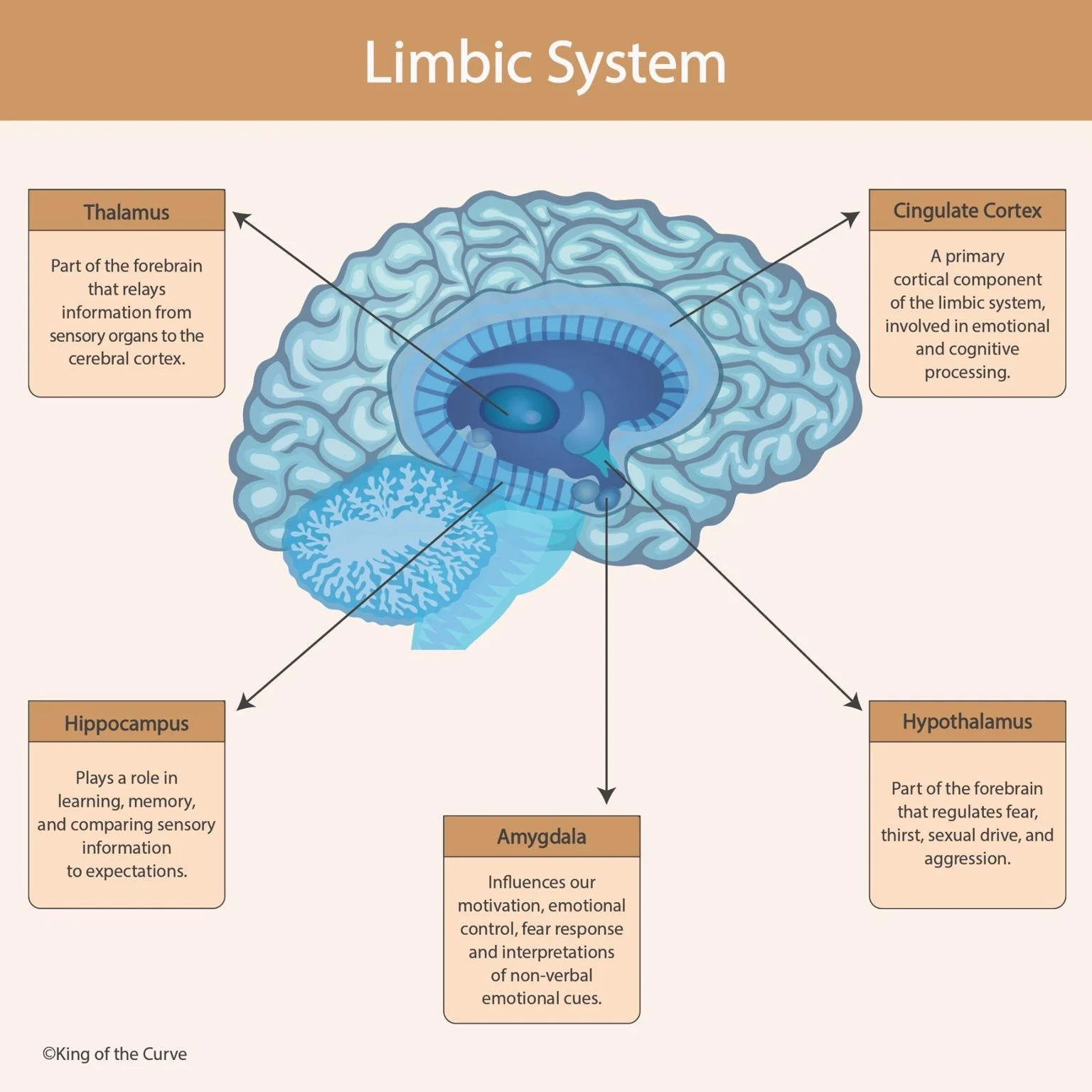
Limbic System
A ring of neural structures associated with memory, emotions, and innate drives.
Hypothalamus
Regulates homeostasis, maintenance activities, and controls the pituitary gland.

Suprachiasmatic Nucleus (SCN)
Cluster of cells in the hypothalamus regulating endogenous circadian rhythms and time perception.

Pineal Gland
Endocrine structure producing melatonin to regulate sleep and circadian rhythms.
Hippocampus
Limbic system structure involved in establishing and forming long-term memories.

Amygdala
Involved in intense emotional responses, especially fear and aggression, and emotional memories.

Substantia Nigra
Plays a central role in dopamine production and the brain's reward circuit.
Cerebral Cortex
Intricate fabric of interconnected neural cells serving as the command center for bodily control and information processing.
Hormones
Hormones are a “slower” form of chemical communication (relative to the speed of neurons)
Organization of the Nervous System
The nervous system is divided into two main parts: the central nervous system (composed of the brain and spinal cord) and the peripheral nervous system. The peripheral nervous system branches into the autonomic nervous system (which communicates with internal organs and glands through the arousing sympathetic division and the calming parasympathetic division) and the somatic nervous system (which communicates with sense organs and voluntary muscles through the sensory/afferent system for sensory input and the motor/efferent system for motor output).

Central Nervous System (CNS)
brain and spinal cord
Peripheral Nervous System (PNS)
The part of the nervous system that lies outside the central nervous system, connecting it to the limbs and organs. It includes the autonomic and somatic nervous systems.
sensory and motor neurons that connect the central nervous system (CNS) to the rest of the body; includes the Autonomic (involuntary, Sympathetic/Parasympathetic) system and Somatic (voluntary, sensorimotor) system.
limbic system
hippocampus, amygdala, hypothalamus, and thalamus. set of structures in the brain that are involved in emotion, motivation, and memory, including the hippocampus and amygdala.