endocrine system
 Call Kai
 Learn
 Practice Test
 Spaced Repetition
 Match
 Flashcards
 Knowt Play
1/11

There's no tags or description
Looks like no tags are added yet.
12 Terms
endocrine system
Network of glands throughout the body that manufactures and secretes chemical messengers (hormones) into the bloodstream
Works with the nervous system to regulate physiological processes
Uses blood vessels rather than nerves to deliver hormones to target areas of the body
hypothalamus
The small region of your brain that functions as the control centre of your body.
Main func= keep body stable (homeostasis) a state of steady balance in the body's internal environment eg temp
2 other functions: maintaining daily cycles eg sleep, controlling hunger and thirst
pituitary gland
The "master gland" of body.
Plays an important role in regulating body functions.
This is because the pituitary gland stimulates other endocrine glands to release their own hormones.
Body feels fear which will alert the hypothalamus. This will stimulate the pituitary which will coordinate the appropriate gland into action eg adrenal glands
Other func= stimulating thyroid, regulating testosterone and oestrogen.
thyroid and parathyroid
Responsible for controlling the body's metabolism.
This means converting the nutrients you eat into fuel and providing your body with the energy you need to breathe, move etc.
Releases hormones such as thyroxine.
pancreas
Involved in digestion.
Pancreas produces enzymes that break down the sugars, fats and starches in the food you eat.
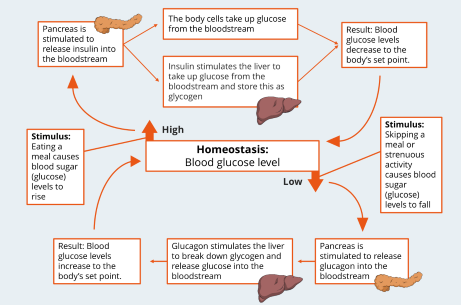
As an endocrine gland, the pancreas also produces hormones such as insulin and glucagon. Taken to treat diabetes.
ovaries
Produces oestrogen and progesterone. During puberty is responsible for transition from girl to adult woman which includes:
changes in shape of body such as widening hips and development of breasts
growth of hair
Start of menstrual cycle.
pineal gland
Responsible for regulating your body's daily (circadian) clock
This gland secretes melatonin, a hormone that causes you to feel tired and fall asleep.
During the day when exposed to more light, the pineal gland stop the secretion of melatonin, leaving you feeling more awake
thymus
Plays a major role in protecting the body from pathogenic threats such as viruses and bacteria.
Does this by producing a hormone called thymosin that stimulates the production of white blood cells
adrenal gland
Produce hormones that regulate the essential functions as metabolism, blood pressure and the immune response,
however, they are most commonly known for the role in the stress response.
Main hormones secreted is adrenaline which is responsible for fight or flight.
testes
Produce hormone testosterone. Allows body to transition from boy to adult man which includes:
development of male sex organs
Growth of facial hair
Voice lowering
-I ncrease in height and muscle mass
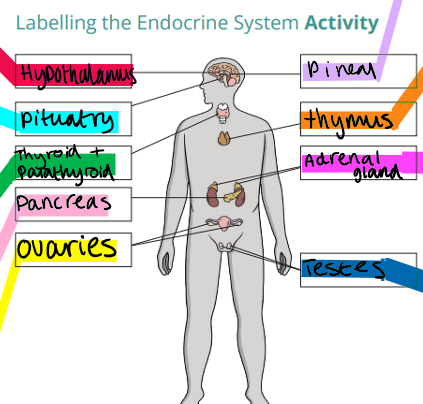
location of endocrine system activity
homeostasis: blood glucose levels