EAR 111 TEST 2
 Call Kai
 Learn
 Practice Test
 Spaced Repetition
 Match
 Flashcards
 Knowt Play
1/70

There's no tags or description
Looks like no tags are added yet.
71 Terms
Archives
Fossils, sediments, ice cores, speleothems, tree rings, coral, historic records
climate archives
are deposits or settings in which scientists
can find information about past climates
climate proxies
are materials and/or properties contained in archives that we use to infer past climate
Fossils
proxies: leaf shape, species assembeleges
sediment
biological (what lived there, who fast did it grow, time deposited?) and geochemical (texture, rate of accumulation, chemical characteristics of organic and inorganic)
Ocean - 10s of millions year old bc of ocean crust is recycled through subduction, before 170
Lake - many from last glaceriation
foraminifera
calcite shell
diatoms
silica shell bearing organism
ice core
gases, particules, physical charateristics, isotope
speleothems (cave depo)
chemistry, isotopes
trees
density, width, Carbon and oxygen
coral
chemistry
history records
phenology (timing of leaf out and flowering), logs, photos
fractionation
light isotope move faster than heavy
Heavy isotopes prefer liquid/solid to vapor
light evaporates
heavy condense
ice volume effect
Light water isotopes preferentially taken upfrom ocean and
deposited on ice
• Ocean water gets heavier as ice sheet grows
EVAPORATION - light isotopes
ONDESATION - HEAVY
direct temperature effect
positive correlation between local air temperature and the ratio of heavy to light stable isotope
As ocean temperatures get warmer:
more fractionation, lighter = lower δ18O, More of the lighter 16O preferentially incorporated into CaCO3
colder: higher δ18O,
Radiocarbon
Radiocarbon half life : 5730 years
aka carbon 14 - 6 protons and 8 neutrons
half lives — 1/2, 1/4, 1/8 etc
carbon cycle
cycle of carbon is exchanged between Earth
system components: biosphere, atmosphere,
hydrosphere, and lithosphere
regulates CO2
organic carbon cycle
the biological process by which carbon moves between the atmosphere, living organisms, soil, and aquatic ecosystems through photosynthesis, consumption, respiration, and decomposition
starts with primary producers and consumers
Primary Producers
Organisms that directly create
organic matter from inorganic
components (sunlight, nutrients)
photosythisis
Consumers
Organisms that get energy and accumulate biomass from
eating other organisms
respriation
respiration uses oxygen to break down carbohydrates to get energy
carbonhydrate + oxygen = water + energy + co2
plant/plankton , consumers, microbial decobial decomp, fire
methanogenesis
In some special cases (ie, without oxygen), decomposition of
organic matter occurs
carbohydrate = methane + CO2
cow poop
ocean reservior
CO2 from biomass gets carried via erosion/runoff to oceans,
where it dissolves and gets converted to bicarbonate
dissolved CO2 + water -> bicarbonate
Bicarbonate in ocean is used to biosynthesize tissues and shells
of photosynthesizing marine organisms
biological pump
Transfers CO2 from surface to the deep ocean reservoir
ocean reservior = bio pump
Upwelling branch of the thermohaline circulation brings carbon from deep ocean back to surface
ocean reservoirs/fluxes
ground of oil and natural gas
Surface ocean biomass – primary productivity
• Respiration → C to atmosphere
• Organic matter settles → C to deep ocean
•Deep Ocean - Decomposition
• Biological Pump (respiration) → C to surface
reservoirs/fluxes with rock
shales and coal
Terrestrial sedimentary rock –
Organic matter → burial → shales and coal
Seafloor to Oceanic Sedimentary Rock
Organic matter→ burial→ shales & petroleum
Inorganic carbon cycle
Cycle of carbon that does not involve organic carbon
Three main reservoirs:
• Atmosphere
• Ocean
• Sedimentary Rocks (mostly limestone)
air sea exchange
the continuous transfer of momentum (wind stress), energy (heat flux), moisture, and gases (CO2 and Methane) across the boundary layer where the Earth's atmosphere meets the ocean
driven by the concentration gradient of CO2
CO2 diffuses from areas of high concentration to areas
of low concentration

Partial pressure
sea air exchange
portion of the pressure due to a specific component
pN2 pO2 pCO2

Total pressure
sum of all the partial pressures of gases in the atmosphere or ocean
pN2, pO2, and pCO2

There are spatial variations
Red = oceans losing CO2 to atmosphere
Bllue= oceans taking CO2 from the atmosphere
happens bc CO2 is more soluble in
cold than warm water
ocean acidification
Increase in CO2 concentrations in the atmosphere increase the
concentration of H+ in the ocean
CO2 + H20 —> carbonic acid —> H+ —> Bicarbonate
carbonate effects
latches onto the excess H+ instead of Ca+ = less
carbonate shells formation
excess carbonic acid dissolves existing shells
chemical weathering
CO2 dissolves in rainfall, forming carbonic acid (H2CO3)
Reacts with silicate and carbonate minerals
• Solutes (Ca, Si) are carried to ocean

volcanos
Volcanoes link the carbon stored in the lithosphere to atmosphere
emit gases
Carbon returned to atmosphere via
• Volcanic activity (natural)
plate techtonics
the idea that plates move rock that shape planets surface
wegner
proposing the hypothesis of continental drift looked at fossils and rock formations
form of plate tectonic theory
Paleomagentism
Earth’s magnetic field generated by the molten iron in the earth’s
outer core
iron-rich mineralsorient like a compass needle towards the magnetic poles
Volcanic rocks from different continents suggested that either the poles had wandered thru time
paleomagnetism debate
the continents themselves moved in relation to the magnetic poles
Volcanic rocks from different continents suggested that either
the poles had wandered thru time
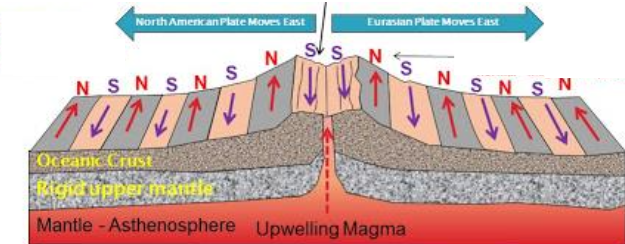
Seafloor spreading
Ocean crust - magnetic mineral orientation show that seafloor forms at spreading ridge
pangea
200 million years ago, the continents were connected
High atmospheric CO2 concentration (1650 ppm)
widespread aridity in low latitude pangea
Hadley circulation (lots of land with descending, dry air
Trade winds (easterlies) losing moisture before reaching interiors
Geologic evidence: Evaporates = salts precipitated
out of water in lakes and coastal settings
moist by water , dry inside
Extreme seasonality
Large temperature changes on land compared to ocean
Moderating effect of ocean did not reach the interiors
Geologic Evidence: Summers too warm for glaciers to expand

supermonsoons
• Large seasonal changes in land temperatures
• Pressure gradients drive winds! (and moisture flow)
Geologic Evidence: Red beds = iron oxide minerals that form
in areas with large season moisture contrasts
polar position hypothesis
• Ice sheets exist in polar regions today
• Cold temperatures from low sun angle Ice-albedo feedbacks
Ice sheets form when continents move into a
position where they exist near one of the poles
some periods there is ice
some periods theres no ice bc of Atmospheric CO2 and greenhouse forcing
BLAG hypothesis
sea-floor spreading has changed thru time — rise in chem weather
Over millions of years, CO2 production (volcanism) is balanced by CO2 removal (weathering)
delays = climate change

chemical weathering BLAG
C and Si buried in
deep ocean =
carbon sink
• Carbon returned to
lithosphere
uplifting weathering hypothesis
mountain building accerated the chemical weathering process
Weathering is mainly affected by availability of rock and mineral surfaces
May be more important to weathering on a global scale than climate/precipitation/vegetation
This means more surfaces for chemical
weathering
More chemical weathering = more
draw-down of CO2 from the atmospher

uplifting weathering hypothesis in SA
Mountain areas 80% of dissolved
chemical load in the Amazon
• High temp/precip/veg areas of the
lowlands = 20%
• Mountain-building = a fresh supply
of minerals to be weathered
Tectonic controls on CO2 – Uplift + Weathering
Continental plate collision
Happens less frequently than
subduction-driven mountain
building
• May help explain cooler,
glaciated intervals in the past
cretaceous period
hot greenhouse climate, high sea levels , warm global temp, ice free
BYE BYE DINOSAUR
CO2 during cretatoes pd
intense volcanic activity and seafloor spreading
= more co2
Sea level cretaceous
Geologic evidence: Lower foram δ18O in oceans (lighter
isotopes) = no glacial ice = larger ocean
water mass + thermal expansion
More seafloor spreading 100 Ma = wider
mid-ocean ridges = smaller ocean basin
volume
ocean spreading - cretaceous
Changes in volume of ocean basins
• More seafloor spreading 100 Ma =
wider ridges at MORs
• Less collision of continents

PETM
Paleocene-Eocene Thermal Maximum - LASTING 200K YRS , TEMP INCREASE, 5 IN TROPIC 9 IN POLES
ocean acidification, “rapid” change due to CO2 and methane
caused oceans to be acidic - bye bye forams
methane clathrates
crystalline form of methane found in the oceans
Warming oceans = methane released to atmosphere
extreme warming
cezonic cooling
from warm to cold

cezonic cooling antaritica
last tree in antartica - beech 40k Ma
first local ice
botanical evidence
smoothness of leaf edge
correlates with mean annual temperature
• Suggest progressive cooling over last 50 Ma
plant - middle

Andes mountain glaciers
7-3 MA
ice rafted debris
dropstones found in ocean sediments
geochemical evidence
Lower foram δ18O = less ice on land, warmer ocean temperature
• Higher foram δ18O = more ice on land, colder ocean temperature
table O isotopes in foraminifera, Deep ocean cooled by ~14°C

gateway hypothesis
Separation of South America from Antarctica 37-33 Ma
opens drake passage
drake passage
allows circumpolar current to develop around Antarctica
Prevents the poleward transport of energy
ice development = further cooling of Antarctic climate
NOT SUPPORTED

ISTHMUS OF PANAMA
Redirected flow of warm salty water in Pacific towards the Poles
This means increased precipitation in North Atlantic = ice sheets
models show this actually warmed the region = warm summers
NOT SUPPORTED

CO2 DRAWDOWN
Models show that ice sheets form in Antarctica when CO2 falls below 750 ppm
Ice forms in Greenland when CO2 reaches 280 ppm Or lower
CO2 DRAWDOWN evidence
Major decrease in CO2
30-25 Ma – ice on
Antarctica by 34 Ma
• 250 ppm 25-20 Ma – ice
on Greenland 7-3 Ma
uncertain, may be decreasing

BLAG Hypothesis icehouse climate
explains overall trends in atmospheric CO2, except after 15 ma

uplift weathering hypothesis reason 1
plate coliding making really high mountains
No major continental collisions 100-65 Ma (warm Cretaceous)

Uplift-weathering hypothesis reason 2
unusual physical weathering
Sediment influx to ocean from Himalayas increased through time
• Rapid increase after 10 Ma
bc As mountains get taller and taller = more mass wasting
(steep slopes, glaciers)
uplift weathering hypothesis 3
unusall chemical weathering
Much more difficult to
measure and compare
between time periods
Chemical
weathering is what draws
CO2 out of the atmosphere