Mendelian Genetics and Inheritance
 Call Kai
 Learn
 Practice Test
 Spaced Repetition
 Match
 Flashcards
 Knowt Play
1/28

Earn XP
Description and Tags
Vocabulary practice flashcards covering Mendelian genetics, pea plant anatomy, gene expression, Punnett squares, and genetic inheritance patterns including Sickle Cell Disease.
29 Terms
Gregor Mendel
Gregor Mendel was a biologist, mathematician, meteorologist, and friar in Austria.His experiments with garden pea plants laid the foundation of modern genetics. Unknowingly, Mendel conducted the first recorded, well-controlled and effectively designed experiments in genetics. His findings were far ahead of their time, and countered the common
Why did he choose peas?
Mendel chose to work with garden peas due to the fact that these plants have a variety of visual traits that only have two forms (i.e., dichotomous—meaning something that has only two possible forms or options).They can also both self-pollinate (asexual reproduction) and cross-pollinate (sexual reproduction).

Seven Dichotomous Pea Plant Traits
The seven easily distinguishable traits tracked by Mendel: flower colour, plant height, seed color, seed shape, pod colour, pod shape, and flower position.

Pea Plant Flower Reproductive Anatomy
shows the reproductive parts, like the stamen and pistil, because Mendel could control pollination, choosing self- or cross-pollination to figure out how those traits got passed along.

Mendel purebred pea plants
Mendel began his experiments by developing purebred pea plants.
Purebred pea plants are plants that always produce offspring with the same trait as the parent (like tall parents)
Breeding two purebred plants always produces identical offspring to the parents.
Mendel’s Cross-Pollination Experiment
The pollen-producing part of the stamen; Mendel removed these from pea plants to prevent self-pollination during his experiments.
Mendel’s Results - Initial Breeding
Mendel found that certain traits were dominant over others.
For example, a purebred tall plant crossed with a purebred short plant will always create a tall plant.
He concluded that there are alternate forms of a gene.
Certain factors within the plant caused these dominant traits to present over the recessive traits.
Identifying Mendals Work
Mendel recorded which trait was dominant using a capital letter, and which was recessive using a lowercase letter.
E.g. T = tall / t = short
Genes
Genes are the unit of heredity that is passed from a parent to their offspring, which determines a characteristic or trait of the offspring.
Genes are composed of DNA.
Through a process called transcription, DNA sequence get transcribed into a temporary copy called messenger RNA (mRNA).Gene
Ribosomes read the mRNA to synthesize proteins; this process is called translation.
Proteins perform the tasks of cellular life.
Protein synthesis: Transcription and Translation
Transcription and translation are two important processes in gene expression. Transcription copies a section of DNA into messenger RNA (mRNA), while translation uses the mRNA to make a protein.
Transcription happens first, making an RNA copy of a gene. Translation happens second, when ribosomes read the mRNA to build a chain of amino acids.
Transcription and translation allow cells to make the proteins the body needs to function, using instructions stored in DNA.
The four bases (A, T, C, and G in DNA; A, U, C, and G in RNA) are the building blocks of DNA and RNA.
Protien synthesis: Transcription
During transcription, a piece of DNA that codes for a specific gene is copied into messenger RNA (mRNA) in the nucleus of the cell
The mRNA then carries the genetic information from the DNA to the cytoplasm, where translation occurs.
Protein synthesis: Translation
During translation, proteins are made using the instructions stored in mRNA
The mRNA attaches to a ribosome, which reads the genetic instructions.
As the mRNA passes through the ribosome, transfer RNA (tRNA) brings amino acids (the building blocks of proteins) to the ribosome.
Each tRNA matches with a specific sequence on the mRNA.
As each tRNA brings an amino acid, the amino acids join together to form a chain.
Once all the amino acids have joined together, the completed protein is released from the ribosome.
Alleles
Alleles are the different forms of a gene.
The alleles are located in the same position on each pair of homologous chromosomes.
Law of segregation
The law of segregation states that each parent has two alleles for each gene, and passes one of those alleles at random to their offspring
Dominant Allels
Alleles of this type determine the expression of the genetic trait in
Offspring (strong). represented by an uppercase letter
Recessive Allel
• Alleles of this type are overruled by dominant alleles (i.e. hidden/shy). represented by a lower case letter
Genotype
the genetic makeup of an individual (the alleles they have)
Phenotype
The observable traits of an individual (how their genes are expressed, such as appearance). [What the trait looks like]
Complete Dominance
Complete dominance refers to the form of inheritance in which a dominant allele completely masks a recessive allele.
Homozygous
Having two of the same alleles for a trait.
- Example: TT or tt
Heterozygous
Having two different alleles for a trait.
- Example: Tt

Mendel’s results – F1 Generation
The gametes produced by the purebred tall plants all have the T (dominant) allele.
The gametes produced by the purebred short plants all have the t (recessive) allele.
All the tall plants produced from this cross have the Tt (heterozygous) genotype.

Mendel’s results – F2 Generation
Mendel allowed the crossbred tall plants (Tt) to self-pollinate.
During meiosis, the two alleles separate, so each gamete receives only ONE allele for each gene: either uppercase T or lowercase t.
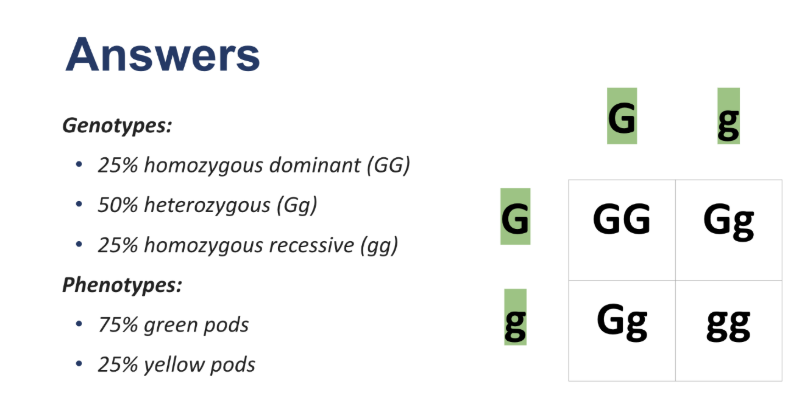
When two Tt plants reproduce, the possible offspring genotypes are TT, Tt, Tt, and tt.
Since uppercase T (tall) is dominant, TT and Tt produce tall plants, while tt produces a short plant.
This results in a 3 tall : 1 short ratio (about 75% tall and 25% short).

Complete Dominance — Forms of Inheritance
Complete dominance happens when a dominant allele completely masks a recessive allele.
AA: Two dominant alleles produce purple flowers.
Aa: One dominant and one recessive allele also produce purple flowers.
aa: Two recessive alleles produce white flowers.
This means AA and Aa look the same, even though their genotypes are different.
Complete Dominance — Human Inheritance
Many people believe traits like earlobes, eye color, and hair texture are controlled by complete dominance.
However, human traits are usually more complicated than a simple dominant/recessive pattern.
Many human traits are influenced by multiple genes, and sometimes environmental factors, too.
Hemoglobin
A specialized protein found in red blood cells that carries oxygen throughout the body.
Capillaries
Extremely narrow blood vessels through which flexible red blood cells must deform and squeeze to supply oxygen to tissues.
Sickle Cell Disease (SCD)
A genetic condition inherited via complete dominance where homozygous recessive (aa) individuals produce stiff, sickled red blood cells under low-oxygen conditions, causing blood vessel blockages.
Anemia
A clinical condition where the blood lacks enough functional red blood cells or hemoglobin to carry sufficient oxygen to tissues, frequently caused by Sickle Cell Disease.