Ch 18 (second) serology vaccines
 Call Kai
 Learn
 Practice Test
 Spaced Repetition
 Match
 Flashcards
 Knowt Play
1/50

There's no tags or description
Looks like no tags are added yet.
51 Terms
delete
How we use (apply) immunology
Using substances (Ag's) that trigger an immune response (humoral or CMI)
Testing/analyzing a patient's blood (serum) sample
What are the 2 common uses of immunology?
Vaccination: inject Ag → body makes Ab → disease prevention
Serological testing: look for Ag's or Ab's in a patient's blood sample → accurate and timely diagnosis
What was the first vaccine?
Cowpox virus inoculated to prevent smallpox
What is a vaccine?
Injection of substances (antigens) into the body → induces an immune response (ex: makes Ab's)
Purpose: disease prevention
What 2 responses does vaccination cause?
Primary immune response (when the Ag/vaccine is injected) → forms memory B cells and antibodies
Rapid and intense secondary immune response (when you later get the Ag)
Where does the word "vaccination" come from?
"Vacca" = cow
What is an immunogen?
A substance (Ag) that stimulates the immune system
What is herd immunity?
Protection for most of the population
If the majority are vaccinated → all are protected
What are the 5 criteria for an ideal vaccine?
Safety
Effectiveness
Oral administration
Only one injection
Affordable and easy access
Ideal vaccine: safety
Must never be pathogenic or toxigenic (must not be poisonous or cause illness/disease)
Ideal vaccine: effectiveness
Must be a strong immunogen (a protein) → strong immune response
Ideal vaccine: why is oral preferred?
Painless (preferred over injection)
Ideal vaccine: number of injections
Only 1 injection or a combination vaccine
Ex: MMR, DTaP
Ideal vaccine: cost and access
Available to most people at a reasonable cost
What is a live, attenuated vaccine?
Uses weakened pathogens (non-pathogenic to the host but still immunogenic)
Ex: MMR and smallpox vaccines
Why do live, attenuated vaccines closely mimic an actual infection?
Because the pathogen is live → can cause mild side effects
What is an inactivated vaccine, and how does its safety compare to a live one?
Uses killed pathogens and is safer than live vaccines
Ex: polio and influenza vaccines
What is a toxoid vaccine?
Uses an inactivated toxin → immune response targets the toxin
Ex: Td vaccine
What is an antitoxin?
An Ab made against a toxin (from a toxoid vaccine)
What is a conjugated vaccine?
Main vaccine component (ex: capsule) is combined with a strong immunogen (protein) → strong immune response
Ex: pneumococcal vaccine
What is a subunit vaccine?
Uses antigenic fragments (pieces of a virus or bacterium) to stimulate an immune response
Ex: hepatitis B and pertussis (DTaP) vaccines
What is injected in an mRNA vaccine?
Only bacterial/viral nucleic acid (mRNA), not the live pathogen
Ex: COVID-19 vaccines
How does an mRNA vaccine work?
mRNA enters host cells → cells make protein Ag's → strong immune response
What is serology?
Serology: Study of blood serum to detect immune responses and diagnose disease (yes/no).
What part of the blood sample does serological testing use?
Serum
Serum vs. plasma?
Serum = plasma minus clotting factors (C.F.)
Plasma: has clotting factors
Serum: no clotting factors
What does plasma contain?
Clotting factors, ions, gases, proteins, Ag's and Ab's (55% of total blood)
What 2 things are we looking for in the serum?
Ag (pathogen)
Ab (IgM)
Purpose of a serological test?
Accurate and timely diagnosis
What does a positive serological test mean?
Positive for the Ag (pathogen) or Ab (usually IgM) → person has the disease
What does a negative serological test mean?
Negative for the Ag (pathogen) or Ab (usually IgM) → person does NOT have the disease
What are the 2 ways a test shows "yes disease"?
Ag (pathogen) is present → yes Dz
Pathogen present → body makes Ab (IgM) → yes Dz
What are the 5 criteria for an ideal serological test?
High specificity/accuracy
High sensitivity
Easy set-up and interpretation
High throughput
Affordable cost and easy access
Ideal serological test: what does "unambiguous" mean?
Can only have 1 interpretation (no multiple interpretations)
100% yes (+) or 100% no (−)
Ideal serological test: what does "reliable" mean?
No false (+) or false (−); must be accurate
Ex: pregnancy test, HIV test, athlete drug doping test
Ideal serological test: high sensitivity
Uses a small sample size
Can detect small quantities of Ag's or Ab's
Ideal serological test: easy set-up and interpretation
Test construction is simple
Results are easy to read
What is throughput?
Ability to simultaneously test hundreds or thousands of samples
Many tests done at one time due to machine automation
Ideal serological test: cost and access
Available to most people at a reasonable cost
What does a direct serological test look for?
Ag (pathogen) in the patient serum
Result can be (+) or (−)
What does an indirect serological test look for?
Ab (IgM) in the patient serum
Result can be (+) or (−)
In serological testing, where can the Ag and Ab come from?
Either the patient serum sample or the lab test
The patient sample is added to a lab test to make a diagnosis
If the lab test provides the Ag, what type of test is it?
Indirect test: looks to see if the patient provides the Ab
Indirectly looking for Ag (by looking for Ab)
If the lab test provides the Ab, what type of test is it?
Direct test: looks to see if the patient provides the Ag
Directly looking for Ag
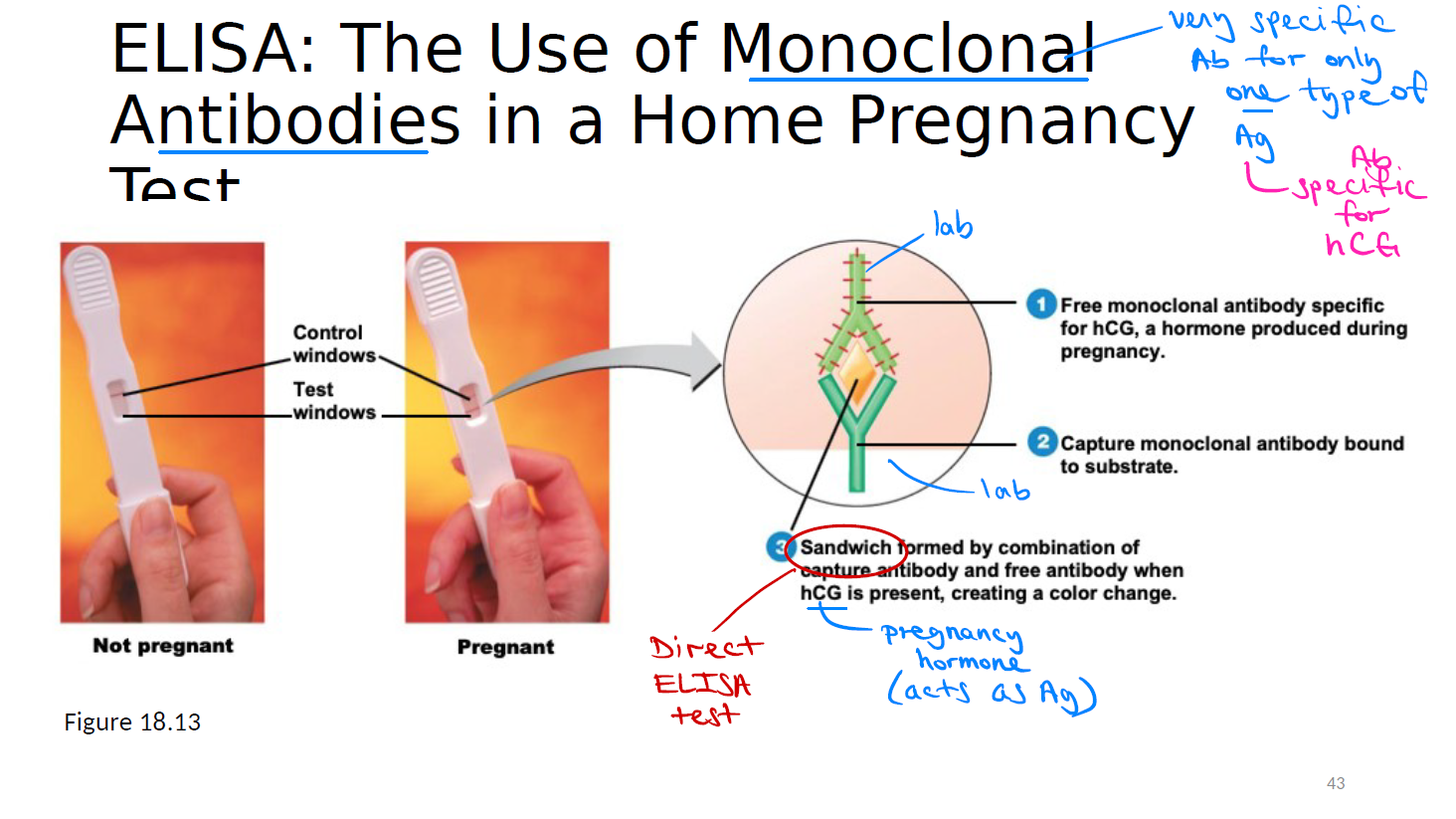
What is a monoclonal antibody?
A very specific Ab for only one type of Ag
What does the monoclonal Ab in a home pregnancy test target?
hCG (the pregnancy hormone, which acts as the Ag)
What type of test is a home pregnancy test?
Direct ELISA test (looking for the Ag, hCG)
How does a home pregnancy test show a positive result?
hCG binds between a free monoclonal Ab (lab) and a capture monoclonal Ab (lab) → forms a sandwich → color change
Which serological tests have high sensitivity (in order)?
Radioimmunoassay (highest of all)
PCR
Complement-fixation tests
ELISA
Which serological tests have intermediate sensitivity?
Agglutination and neutralization reactions
Which serological test has low sensitivity?
Precipitation reactions