3 - Fluids and Electrolytes
 Call Kai
 Learn
 Practice Test
 Spaced Repetition
 Match
 Flashcards
 Knowt Play
1/80

Earn XP
Description and Tags
4 Questions
Name | Mastery | Learn | Test | Matching | Spaced | Call with Kai | Chat |
|---|
No analytics yet
Send a link to your students to track their progress
81 Terms
How is total body fluid distributed?
60% intracellular fluid
40% extracellular fluid
Of extracellular fluid → 75% is interstitial fluid and 25% is intravascular fluid
What substances are found in body fluids?
Water, glucose, lipids, creatinine, and urea
Cations (+) → Sodium, potassium, magnesium, calcium
Anions (−) → Chloride, bicarbonate, phosphate
How does water move between body fluid compartments?
Water is an uncharged molecule that can cross cell membranes
Movement is regulated by osmotic pressure
It moves toward the area with the higher osmolar concentration → more dissolved particles
Osmolarity?
Number of osmoles in a particular volume of solvent
Accounts for total volume, including solutes and water
Units → mOsm/L
Osmolality?
Number of osmoles in a particular weight of solvent
Accounts only for water content
Units → mOsm/kg
What is normal plasma osmolality?
275-295 mOsm/kg
Tonicity?
Concentration of non-permeable solutes in a solution
Higher concentrations → pull water out of cells
Lower concentrations → push water into cells

Hypertonic?
Solute concentration of intravenous fluid is higher than intracellular fluid
Fluid moves out of the cell
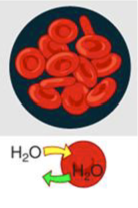
Isotonic?
Solute concentration of intravenous fluids equal to intracellular fluid
No overall net movement of water
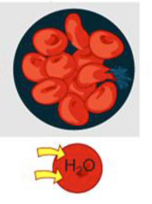
Hypotonic?
Solute concentration of intravenous fluids less than intracellular fluids
Fluid moves into the cell
Examples of fluid disorders?
Dehydration
Hypovolemia
Hypervolemia
ELectrolyte imbalances
What causes dehydration?
Diarrhea
Vomiting
Excessive sweating
Fever
Inadequate fluid intake
Diuretic use
Hypovolemia?
Significant decrease in volume
Caused by → bleeding, severe dehydration, burns
Can lead to either hemorrhagic (blood loss) shock or distributive (sepsis) shock!!
Fluid resuscitation?
The practice of →
Restoring the intravascular volume
Improving tissue perfusion to prevent end organ damage
Correcting hemodynamic instability
What characteristics should we look for when choosing a fluid for resuscitation?
Remains in the intravascular space
Predictably increases blood volume and restores hemodynamics
Causes minimal electrolyte changes
Readily available and inexpensive
Adult fluid resuscitation?
Estimated around 30-35ml/kg/day
Or around 1500 mL/m²
Pediatric fluid resuscitation for <10kg?
At least 100 mL/kg/day
Pediatric fluid resuscitation for 10-20kg?
100 mL/kg/day plus an additional 50mL/kg/day
Pediatric fluid resuscitation for >20kg?
100 ml/kg/day, and 50ml/kg/day AND an additional 20 ml/day/day
What is the 4-2-1 rule for maintenance fluids?
Calculates hourly maintenance fluid requirements for PEDs →
First 10 kg → 4 mL/kg/hr
Next 10 kg → 2 mL/kg/hr
Each kg over 20 kg → 1 mL/kg/hr
What are the fluid resuscitation guidelines for special populations?
Sepsis → 30 mL/kg fluid bolus over the first 3 hours
Burn patients → Use the Parkland formula to calculate fluid requirements
Examples of crystalloid fluids for fluid resuscitation?
0.9% Normal saline (NS)
Lactated Ringers (LR)
Plasma-lyte
Examples of colloid fluids for fluid resuscitation?
Blood
Albumin
Hetastarch
Dextran
Blood?
Colloid
Typing required
Potential disease transmission
Increases oxygen carrying capacity
Product of choice → during hemorrhagic shock
Albumin?
Colloid
No blood typing
Must be treated like a blood product
Potential disease transmission
Hetastarch and Dextran?
Colloids
Risk of kidney injury
Increased bleeding risk
Normal sodium range?
135-145 mEq/L
Hypernatremia?
>145 mEq/L
Hyponatremia?
<135 mEq/L
Severe hyponatremia?
<125 mEq/L
Causes of hypernatremia?
Insensible water loss → lungs, skin
GI water loss
Fever
Burns
Arginine vasopressin disorder (diabetes insipidus) → either AVP-Deficiency or AVP-Resistance
How is hypernatremia treated?
Correct elevated sodium slowly to avoid complications
If hypovolemic → restore intravascular volume first
Then give hypotonic fluids → D5W or 0.45% NS to replace free water
Arginine vasopressin deficiency disorder (AVP-D) treatment?
Desmopressin (DDAVP) 5-10 mcg up to twice daily intranasally
Max dose 40 mcg/day
Arginine vasopressin resistance disorder (AVP-R) treatment?
Sodium restriction → 2000 mg/day
Thiazide diuretics
Hyponatremia symptoms?
Nausea
Headache
Fatigue
Hyponatremia treatment?
Treat underlying cause
Max correction rate generally 8-10 mEq/L per 24 hours to → reduce the risk of osmotic demyelination syndrome
Isotonic hyponatremia / pseudohyponatremia ?
Osmotic substances in the blood that make the sodium “look” low on the lab
Causes include → hyperlipidemia, hyperproteinemia, hypertriglyceridemia
Hypertonic hyponatremia ?
Osmotic substances in the blood that pull water into the bloodstream and dilute sodium
Causes include → hyperglycemia, mannitol infusions
Hypotonic hyponatremia?
Low serum tonicity causing water to move into cells
Types include → hypovolemic, euvolemic, hypervolemic hyponatremia
Hypovolemic hyponatremia?
Loss of sodium and water, with proportionally greater sodium loss
Causes include → diarrhea, vomiting, blood loss, diuretic use
Treatment → replace lost volume with NS
Hypervolemic hyponatremia ?
Excess water relative to sodium, causing low sodium and fluid overload
Causes include → heart failure, cirrhosis, nephrotic syndrome
Treatment → fluid restriction, loop diuretics, vaptans
Euvolemic hyponatremia ?
Low sodium with normal fluid volume
Causes include →
SIAD
Hypothyroidism
Adrenal insufficiency
Cerebral salt wasting
Thiazide use
Excessive water intake
Beer potomania / tea and toast syndrome
Treatment for euvolemic hyponatremia?
Adrenal insufficiency → hydrocortisone
Cerebral salt wasting → 3% NaCl solution and fludrocortisone can be used
Thiazide → Stop thiazide
Primary polydipsia/excessive water intake → limit fluid intake
Beer potomania / Tea and toast syndrome → improve nutrition
Potassium normal range?
3.5-5 mEq/L
Is the most prominent intracellular cation
Hyperkalemia?
>5 mEq/L
Hypokalemia ?
<3.5 mEq/L
Causes of hyperkalemia?
Decreased renal excretion
Increased extracellular potassium
Increased potassium intake
Pseudo-hyperkalemia → hemolysis
EKG changes with hyperkalemia?
Use calcium!!
Stabilizes cardiac cells → does NOT lower potassium
Calcium gluconate: 1–2 g IV over 10 min
Calcium chloride: 1 g IV push
Also use temporizing treatment!!!
Temporizing treatment with hyperkalemia?
Push potassium into the cells intracellularly → temporary lowers K
Use → Insulin + glucose: 10 units regular insulin + 50 g dextrose
Sodium bicarbonate: 50 mEq IV push
Albuterol: 10–20 mg nebulized
Treatment for hyperkalemia after calcium and temporizing treatment?
Potassium removal
Use →
Loop diuretics
Cation exchange resins → sodium polystyrene, sodium zirconium cyclosilicate, patiromer
Dialysis
Causes of hypokalemia?
Increased intracellular shift
Increased GI losses
Increased renal losses
Electrolyte imbalances
Symptoms of hypokalemia?
Fatigues
Muscle weakness / cramping
EKG changes → cardiac arrhythmias
Constipation
Treatment of hypokalemia?
10 mEq KCl = 750 mg; may increase serum K⁺ by ~0.1 mEq/L
IV replacement rates → peripheral line: 10 mEq/hr; central line: 20 mEq/hr
Replacing too much or too quickly can cause dangerous cardiac arrhythmias or death
Magnesium normal range?
1.5-2.2 mg/dL
Hypomagnesemia?
<1.5 mg/dL
Hypermagnesemia?
>2.2 mg/dL
Concerns with hypomagnesemia?
Can cause → neuromuscular problems and cardiovascular problems
Treatment of hypomagnesemia?
Magnesium oxide: oral
Magnesium plus protein: 133 mg tablet, oral
Magnesium sulfate: 1 gm, 2 gm and 4 gm IV bags
What population is often affected by hypermagnesemia?
Chronic kidney disease patients
Over supplementation of pregnant mothers
Symptoms of hypermagnesemia?
Nausea / vomiting
Hypotension
Hyporeflexia
Treatment of hypermagnesemia?
If symptomatic → calcium gluconate
Stop magnesium supplements
Loop diuretics, fluids (NS), or dialysis
Calcium normal range?
8.5-10.5 mg/dL
Ionized caclium normal range?
4.4-5.4 mg/dL
Hypocalcemia?
<8.5 mg/dL
Hypercalcemia?
>10.5 mg/dL
Causes of hypocalcemia?
Vitamin D deficiency
Hypomagnesemia
Hypoparathyroidism
Drug-induced hypocalcemia
Post surgical → hungry bone syndrome
Symptoms of hypocalcemia?
Tetany
Myopathy
Hypoactive reflexes
Hypotension
Impair
Insulin function
Treatment of hypocalcemia?
Oral → calcium citrate, calcium carbonate (tums), calcium carbonate + vitamin D
IV → calcium gluconate, calcium chloride
Causes of hypercalcemia?
Increased bone resorption (cancer)
Increased GI absorption
Increased kidney resorption
Symptoms of hypercalcemia?
Fatigue/weakness
Constipation
Cognitive dysfunction
Polyuria
Severe cases may include → calcium containing kidney stones or acute pancreatitis
Treatment of hypercalcemia?
IV fluids (NS)
Loop diuretics
Calcitonin (4mg/kg IM/SC q12h)
Bisphosphonates
Rank-L inhibitor
Corticosteroids
Cinacalcet
Phosphorus normal range?
2.6-4.5 mg/dL
Hypophosphatemia?
<2.6 mg/dL
Hyperphosphatemia?
>4.5 mg/dL
Causes of hypophosphatemia?
Decreased GI absorption
Increased renal elimination
Cellular shifts (refeeding syndrome)
Symptoms of hypophosphatemia?
Weakness, numbness, irritability, paresthesias
Seizures or coma
Treatment of hypophosphatemia?
Many oral products (Neutra-Phos, K-Phos neutral)
IV phosphate replacement must go → in slowly and need to check a calcium level prior to start of infusion
Causes of hyperphosphatemia?
Chronic kidney disease
Hypoparathyroidism
Symptoms of hyperphosphatemia?
GI disturbances
Calcium-phosphate crystals → urinary tract obstruction
Treatment of hyperphosphatemia?
Sevelamer, lanthanum
Products containing calcium, magnesium, and/or aluminum
Dialysis