THE ENDOCRINE SYSTEM
 Call Kai
 Learn
 Practice Test
 Spaced Repetition
 Match
 Flashcards
 Knowt Play
1/85

There's no tags or description
Looks like no tags are added yet.
86 Terms
MACRO TO MICROMOLECULES
Digestion breaks down macromolecules into micromolecules.
Carbs → protein
Proteins → amino acids
Lipids → fatty acids

CATABOLIC AND ANABOLIC
Catabolic = breakdown to small molecules
Anabolic = build-up and storage
Our metabolism is build for intermittent eating, not constant snacking.

GLUCOSE VS GLYCOGEN
Glucose = utility (fuel)
Glycogen = storage (skeletal muscle + liver)
KETONE BODIES
Glycogen cannot be stored in the neurons so they need a constant glucose supply
BUT
when glucose is limited, ketone bodies are a back-up fuel after days of prolonged fasting.

HYPOGLYCEMIA
blood glucose < 4mM (acute < 3mM)
Possible brain dysfunction, seizures, loss of consciousness, coma
defended by glucagon, cortisol, adrenaline, GH
HYPERGLYCEMIA
Blood glucose > 10mM (persistent > 20mM)
Osmotic diuresis, thirst, long-term vascular and neural damage
defended by insulin
THE PANCREAS (EXOCRINE)
98%
Acinar cells in lobules secrete digestive enzymes, bicarbonate, and electrolytes via the pancreatic duct to the duodenum
Bicarbonate neutralises stomach acid so pH suits the enzyme = better digestion + absorption

THE PANCREAS (ENDOCRINE)
2%
Islets of langerhans secrete hormones into systemic blood
Leaf-like gland posterior to the stomach

ISLETS OF LANGERHANS - B CELLS
Produce insulin
anabolic
promotes storage of glucose, fatty acids and amino acids in cells
ISLETS OF LANGERHANS - A CELLS
produce glucagon
catabolic
mobilises glucose, fatty acids and amino acids for energy
ISLETS OF LANGERHANS - DELTA CELLS
produce somatostatin
paracrine
acts on neighbouring cells to inhibit insulin and glucagon
INSULIN AND GLUCAGON
in the context of glucose homeostasis, they are stated to be ‘functional antagonists’ (they act opposite to each other and are reciprocally secreted in most circumstances).
They are not antagonists in the pharmacological sense
The opposition is not strict
It is not always glucose ←> insulin relationship
DIABETES AND GLUCAGON DEFICIENCY
Insulin is the only blood glucose-lowering hormone, so failure of synthesis/secretion = diabetes mellitus
But there is no disease from glucagon deficiency as other hormones compensate
INSULIN SYNTHESIS
Pro-insulin in nucleus → signal peptide removed in ER → folded proinsulin → c-peptide cleaved in golgi → mature insulin (51aa) in secretory glands → exocytosis.
*measuring c-peptide indicates the secretory capacity of B cells
INSULIN RECEPTOR
Tyrosine kinase receptor (RTK)
Receptors highest in the liver, skeletal muscle, adipose tissue
Insulin binds → activates receptor → autophosphorylation of intracellular RTK domain → activates tyrosine kinase → phosphorylates proteins → glucose homeostasis + metabolic functions
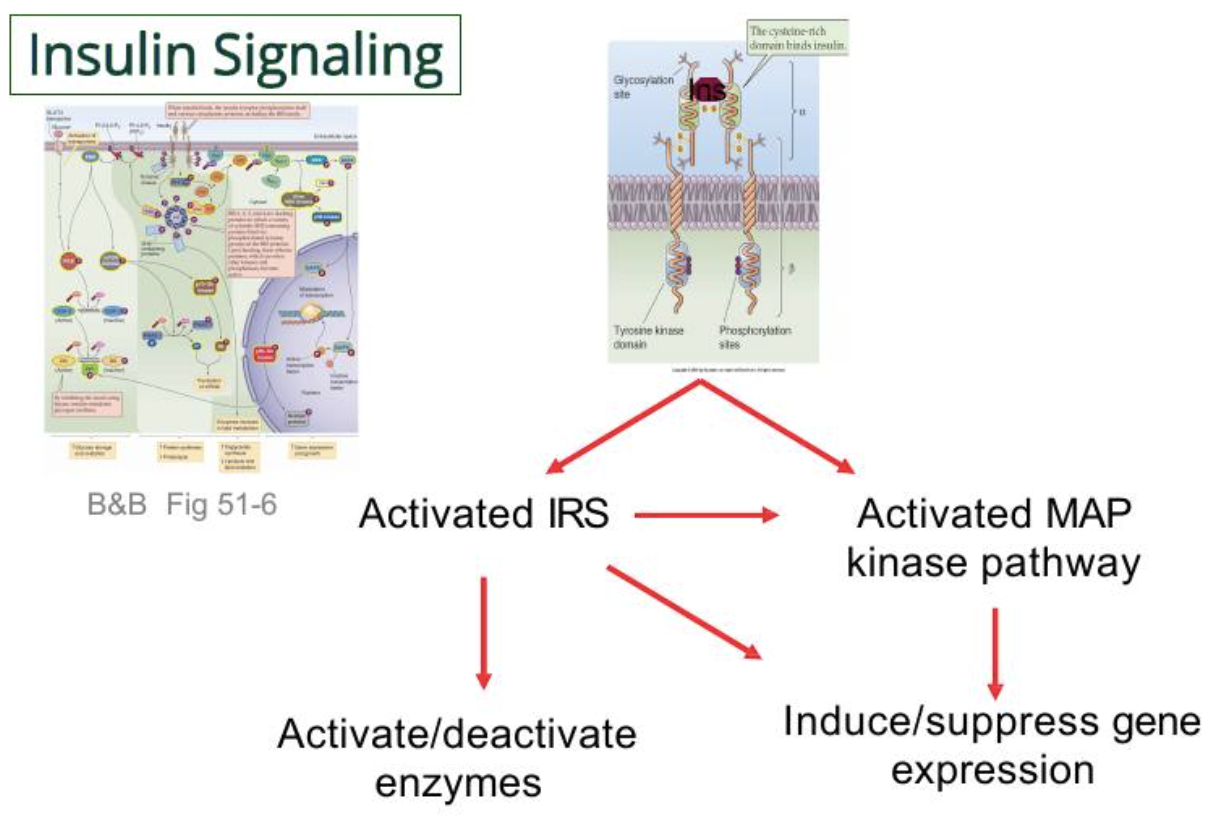
INSULIN EFFECTS PER ORGAN SUMMARY

GLUT FAMILY
Glucose is too big/polar to cross the membrane freely, so it needs carriers (GLUT).
move glucose via facilitated diffusion
14 in human genome
GLUT 1
In many cells, blood brain barrier, erythrocytes
role in basal glucose uptake
insulin independent
GLUT 2
in liver hepatocytes, pancreatic b cells
role in hepatic glucose uptake + glucose sensing in b cells
insulin independent
GLUT 3
in most cells, high in CNS neurons
role in basal uptake + keeps neurons supplied
insulin independent
GLUT 4
in skeletal/cardiac myocytes, adipocytes
role in regulating glucose uptake
insulin dependent
GLUT 5
in intestinal epithelium
role in fructose transport
insulin independent
INSULIN AND GLUT4
Insulin stimulated:
vesicles undergo exocytosis, inserting GLUT 4 into the cell membrane
Insulin unstimulated:
GLUT4 sits in the cytoplasmic vesicles
*only GLUT4 regulated this way, other gLUTS already on the membrane
DEFINITIONS
Glycogenesis = forming glycogen
Glycogenolysis = breaking down glycogen
Gluconeogenesis = forming new glucose
Glycolysis = breaking down glucose
Lipogenesis = forming fat
Lipolysis = breaking down fat
INSULIN IN THE LIVER (Hepatocytes)
Nutrient-rich blood passes via hepatic portal vein, insulin is secreted in response to nutrients and acts immediately at the liver.
mainly GLUT 2
insulin maintains concentration gradient to promote further glucose entry
INSULIN EFFECTS ON LIVER CELL
increase glucose uptake, glycogen synthesis, fat synthesis/storage, protein synthesis
decrease glycogenolysis, gluconeogenesis, breakdown
INSULIN IN THE SKELETAL MUSCLE (Myocytes)
Glucose uptake via GLUT4
Important protein anabolic effects in muscle by promoting amino acid uptake
Muscle holds the largest glycogen store
Promotes increased glucose uptake, glycogen synthesis, glycolysis, oxidation
Hexokinase (Enzyme) expression
INSULIN IN ADIPOSE TISSUE (Adipocytes)
Glucose uptake via GLUT4
Promotes glucose uptake + glycolysis to give precursors for lipogenesis
Inhibits hormone-sensitive lipase (enzyme required for breakdown of fats)
Hexokinase expression
HOW B CELLS SENSE GLUCOSE
Increase blood glucose → GLUT2 uptake (no insulin needed) → glucokinase = glucose → GGp → glycolysis + oxidation → increased ATP → ATP-sensitive K+ channels close → K+ builds up → depolarisation → voltage-gated Ca2+ channels open → Ca2+ influx → granule fusion → insulin exocytosis
STIMULATES INSULIN SECRETION
increased glucose, amino acids, fatty acids
Parasymp NS stimulation (acetylcholine)
Glucagon-like peptide (GLP-1)
Gastric inhibitory polypeptide
gastrin, secretin, CCK
Glucagon
INHIBITS INSULIN SECRETION
Sympathetic NS stimulation (noradrenaline)
somatostatin
GLUCAGON
prevents blood glucose from falling too low
important in post-absorptive and fasting state
opposite effects to insulin
major action site is the liver
promotes catabolism and increased blood glucose
GLUCAGON SYNTHESIS
Glucagon is a 29-residue peptide cleaved from proglucagon in pancreatic a-cells.
Glucagon-like peptide (GLP-1) is secreted by intestinal L-cells.
STIMULATES GLUCAGON SECRETION
decreased glucose
increase amino acids
SNS stimulation (noradrenaline/adrenaline)
cortisol
infection
exercise
INHIBITS GLUCAGON SECRETION
insulin
PSNS stimulation (acetylcholine)
somatostatin
AMINO ACID PARADOX
Why does a protein meal raise both insulin and glucagon?
Amino acids stimulate insulin → insulin drives amino acid uptake into muscle but also lowers blood glucose. Glucagon rises at the same time → liver output of glucose replaces what insulin removed → blood glucose stays flat.
GLUCAGON ACTIONS
Lipolysis effects more in liver than adipose tissue
no effect on amino acids blood levels
Key hormone in post-absorptive state, but not the only one in starvation
Liver (and kidney)
increase glucose production via glycogenolysis + gluconeogenesis = increased blood glucose
DIABETES MELLITUS
Disease of impaired carbohydrate, fat + protein metabolism
Characterised by persistent hyperglycemia
urine is sweet, causing osmotic diuresis
polyuria (increased urination)
polydipsia (increased drinking, dehydration)
polyphagia (increased eating)
vascular and peripheral nerve damage
TYPE 1 DIABETES
Insulin dependent
juvenile onset
destruction of beta cells
inadequate insulin production
abrupt/rapid
treatment = insulin injections, dietary management
TYPE 2
Non-insulin dependent
adult-onset
insulin resistance/insensitivity
inability of b-cells to produce adequate insulin quantities
slow/gradual
treatment = dietary management, exercise, oral medication
TYPE 2 PROGRESS
Early stages:
Insulin insensitivity → hyperglycemia → increased signals to B cells → increased pancreatic mass and hyperinsulinema
Later stages:
Hyperinsulinema + hyperglycemia → increased FFA → B-cell failure and hypoinsulinema
INSULIN INSENSITIVITY
Is a lack of insulin signal transduction, a rightward shift in sensitivity, not a loss of maximal capacity.

GESTATIONAL DIABETES MELLITUS
Hyperglycemia first detected in pregnancy
most common in 3rd trimester
similar to type 2
stabilises after birth but long term risk for mother + child.
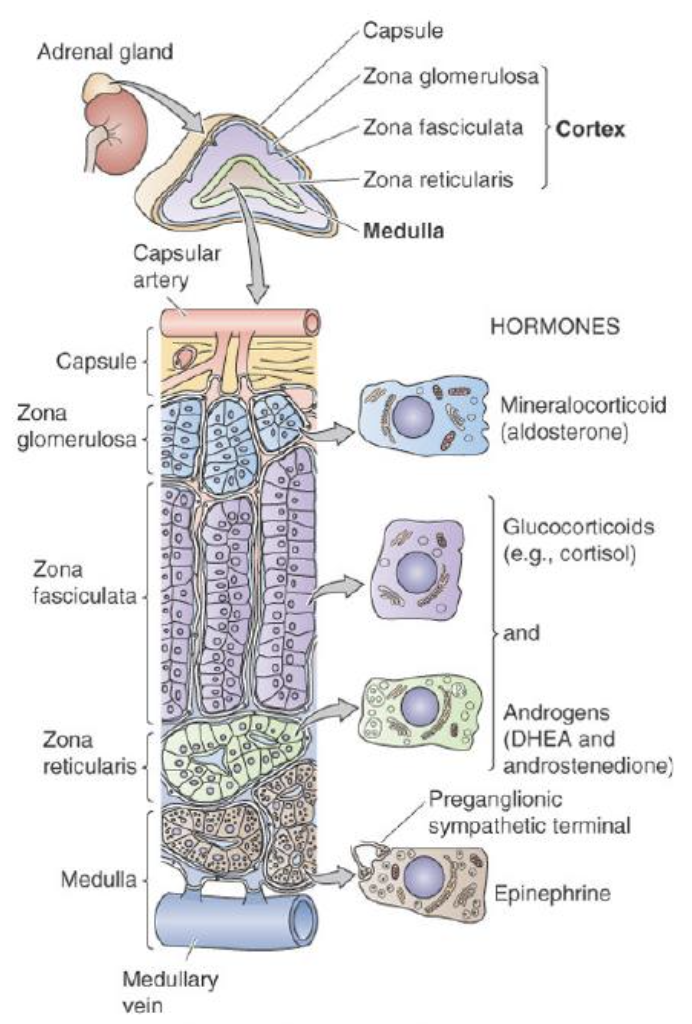
ADRENAL GLAND
Zona Glomerulosa
adrenal cortex
hormone = aldersterone
Zona Fasciculata & Reticularis
adrenal cortex
hormone = cortisol, corticosterone, androgens
Medulla
adrenal medulla
hormone = adrenaline, noradrenaline
STEROID HORMONES
Sex steroids
progesterone, testosterone, oestradiol
Glucocorticoids
cortisol, corticosterone
Mineralocorticoids
aldersterone
All are made from cholesterol
lipophilic
synthesis = secretion
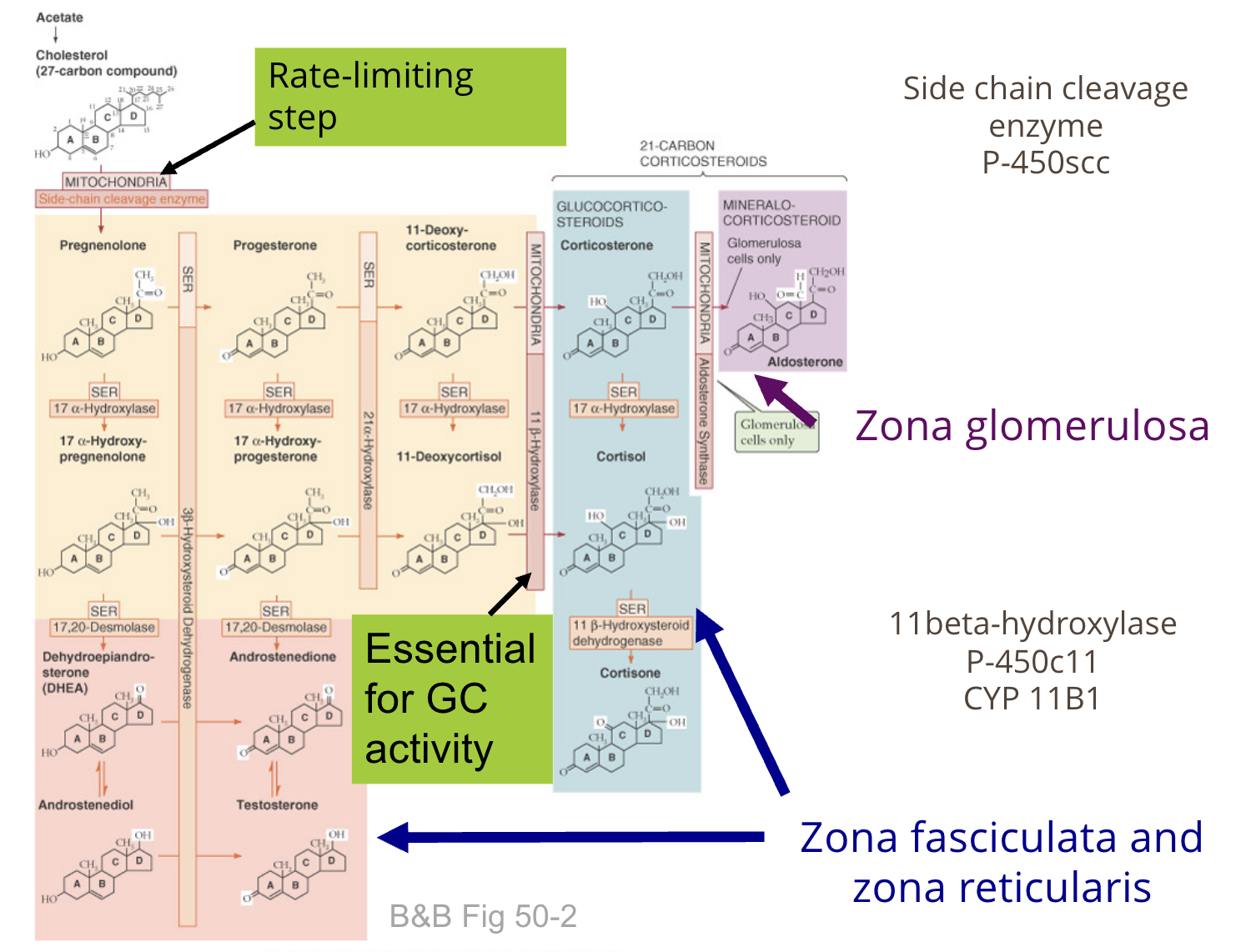
STEROID HORMONE SYNTHESIS
Cholesterol moves along the line and gets edited at each step by enzymes. The enzyme a layer has, determines what it makes.
STEROID SYNTH - OUTER LAYER
Zona glomerulosa
enzyme aldersterone synthase
makes aldersterone
STEROID SYNTH - MIDDLE/INNER LAYER
zona fasciculata + reticularis
enzymes make cortisol, corticosterone, androgens
ENZYME P450scc
first edit of cholesterol → pregnenolone
rate-limiting step (like a speed limit for the whole line)

ENZYME 11B-Hydroxylase
last edit of precursor → active cortisol

HPA AXIS
Stressor occurs
Hypothalamus releases CRH
CRH travels to anterior pituitary which releases ACTH
ACTH travels in blood to adrenal cortex
Adrenal makes cortisol
Negative feedback

IMMEDIATE ACTH EFFECTS IN ADRENAL CELL
Brings in more cholesterol and moves it to the mitochondria
Boosts first edit of cholesterol → pregnenolone
LATER ACTH EFFECTS IN ADRENAL CELL
Hours later:
Turns on genes for key enzymes (P450scc, 11B-hydroxylase) and LDL receptor = more cholesterol uptake
Long-term:
Cells grow in size and number
CORTISOL EFFECTS
Fuel metabolism
Liver = makes new glucose
Muscle = breaks proteins into aa which helps get more glucose
Fat = break down into fatty acids which become alternative fuel source to save glucose for brain
Permissive
Helps noradrenaline and GH work properly
Water excretion
Needed for normal water excretion
Stress adaptation
So the system can ‘switch off’ and preserve glucose
Anti-inflammatory and immunosuppressive
CORTISOL EFFECT SUMMARY
Make sugar, burn muscle and fat
GH MAIN EFFECT SUMMARY
Make sugar, keep muscle, burn fat
GH METABOLIC ACTIONS IN MUSCLE
Stimulate amino acid uptake
Decrease glucose uptake
Inhibit protein breakdown
Overall, inhibit muscle mass.
GH METABOLIC ACTIONS IN ADIPOSE TISSUE
Decrease glucose uptake
Increase fat breakdown
Overall, decrease in fat deposits.
GH METABOLIC ACTIONS IN LIVER
Increase protein synthesis
Increase gluconeogenesis
Overall, increase blood glucose.
GH AND GLUCOSE
GH causes an overall blood glucose rise as it acts against insulin (diabetogenic).
Matters most in fasting/starvation/exercise
GH teams up with glucagon, adrenaline and cortisol to keep glucose high and shift body to burning fat and protecting muscle
Triggered by:
low glucose and fatty acids, high amino acids, stress/exercise/deep sleep
EXERCISE AND IMMEDIATE ENERGY
Ex. power lift
stored ATP and phosphocreatine
ADP + PCr → ATP + Cr

EXERCISE AND NON-OXIDATIVE ENERGY
Ex. 100m sprint
glucogenolysis + anaerobic glycolysis
fastest pathway

EXERCISE AND OXIDATIVE PATHWAY
Ex. 10km run
Oxidation of glucose and fat
needs liver and adipose tissue
most efficient

EXERCISE AND HORMONES
Increased:
adrenaline, glucagon, cortisol, GH
Decreased:
insulin
With greater exercise intensity/duration.
EXERCISE AND MUSCLE CONTRACTION
Moves GLUT4 to the membrane without insulin
Uses plasma glucose once glycogen is depleted
EXERCISE AND LACTATE
Type 11b muscle fibres converted to pyruvate and oxidised
Lactate taken up by liver and converted to glucose
CARBOHYDRATE STORAGE AFTER MEAL
First pass through liver takes 20-30% of glucose (insulin-independent)
Rest enters circulation, RBCs and brain (insulin-independent)
Muscle and fats use GLUT4 (insulin-dependent)
PROTEIN STORAGE AFTER MEAL
Some amino acids taken up/oxidised by liver
Insulin drives amino acid uptake into muscle → protein
FAT STORAGE AFTER MEAL
Insulin stores lipoprotein lipase
Inhibits hormone-sensitive lipase and prevents lipolysis
OVERNIGHT FASTING
Priorities:
Maintain blood glucose for the brain
Maintain protein reserves
Done by:
Endocrine control (increased glucagon, decreased insulin)
Metabolism (decreased glucose uptake, glycogenolysis, gluconeogenesis, lipolysis)
FASTING TO STARVING
After a few days of not eating, metabolism shifts from enhanced gluconeogenesis to ketogenesis.
GLUCOGENEOSIS VS KETOGENESIS
Glucogeneosis:
Precursors = glycerol, amino acids, lactate
Site = liver, kidney in prolonged starvation
Ketogenesis:
Precursors = fatty acids → B-oxidation → acetyl-CoA
Site = liver only
KETOGENESIS
Acetoacetate, B-hydroxybutyrate and acetone produced by the liver enter circulation and can be used as an alternative energy store
Muscle and CNS can do reverse action, liver can’t
Brain gets 30% of energy from ketones after 3 days and 70% after 40days
Fruity smelling breath due to acetone
STARVATION DURATION
Circulating glucose ~ 1.4hr survival
Liver glycogen ~ 4.2 hr survival
Muscle glycogen ~ 8.4hr survival
Muscle protein ~ 14 days survival
Adipose TAG ~ 83 days survival
ENERGY BALANCE
Law of thermodynamics: energy in = energy out + storage
A surplus of 20kcal per day = +1kg a year = +20kg in two years… yet most adult weights remain relatively constant. Suggesting other factors like appetite and body composition.
LATERAL HYPOTHALAMUS
Hunger/feeding
Stimulation causes eating
VENTROMEDIAL NUCLEUS
Satiety centre
stimulation reduces eating
HUNGER AND SATIETY
Also influenced by cortex (willpower), senses (smell), environment (stress), memory, hedonics and genetics.
DISCOVERY OF LEPTIN
Ob/Ob = obese mouse
Db/Db = diabetic mouse
Db makes an excess of a signal that cures Ob mouse
Db lacks the receptor for its signal
Absence of receptor and feedback leads to higher levels of the signal in Db mouse
Signal/factor = leptin
LEPTIN
Polypeptide hormone
produced by apidocytes
Plasma levels proportional to total body adipose tissue
Provides brain info about fatness
Receptor:
Class 1 cytokine receptor
present in many tissues
main target = neurons in hypothalamus
WHY LEPTIN DIDNT CURE OBESITY
It was thought that leptin injections would cure obesity but:
many obese people already have high leptin but not the receptor
leptin resistance
LEPTIN IN BRAIN (ARCUATE NUCLEUS)
Anorexigenic neurons
‘brake’
transmitter = POMC, CART
reduce food intake, feel full
leptin stimulates these neurons
Orexigenic neurons
‘accelerator’
transmitter = NPY, AGRP
increase food intake, feel hungry
leptin inhibits these neurons
FULLNESS SIGNALS (ANOREXIGENIC)
Stomach stretch
CCK
Peptide YY
Insulin
GLP-1 and GIP
Switch on ‘brake’, switch off ‘accelerator’
HUNGER SIGNAL (OREXIGENIC)
Ghrelin (stomach grumble)
Low blood glucose
Switch off ‘brake’, switch on ‘accelerator’
INCRETIN DRUGS
Incretin = gut hormones that boost insulin release when glucose present
Drugs = ozempic
Are agonists of GLP-1, GIP
Treat type 2 diabetes, cause weight loss
3 actions:
pancreas = more insulin
Stomach = slows gastric emptying, feel full longer
Hypothalamus = acts on brain to cut appetite