Histology and Tissue Types: Cell Junctions, Membranes, and Body Cavities
 Call Kai
 Learn
Learn Practice Test
 Spaced Repetition
 Match
Match Flashcards
 Knowt Play
1/59

There's no tags or description
Looks like no tags are added yet.
Name | Mastery | Learn | Test | Matching | Spaced | Call with Kai | Chat |
|---|
No analytics yet
Send a link to your students to track their progress
60 Terms
Histology
the study of tissues.
Intracellular
All fluid within the cells.
Interstitial fluid
All fluid between the cells.
Extracellular fluid
All fluid outside of cells.
Cell junctions
Hold cells together to form tissue + point of contact between plasma membranes of cells.
Epithelial tissue
Covers body surfaces, lines hollow organs, body cavities + ducts, forms glands, allows the body to interact with internal + external environments.
Connective tissue
Protects + supports the body + organs, vascular tissue that distributes all blood vessels.
Muscular tissue
Composed of fibers (cells) specialized for contraction of force, generates heat that warms the body.
Nervous tissue
Detects changes in a variety of conditions, generates electrical signals that activate muscular contractions.
Mucous membranes
Forms mucous, little or no interstitial fluid or matrix, no blood vessels.
Serous membranes
Divided into visceral and parietal membranes.
Synovial membranes
Line synovial joint capsules, connective tissue membranes.
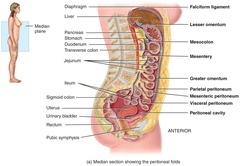
Peritoneum
Serous, located in the abdominopelvic cavity.
Pleura
Serous membranes that surround the lungs.
Pneumothorax
Air in the pleural cavity.
Pleural effusion
Fluid in the pleural cavity.
Pleurisy
Inflammation of the serous membranes that line the chest cavity.
Peritonitis
Inflammation of the serous membranes in the abdominal cavity.
Quadrants and Regions of Abdominopelvic Cavity
Anatomical divisions used to describe locations within the abdominopelvic cavity.

Tight junctions
Prevent leakage of organ contents into extracellular fluid or blood and prevents the passage of substances between cells.
Adhering junctions
Fasten cells to each other and help epithelial surfaces resist separation.
Desmosomes
Prevents epidermal cells from separating under tension and cardiac muscle cells from pulling apart during contraction.
Hemidesmosomes
Strongly anchor cells to an underlying basement membrane and help anchor epithelial cells to the basement membrane.
Gap junctions
Facilitate rapid signal communications between adjacent cells.
Thoracic cavity
Contains pericardial cavities, pleural cavities, and the mediastinum.
Abdominopelvic cavity
Subdivided into abdominal and pelvic cavities.
Simple squamous epithelium
One cell thick, allows for easy transport of nutrients and waste.
Mediastinum
Mid portion of thoracic cavity; contains heart and trachea.
Simple cuboidal epithelium
Found in glands and ducts, involved in secretion and absorption.
Simple columnar epithelium
Has more surface area for absorption of nutrients; can be nonciliated.
Loose fibrous tissue (Areolar)
Fibers arranged randomly in a web-like, airy structure to hold organs in place and attach epithelial tissue to underlying tissue. Provides strength, elasticity and support
Adipose tissue
A type of connective tissue that stores fat.
Dense fibrous tissue
A type of connective tissue that provides strength and support.
Muscle Tissue
Enables movement.
Skeletal muscle
Attaches to bones and is under voluntary control. Striated
Smooth muscle
Involuntary muscle found in walls of hollow organs. Non-striated.
Liquid connective tissue
Includes blood and lymph.
Visceral
Closely packed cells with no blood vessels and involuntary movement.
Cardiac muscle
Striated muscle found in the heart. Involuntary
Ciliated simple columnar epithelium
Creates motion to move substances across the surface.
Stratified transitional epithelium
Stretchy tissue that can change shape.
Neurons
Cells that carry nerve impulses; consists of a cell body, axon, and dendrites.
Axon
Carries impulse away from the cell body.
Dendrites
Carry impulse toward the cell body.
Tissue repair
Begins regeneration that varies by tissue type.
Free-radical theory of aging
Suggests that aging results from damage caused by free radicals.
Epithelial tissues
Regenerate easily.
Smooth and cardiac muscle
Have limited regeneration capabilities.
Neoplasm
New growth, which can be benign or malignant.
Benign tumors
Localized growths that do not spread.
Malignant tumors
Growths that spread to other parts of the body.
Radiographic tissue appearances
Tissue density and thickness affect visualization.
Dense regular connective tissue
Includes tendons and ligaments.
Dense irregular connective tissue
Includes pericardium and heart valves.
Elastic connective tissue
Found in arteries, lung tissue, and trachea.
Hyaline cartilage
Found in the trachea and nose.
Fibrous cartilage
Found in intervertebral discs.
Compact bone
Forms the dense outer layer of bones.
Smooth muscle tissue
Found in tube-shaped organs and is non-striated.
Cardiac muscle tissue
Striated muscle found in the heart.