THE APPRAISAL PROCESS - Step 1
 Call Kai
 Learn
 Practice Test
 Spaced Repetition
 Match
 Flashcards
 Knowt Play
1/10

Earn XP
Description and Tags
While it appears that each step is quite separate from the other, in fact, they often overlap each other. This process may be applied formally or automatically,
11 Terms
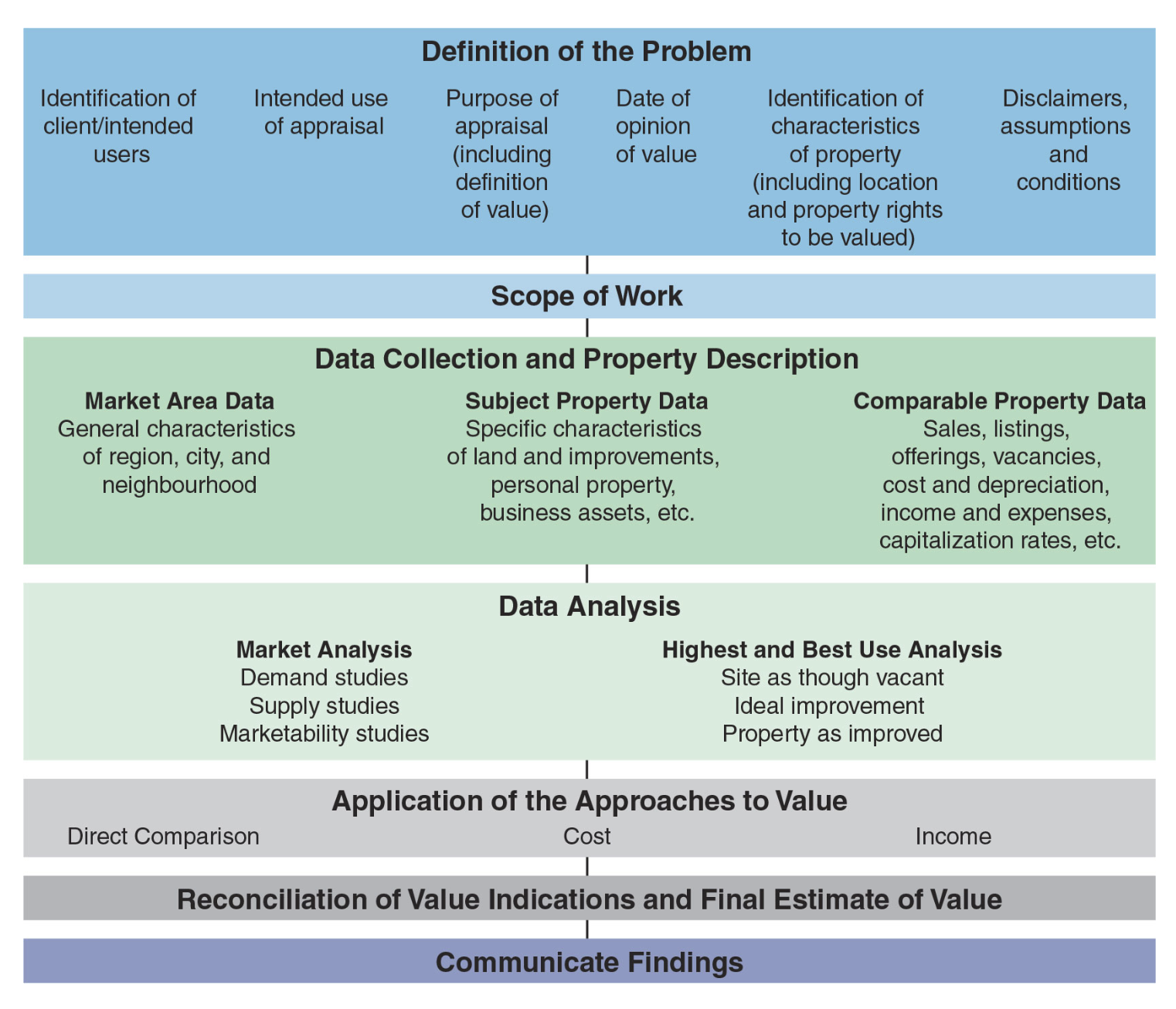
STEP 1: DEFINING THE APPRAISAL PROBLEM
-to clarify what is to be appraised and why.
-The appraiser defines the appraisal problem by considering:
• Client and intended users of the report
• Intended use of the valuation
• Purpose of the valuation, including the definition of value that is required
• Effective date of the report
• Characteristics of the property, including its location, legal description, and the property rights to be valued
• Disclaimers, extraordinary assumptions that are relevant to the report, and any limiting or hypothetical conditions upon which the estimate of value is based
Client and Intended Users of the Appraisal
• Lending: financial institutions, mortgage companies, banks, other lenders
• Insurance: real property insurance companies
• Expropriation: federal government, provincial government, organizations authorized by federal or provincial statute
• Property taxation (assessment): assessment authorities, property owners (disputing assessed values)
• Real estate transactions (including listings for sale): federal government, provincial government, other large organizations, developers, vendors, purchasers, real estate salespeople
• Investments: Real Estate Investment Trusts (REITs), pension fund investment companies, other investment companies
• Financial records: accountants, financial analysts, auditors, government organizations
• Legal requirements such as estate, gift and transfer taxes, or divorce: lawyers, parties with a legal interest in the real property, owners, property managers
Intended Use and Purpose of the Appraisal
An appraiser needs to understand why the client has requested the appraisal. The purpose may be for:
• a statutory reason; for example, for expropriation or taxation purposes, where the valuator is guided by provisions outlined in relevant Acts; or
• a market reason; such as buying, selling, leasing, or developing a property, where the valuator may consider market data and is not forced to follow government statutes.
-This information will help the appraiser determine what form of value needs to be determined, the type of market data required, and the potential constraints on the appraisal process.
Value Definitions: Objective, Subjective, and In Exchange
-Estimating value is the object of an appraisal, but the word “value” may be defined differently in various contexts.
-The interrelationship between sale price, value to the owner, and market value play a central role in the appraisal process.
-Appraisers are typically called upon to estimate objective values, which in appraisal terms refers to a value that is determined based on market evidence and by applying generally accepted valuation techniques
-The objective values commonly estimated by appraisers may include insurable value, lending value, taxable value, or actual (assessed) value.
-Market value is the most common objective value estimated by appraisers (expected sale price or forecasted sale price in a typical transaction)
-Appraisers do not commonly work with value to the owner or subjective values, but licensees’ roles focus on it.
- In order for a sales transaction to occur, sale price must be at least equal to or more than the vendor’s floor price (the minimum price at which a seller is willing to sell their property) and at most, equal to or less than the purchaser’s ceiling price (the maximum price a purchaser is willing to pay for a property).
Definitions of Market Value
At any given time, the market value of an interest in land is the price it might reasonably be expected to realize when sold by a willing seller to a willing buyer after adequate time and exposure to the market.
-The major points of this definition are:
• Value is related to a certain point in time: A change in value after the appraisal date will not necessarily invalidate the accuracy of the original appraisal.
• Value is the price which might reasonably be expected: Value is the expectation of someone who has sufficient knowledge of the real estate market to form an opinion;
• Willing seller and willing buyer: This means that both buyer and seller are negotiating in their own self-interest and neither party is exerting undue influence on the other.
• Adequate time and exposure to the market: These terms must reflect market conditions and marketing practice as of the date of the appraisal.
The main reasons for the adoption of this particular definition of market value are because:
• It is objective. The appraiser is not required to determine whether the price is justified economically or to assume degrees of knowledge of buyers and sellers.
• It can be applied to a large proportion of past transactions. Hence, it is practical to collect evidence of value from past market transactions.
• It applies to a large number of appraisal situations.
Factors Influencing Market Value
• Economic: trends in commerce and industry, interest rates, unemployment rates, wage levels, availability of money and credit, price levels, tax burdens, etc.
• Political/government: zoning bylaws, building codes, fire regulations, public health measures, rent controls, monetary policies including all forms of taxation, legislation, political upheaval or stability, government housing programs, etc.
• Social: population growth/decline, shifts in population density, changes in the size of families, desire for recreation/education facilities and neighbourhood amenities, desire for privacy, pride leading to ostentation and show in expensive homes, etc.
• Physical: created either by nature or by people including topography, soil fertility, climate, location, flood control, soil conservation, and community factors such as transportation, schools, churches, parks, and recreation areas
Value to the Owner vs. Investment
-An appraisal to find the estimated sales price (or market value: the value that is specific to a particular investor) is not the same as one made to determine whether that price (or value) is justified.
-Justifying the price falls in the area of real estate investment counselling, not appraisal
-What a property is worth depends on the personal preferences, tastes, and biases of the owner or prospective purchaser.
- To an appraiser, worth simply means what the property is most likely to sell for in a typical sale, given current market conditions.
- In estimating the investment value for a particular investor or calculating the justified investment price, the appraiser will use the owner’s tax status and the financing capabilities to determine a value specific to that investor.
Date of Valuation
-The specific date of valuation is important since value can fluctuate over reasonably short periods of time.
- Every valuation must be made as of a specific date to identify the prevailing market forces and conditions, in terms of which value is estimated; this is the effective date of the valuation.
Identifying Property Characteristics
Market value is the product of two property elements:
1. Rights of ownership
2. The physical property in which those rights are vested
Interests to be Valued
- the physical property is not the true subject of the appraisal. It is the value of legal interests in real estate that is estimated.
-The words “legal interests” mean “legal rights of ownership”, and the true subject of an appraisal is the particular rights of ownership vested in a certain piece of real estate.
-The most common interest in land to be appraised is the fee simple interest, but there are other lesser interests and there may also be charges registered against these interests
-The legal interest in real property may include:
• Fee simple ownership
• Leasehold estate (long-term, pre-paid leases)
• Condominium ownership (a combination of fee simple ownership of a unit and ownership as tenants in common of the common areas)
• Air space rights
• Easements (e.g., for hydro right-of-ways)
• Any combination of these separate interests
Disclaimers, Assumptions, and Conditions
-Appraisers typically include a variety of disclaimers in their appraisal reports, usually in the form of limiting conditions and assumptions that are inherent in the estimate of value → can potentially excuse what liability may be owed by the appraiser and to whom
-Appraisers will normally specify that liability is owed only to the client and not to any other readers or users of the report.
-However, disclaimers cannot be used to waive away the liability for gross negligence on the part of the appraiser in delivering the service.