Topic 2: Economic Systems
 Call Kai
 Learn
 Practice Test
 Spaced Repetition
 Match
 Flashcards
 Knowt Play
1/85

There's no tags or description
Looks like no tags are added yet.
86 Terms
economic system
the method a country uses to organize an economy

factor payments
the income people receive for supplying factors of production, such as land, labor, or capital

Economic safety net
made up of various Welfare Programs to protect low-income citizens from poverty and hardship.
economic growth
the ability of the economy to increase the production of goods and services

standard of living
Quality of life based on ownership of necessities and luxuries that make life easier.
innovation
(n.) something new, a change; the act of introducing a new method, idea, device, etc.

Traditional Economy
economic system that relies on habit, custom, or ritual to decide questions of production and consumption of goods and services
centrally planned , aka , command economy
a method of organizing an economy in which property resources are publicly owned & government directs the economic activity

free market economy
An economic system in which prices and wages are determined by unrestricted competition between businesses, without government regulation

mixed economy
market-based economic system with limited government involvement

circular flow model
The flow of resources from households to firms and of products from firms to households. These flows are accompanied by reverse flows of money from firms to households and from households to firms.

market
arrangement that allows buyers and sellers to exchange goods and services

Specialization
the concentration of the productive efforts of individuals and firms on a limited number of activities

free market economy
an economic system in which decisions on the three key economic questions are based on voluntary exchange in markets

household
a person or group of people living in the same residence

firm
an organization that uses resources to produce a product, which it then sells

factor market, aka resource market
market in which households sell (labor and human capital) and firms buy the factors of production resources from the households

product market
the market in which products are sold by forms and bought by households

self-interest
That which each firm, property owner, worker, and consumer believes is best for itself and seeks to obtain.

incentive
a positive or negative environmental stimulus that motivates behavior

competition
The presence in a market of independent buyers and sellers competing with one another along with the freedom of buyers and sellers to enter and leave the market.

consumer sovereignty
the power of consumers to decide what gets produced

voluntary exchange
the act of buyers and sellers freely and willingly engaging in market transactions
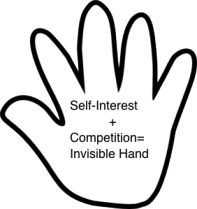
invisible hand
term economists use to describe the self-regulating nature of the marketplace = self interest + competition
innovation
(n.) something new, a change; the act of introducing a new method, idea, device, etc.

Socialism
A system in which society, usually in the form of the government, owns and controls the means of production.

Communism
A theory or system of social organization based on the holding of all property in common, actual ownership being ascribed to the community as a whole or to the state.

Authoritarian
A government in which one leader or group of people holds absolute power.

privitization
the process by which a piece of property or business goes from being owned by the government to being privately owned.
nationalization
the process of taking privately-controlled companies, industries, or assets and putting them under the control of the government.
economic equality (collectivism)
A situation where there are only small differences in wealth between citizens
economic equity
the fairness with which an economy distributes its resources and wealth
Laissez-faire
Idea that government should play as small a role as possible in economic affairs.

private property
property owned by individuals or companies, not by the government or the people as a whole

Intellectual Property (IP)
Ownership of innovation by an individual or business enterprise; includes patented, trademarked, or copyrighted property.

free enterprise system
an economic system characterized by private or corporate ownership of capital goods

profit motive
the force that encourages people and organizations to improve their material well-being

open opportunity
the concept that everyone can compete in the marketplace

legal equality
the principle that everyone has the same legal rights

private property rights
the principle that people have the right to control their possessions and use them as they wish

free contract
the concept that people may decide what agreements they want to enter into

voluntary exchange
the act of buyers and sellers freely and willingly engaging in market transactions
interest group
private organization that seeks to persuade public officials to act in ways that benefit its members

Patriotism
Love for one's country

eminent domain
the right of a government or its agent to expropriate private property for public use, with payment of compensation.

public interest
The best interests of the overall community; the national good, rather than the narrow interests of a particular group.

public disclosure laws
laws requiring companies to provide information to consumers about their products and services

Macroeconomics
the study of the economy as a whole, including topics such as inflation, unemployment, and economic growth

Microeconomics
the study of the economic behavior and decision making of small units, such as individuals, families, and businesses

Gross Domestic Product (GDP)
A measurement of the total goods and services produced within a country.

business cycle
a period of macroeconomic expansion followed by a period of contraction

obsolescence
situation in which older products and processes become out-of-date

patent
(n.) exclusive rights over an invention; copyright; (v.) to arrange or obtain such rights; (adj.) plain, open to view; copyrighted

work ethic
the principle that hard work is intrinsically virtuous or worthy of reward.

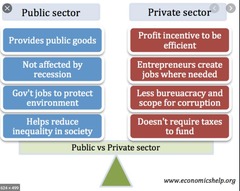
public goods
a shared good or service for which it would be impractical to make consumers pay individually and to exclude non-payers

public sector
that part of the economy made up of the local, state, and federal governments

private sector
the part of the economy that involves the transactions of individuals and businesses
infrastructure
Fundamental facilities and systems serving a country, city, or area, as transportation and communication systems, power plants, and schools

free rider problem
the problem faced by interest groups when citizens can reap the benefits of interest group action without actually joining, participating in, or contributing money to such groups.

market failure
a situation in which a market left on its own fails to allocate resources efficiently: occurs when people acting in their self-interest produce inefficient outcomes
Examples: externalities, tragedy of the commons, monopoly, public goods, and more

Externality
an economic side effect of a good or service that generates benefits or costs to someone other than the person deciding how much to produce or consume: a cost or benefit to a third party arising from a transaction between two parties unrelated to the third party

poverty threshold
an income level below that which is needed to support families or households

welfare
government aid to the poor

Tragedy of the Commons
the tendency of a shared, limited resource to become depleted because people act from self-interest for short-term gain

nonexcludable
Characteristic of a public good: if the good is available to one actor to consume, then other actors cannot be prevented from consuming it as well.
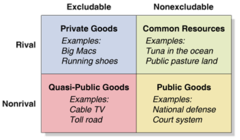
rival
Rival means that the good in question is made less abundant or enjoyable for others when an individual uses it.

common pool resources
goods that are available to everyone, such as open ocean fisheries; it is difficult to exclude anyone from using the common pool, but one user's consumption reduces the amount available for others

positive externality
a benefit to a third party arising from a transaction between two parties unrelated to the third party

negative externality
a detriment to a third party arising from a transaction between two parties unrelated to the third party

self-interest
The most-advantageous outcome as viewed by each firm, property owner, worker, or consumer.

medium of exchange
Any item sellers generally accept and buyers generally use to pay for a good or service; money; a convenient means of completing transactions, that is exchanging goods and services without engaging in barter. Money meets transactions demand.

barter
exchange (goods or services) for other goods or services without using money.
money
Any item that is generally acceptable to sellers in exchange for goods and services.

dollar votes
The "votes" that consumers and entrepreneurs cast for the production of consumer and capital goods, respectively, when they purchase those goods in product and resource markets.

household
an economic unit of one person or more that sells resources and buys goods and services

business
a firm that purchases resources and provides goods & services to the economy

demand-side market failures
Underallocations of resources that occur when private demand curves understate consumers' full willingness to pay for a good or service.
supply-side market failures
Overallocations of resources that occur when private supply curves understate the full cost of producing a good or service.
productive efficiency
The production of a good in the least costly way; occurs when production takes place at the output at which average total cost is a minimum and marginal product per dollar's worth of input is the same for all inputs.

allocative efficiency
The apportionment of resources among firms and industries to obtain the production of the products most wanted by society (consumers); the output of each product at which its marginal cost and price or marginal benefit are equal, and at which the sum of consumer surplus and producer surplus is maximized.

private goods
A good, or service that is individually consumed and that can be profitably provided by privately owned firms because they can exclude nonpayers from receiving the benefits.

public goods
A good or service that is characterized by nonrivalry and nonexcludability; a good or service with these characteristics provided by government.

cost-benefit analysis
A comparison of the marginal costs of a government project or program with the marginal benefits to decide whether or not to employ resources in that project or program and to what extent

quasi-public goods
A good or service to which excludability could apply but that has such a large positive externality that government sponsors its production to prevent an underallocation of resources.

direct controls
government policies that directly constrain activities that generate negative externalities

creative destruction
the hypothesis that the creation of new products and production methods simultaneously destroys the market power of existing monopolies