Biology 1001A- Cycle 1 & 2
 Call Kai
 Learn
 Practice Test
 Spaced Repetition
 Match
 Flashcards
 Knowt Play
1/87

There's no tags or description
Looks like no tags are added yet.
88 Terms
Characteristics of a Virus
1. Cannot replicate outside of a host
2. Lack a metabolic system to provide energy for themselves
3. Cytoplasm is not enclosed by a plasma membrane
Nucleic acid surrounded by a protein coat

1. Their protein coats
2. Protein involved in replication of viral nucleic acid in host cells
Viruses have genes that encode for
Helical Viruses
Protein subunits are arranged in a rod like structure surrounding the nucleic acid.
-Many helical viruses affect plant cells
-can be enveloped

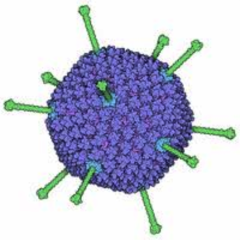
Polyhedral Viruses
protein subunits are in the shape of a triangle and fit together like a soccer ball
-can infect animals, plants and bacteria
-Have protein spikes that provide host cell recognition
-can be enveloped in a membrane derived from the host cell's membrane
Enveloped Viruses
-Proteins synthesized by the viral genome in the host cell are transported to the membrane and become embedded in it.
-the virus particle buds through the host cell
-virus is now enveloped
-Examples of enveloped viruses: herpes, HIV, Rabies
-Enter host cell by fusion of their envelope with host cell's plasma membrane or enter by ENDOCYTOSIS
-
Non-enveloped viruses
-ex: poliovirus,
-These viruses bind by their recognition proteins to the plasma membrane of host cell and are taken in by ENDOCYTOSIS (bud)
-viruses that are completed WITHOUT an envelope are released by the host cell and rupture it often killing host cell
Infection of Animal Cells
-both the viral coat and genome enter a host cell
-removal of coat to release genome can occur after or before it enters the cell
-The envelope does NOT enter the host cell
-often asymptomatic because causing a disease is not helpful for the virus (selfish)
-some animal viruses enter a latent phase in which virus remains inactive
Evolution of Viruses Ideas
1. They have evolved after cells appeared, since they need cells to replicate
2. Come from escaped RNA fragments, originating from the first pool of RNA that was the first genetic material
Viroids (small SS RNA particle without protein coat)
-small infectious pieces of RNA
-SS RNA WITHOUT protein coat
-differ from viruses because their RNA genome DOES NOT code for proteins.
Virion
Entire virus particle, contains outer protein coat and nucleic acid inside
Antiviral drugs vs Anitbiotics
Antiviral drugs often have worse side effects than antibiotics
-difficult to hurt the virus without harming the host cell too
How can we target viruses?
-identify steps in viral life cycle that are UNIQUe to the virus
-replicating viral RNA to mRNA is not needed for host cell drugs, only needed for EBOLA because it needs to convert negative sense to positive sense RNA
-so drugs could target this
Mutations and Antiviral drugs
-applying selective pressure (non-random survivorship)
-that ones that survive will replicate
-mutation rate is NOT affected by drugs, it will occur anyways
-but how the mutation is passed on matters, we change the fate of genetic variation
-Likelihood of a mutation appearing is not affected by the presence of drugs.
Variation +non random survival
=evolution by natural selection
Biological Evolution
Gradual change of populations/organisms over time (generations)
-Descent with modification
Aristotle
-classification of nature from simplest to most complex (minerals, plants, animals, humans, gods etc)
Biogeography
Studies of the world distribution of plants and animals.
Comparative Morphology
-morphology (anatomical structure)
-front legs of pegs, flippers of dolphins and wings of bats differ in size, shape and function
-however they have similar location on the mammal's body
Leclerc-
Suggested idea of vestigial structures
-structures that are no longer needed
-useless parts parts must have functioned in ancestral organisms
Hutton-gradualism
Gradualism- Slow and continuous physical processes acting over long periods of time produced Earth's major geologic features
"movement of water in a river slowly erodes"
Lyell-uniformitarianism
Uniformitarianism- Geological processes like volcanic eruptions, earthquakes and erosion that once sculpted Earth's surface over long periods of time are the same processes that we observe today
- Earth is at least millions, not thousands, of years old
Lamarck- inheritance of acquired characteristics
-simple organisms evolve into more complex ones
-body parts grow in proportion to how much they are used
-characteristics acquired throughout lifetime are passed on
Main Ideas
1. All species change through time
2. Changes are passed from one generation to the next
3. Organisms change in response to their environments
4. Hypothesized the existence of specific mechanisms that caused evolutionary change.
Transformation: relied on the idea of individuals transforming over their lifespan in order to adapt to environment and passing on these changes
Darwin Main concepts
1. Individuals within population vary in size, colour, behaviour and form
2. Many of these variations are passed on from parent to offspring
3. Favourable hereditary traits become more common in next generations
4. Individuals will compete for food and resources..
Darwin Descent with Modification
-argues that all the organisms that have ever lived arose through descent with modification
Characteristics that Separates Darwin's Theory with Others
1. He provided PHYSICAL explanations, not spiritual
2. Recognized that evolutionary changed occurs in group of organisms NOT individuals
3. Evolution is a multi stage process. Variations arise within groups, natural selection eliminates unsuccessful variations, next generation inherits successful variations.
4. Like Lamarck, he understood that evolution occurs because some organisms function better than other in a particular environment.
Modern Synthesis
-unified theory of evolution in the 1930's
-describes the fusion (merger) of Mendelian genetics with Darwinian evolution that resulted in a unified theory of evolution
-comparative morphology, biogeography, comparative embryology, taxonomy
Microevolution
small scale genetic changes that populations undergo (small shift in size of the galapagos finch bill)
Macroevolution
Larger evolutionary changes
The Fossil Record
-Darwin's theory proposes that all species that have ever lived are genetically related
-
Homologous Traits
-Traits similar in species that result from a common ancestor
limbs of cars, whales, and humans
Convergent Evolution
-Organisms that are not closely related independently evolve similar traits from living in same environment and having to adapt to similar ecological niches.
Linneas
Taxonomy
Wallace
developed a theory nearly identical to Charles Darwin's on the mechanism for evolution of species
Non- falsifiable statement
-matters of opinion (Biology is the best class)
- "a square has four sides" -definition
-"Santa is real" -no way to prove its false
Falsifiable Statement
Have to be able to come up with an observation that can prove this wrong
-"There aren't any red doors in this building"- to falsify that we would have to find a red door
-All swans are white-find a black swan to falsify statement
Statements that all x are y (usually are falsifiable statement)
"All birds can fly"-find a bird that can't fly to falsify it
Theory of Evolution
1. Evolution happens-allele frequencies in a population change from one generation to the next
2. All life is related through a common ancestor
3. Speciation: lineages diverge into multiple daughter lineages
4. Evolution is variation not transformational (Lamarck). Populations evolve, individuals do not.
5. Selection generates adaptation and explain most of evolutionary change
6. Genetic Drift, gene flow can also change populations but not adaptation and whether individuals will become better suited to their environment.
Theories are scientific if they are...
1. Testable
2. Falsifiable
3. Revised in light of new evidence.
Humans have.. cS
23 different pairs of chromosome for a diploid number of 46
-23 chromosomes in one set/genome
Ploidy
Number of chromosome sets
Sister Chromatids
Two identical copies of a chromosome, held together by cohesins
Chromosome Segregation
Equal distribution of daughter chromosomes into each of the 2 daughter cells that results from cell division
g1 phase
-time length varies
-cell is carrying out normal functions
-proteins are being made, RNA made, other cellular mlcs but NOT DNA
-cell is growing
g0 phase
-Cells not destined to divide enter this stage (nerve, liver cells)
-if they want to divide they can return back into G1 phase
-most cells are in the G0 stage, they are just doing their job
S phase
-10-12 hrs
-DNa is replicating and chromosomes are duplicating
-humans 2c- 4c
G2 phase
-m phase proteins are made
-cell is preparing for mitosis
-no dna synthesis
-4-6 hours
Prophase
-nucleolus starts to disappear
-chromatin condenses into chromatids, coils up and becomes visible under a microscope
-Centrioles migrate to opposite poles, spindle fibres start to form
Prometaphase
-nuclear envelope starts to break down
-kinetechore microtubules binds to kinetochores
-microtubules that do not attach to the kinetochores attach to opposite microtubules and push against them
-
Metaphase
-CS become aligned at the spindle midpoint
-Sister chromatid pair is held in position by two opposing forces
-the cohesins pull them together and the microtubules are pulling them apart
Anaphase
-sister chromatids separate and are now called daughter chromosomes
-chromosome segregation has been complete
Telophase
-spindle dissembles
-nucleolus reappears, RNA transcription can occur again
-nuclear envelope reforms around CS producing 2 daughter nuclei
-cytoplasm begins to divide
Cytokinesis Plants
Vesicles produced by the ER and golgi bodies collect together and fuse to make a new cell wall
Cytokinesis Animals
-layer of microfilaments (actin) laterally stretches across the cell
-cuts it off like a jawstring
Bacteria and Archea (Prokaryotes)
Divide by fision
-have circular chromosomes
Apoptosis
Process of cells dying
-infected cells, cancer cells, cells that don't work properly etc.
Mitosis Checkpoints
Before S phase: Cells will not move from G1 to S phase if there is any DNA damage
At the end of G2: checks to make sure that cells are ready to go into mitosis
At anaphase: making sure chromosomes are properly attached
Genome
All of the DNA sequence in ONE copy of an organism's chromosome
N
Number of copies of the SAME chromosome
C
Amount of DNA/ Chromosomes
Microtubule
Composed of tubulin
-pulles chromosomes
-have motors associated with them
Intermediate Filaments
Keratin, maintains the cell shape
Microfilament
Composed of actin, used for movement (pinches itself of) -cytokinisis
What W and C knew before...
-4 bases
-each nucleotide has a 5 carbon sugar, base and phosphate group
-pyrimidines
-purines
-phosphodiester bond (sugar & phosphate)
-
What W & C didn't know?
-how DNA twists/folds
-number of polynucleotide chains in a DNA mlc
W & C model
-used wilkins and franklin x ray crystallography
-Double helix model
-3.6 nm vertically from crest to crest
-0.34 nm in between bases
-sideways 2 nm
-base pairs lie in flat plane perpendicular to long axis of helix
-antiparallel, semi-discontinuous and bi directional
Why DNA isn't technically a mlc
-a mlc is a collection of atoms connected by covalent bonds
-so... then each of the 2 sugar phosphate backbones qualifies as a mlc
Wilkins and Franklin X-ray
shot x-rays at a sample of a compound (usually crystal)
-atoms in the compound deflect x-rays in a specific way that creates a pattern on a plate
-rays become scattered which creates a pattern
-W and F were able to obtain x-ray diffraction patterns from a sample of DNA mlc that had been pulled out into a fibre
Conservative Model
One DNA mlc is fully parental and the other is new
Dispersive Model
Each strand in molecule has chunks of old and new DNA
Substrates for polymerization reactions in DNA replication
-nucleoside tri phosphates
-base, sugar and 3 phosphate groups
-once added to strand the 2 extra phosphate groups come off and supply the reaction with energy
-
DNA sliding clamp
-Tether DNA polymerase to the template strand
-makes replication more efficient
-
DNA helicase
-unwinds DNA strands using energy of ATP hydrolysis to unwind
-BREAKS HB
Single Stranded Binding Proteins
-Stabilizes the single stranded DNA
-ensures that the two strands do not re join
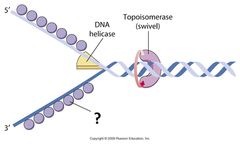
Topoisomerase
-Prevents tangling AHEAD of the replication fork
-Cuts the DNA, turns the DNA on one side of the break in the direction opposite to that of the twisting force, and rejoins the two strands
-strands aret less coiled
Primase
-Assembles RNA primers in the 5' to 3' direction
-few nucleotides long
-rna primers removed and replaced with DNA later except the one on the 5' end of the new DNA strand
DNA polymerase 3
Extends the 3' end of the RNA primer by adding nucleotides
DNA polymerase I
-Removes the primers from the 5' end of the okazaki fragment
-Replaces RNA nucleotides with DNA nucleotides
-cleaves off primer and replaces it with nucleotides
Exonuclease
-RNA nucleotide removal uses the 5' to 3' exonuclease activity of the enzyme
-removes nucleotides from the end of a molecule, the primer is digested from its 5' end to its 3' end
-replaces the RNA nucleotides with DNA nucleotides using 5' to 3'
-nick that is left over is sealed by DNA ligase
DNA ligase
-makes covalent bond in backbone
-seals nick left between adjacent bases after RNA primers replaced with DNA
-catalyzes the formation of a phosphodiester bond
Telomere Replication
-Telomerase elongates the 3' end of the new strand
-brings its own RNA template
-extends the parent strand
-now primer can attach and DNA polymerase can add to 3' end and elongate the new strand
-once primer is removed there will be a region that is still single stranded
-telomerase not really active in somatic cells but yes in germline cells/sex cells
Kinetochore
-Protein structure that attaches centromere of the sister chromatid to the microtubules
Centromere
Piece of DNA that the kinetochore attaches to.
Centrosome
Circular organelle that organizes the microtubules in ANIMALS ONLY. Contains the centrioles.
Centriole
Contained in the centrisome. Help with formation of spindle fibres.
Speciation
Lineages evolve into multiple daughter lineages
Genome
all of the DNA sequences in ONE copy of an organisms chromosomes.
Enzymes that break the covalent sugar-phosphate bond/ breaks backbone
-topoisomerase
-dna polymerase I
-dna polymerase III
Enzymes that break the hydrogen bond
-dna helicase
Natural Selection
-change in allele frequencies over evolutionary time
-change in heritable phenotypes